
Table of Contents
- 1. Understanding the Dolomites
- 2. Terrain and What Cycling in the Dolomites Means in Practice
- 3. The Sellaronda: Cycling the Dolomites' Flagship Circuit
- 4. Other Major Dolomites Cycling Climbs and Routes
- 5. Best Regions for Cycling the Dolomites
- 6. Best Time for Cycling the Dolomites
- 7. Giro d'Italia: The Dolomites and Professional Road Racing
- 8. Wildlife and Natural Landscapes Along the Dolomites Cycling Routes
- 9. Culture, Language, and Identity in the Dolomites
- 10. What to Eat When Cycling in the Dolomites
- 11. Fitness, Bikes, and Equipment for Cycling in the Dolomites
- 12. Practical Information for Cyclists in the Dolomites
- 13. Accommodation for Cyclists in the Dolomites
- 14. Read, Watch, Listen, and Experience
- 15. Plan Your Cycling Trip to the Dolomites with Art of Bicycle Trips
Understanding the Dolomites
The Dolomites sit in the far northeast of Italy, bordered by Austria to the north and the Venetian plain to the south. They are part of the Southern Limestone Alps, distinct from the main Alpine chain to the west, and they are geologically unlike any other mountain range in Europe. The rock is named after the French geologist Deodat de Dolomieu, who first described the pale magnesium-calcium carbonate limestone in the late 18th century. This rock gives the mountains their defining characteristic: the ability to absorb and reflect light in ways that other mountains cannot. In the right conditions, the Dolomites glow.
The region straddles three political and cultural zones. The province of Bolzano (also known as South Tyrol or Alto Adige) is predominantly German-speaking with strong Austrian and Tyrolean cultural traditions. The province of Trento (Trentino) mixes Italian and Tyrolean influence. The province of Belluno and the Venetian Dolomites to the south are more thoroughly Italian in character. Across all three, a third language is also spoken: Ladin, an ancient Rhaeto-Romance tongue native to the high valleys of the central Dolomites, particularly the Alta Badia, Val Gardena, and Val di Fassa. Road signs in these valleys appear in all three languages simultaneously, and the cultural identity of the area is genuinely distinct from both Italy and Austria.
For cyclists, this cultural complexity is part of the experience. A ride that begins with a morning espresso in an Italian-style bar in Cortina d'Ampezzo may end with an Austrian-style dinner of Speck, Knodeln, and Schuttelbrot in a rifugio above 2,000 m (6,562 ft). The cuisine, architecture, and riding culture all reflect this layered history.
DREAMING OF CYCLING IN DOLOMITES ?
Explore our amazing bike tours inDolomites now !
Terrain and What Cycling in the Dolomites Means in Practice
The single most important thing to understand about cycling in the Dolomites is that flat terrain is scarce. The valleys are deep and narrow; the roads quickly turn toward passes. Even routes described as 'valley rides' involve regular rollers. Riders who come expecting long sections of flat recovery will be surprised. The cycling here is fundamentally about climbing.
Road Cycling: The Passes
The classic Dolomites cycling experience centers on the high mountain passes, most of which sit between 1,800 m (5,906 ft) and 2,350 m (7,710 ft). These roads were built in the early 20th century, largely following routes used by armies and traders before them, and they were designed for drama rather than efficiency. The hairpin switchbacks that define the passes are not an engineering constraint but an architectural statement: the Dolomites roads are among the most deliberately beautiful in the world. Gradients on the classic passes average 6 to 9%, with sections reaching 12 to 15% on climbs like the Passo Giau (9.5% average over 9.5 kms / 5.9 mi) and the steepest wall of the Passo Fedaia (10 to 15% over 2.7 kms / 1.7 mi from Caprile). Road surfaces are generally well maintained, as the Giro d'Italia and the Maratona event create practical incentives for local authorities to keep passes in good condition.
Valley Paths and Rail Trails
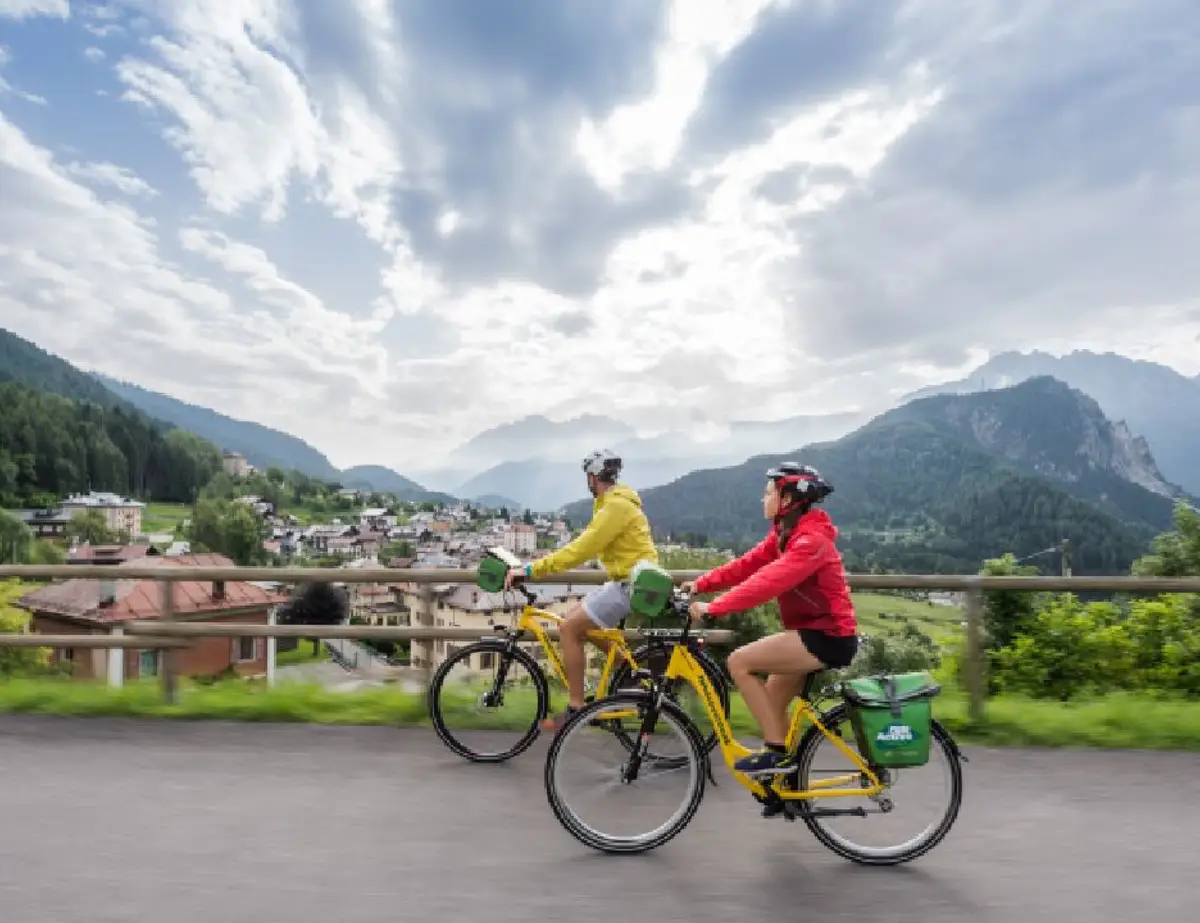
Alongside the pass network, the Dolomites have an extensive and well-developed system of valley cycle paths, many built on converted railway beds. The Pustertal/Alta Pusteria valley path, running along the floor of the high valley between Toblach and Lienz, is one of the finest recreational cycling corridors in northern Italy: wide, smooth, largely car-free, and framed by dramatic mountain walls on both sides. The old Dolomite railway corridor from Cortina d'Ampezzo toward Belluno provides another car-free route through lower terrain. These paths make the Dolomites accessible for cyclists who are not targeting the high passes but still want to experience the landscape at altitude.
Gravel and Bikepacking
The Dolomites are increasingly popular with gravel cyclists and bikepackers, though the terrain is demanding. Military roads from World War One (the Dolomites were a major front from 1915 to 1918) have left a network of unmade tracks crossing high terrain, and several multi-day gravel routes now use these corridors. The Transalp and various long-distance off-road routes traverse the region. These options suit experienced riders comfortable with significant elevation and variable surfaces.
Not the Stelvio
One important clarification for first-time visitors: the Stelvio Pass, the Mortirolo, and the Gavia are not in the Dolomites. They are located approximately 200 kms (124 mi) to the west, in the Ortler Alps of South Tyrol and Lombardy. The confusion arises because both regions are sometimes loosely described as 'the Italian Alps' or 'northern Italy cycling.' If your goal is specifically those three climbs, you need to base yourself around Bormio, not Cortina or Corvara.
The Sellaronda: Cycling the Dolomites' Flagship Circuit
The Sellaronda is the defining cycling circuit of the Dolomites. It loops around the Sella Massif, one of the most distinctive rock formations in the range, crossing four passes in a single continuous ride. It can be ridden clockwise or counterclockwise from any of its four starting points: Corvara in Badia, Canazei, Selva di Val Gardena, or Arabba. The four passes are the Passo Gardena, Passo Sella, Passo Pordoi, and Passo Campolongo.
The Circuit in Numbers
Distance: approximately 55 kms (34 mi) for the core loop | Total elevation: approximately 1,400 m (4,593 ft) | Highest point: Passo Pordoi at 2,239 m (7,346 ft) | Difficulty: Moderate to challenging.
This is not a beginner ride. The four climbs come in succession with limited recovery between them. But none of the individual passes is extreme: the Passo Gardena rises 8.3 kms (5.2 mi) from Corvara at an average of 6.8%; the Passo Sella is 10 kms (6.2 mi) at 7.1% from the Val di Fassa junction; the Passo Pordoi is 9.4 kms (5.8 mi) at 6.9% from Arabba; and the Passo Campolongo is 3.8 kms (2.4 mi) at 7.1% from Arabba, the most compact climb of the four. Experienced club cyclists will complete the full circuit in 3 to 4 hours. Less experienced riders should allow 5 to 6 hours, including time at the pass summits.
Sellaronda Bike Day: The Closed-Road Experience
Once per year in early June, the four passes of the Sellaronda are closed to motor traffic for the Sellaronda Bike Day. Approximately 20,000 cyclists from across Europe participate. The roads, normally shared with cars and motorcycles, become entirely pedestrian and cycling-only for the day. The experience is genuinely different: the hairpins are visible far ahead and behind without obstruction, the sound environment changes completely, and the sense of the road as a cycling space rather than a shared carriageway is striking. The event is free to join, requires no pre-registration, and represents one of the best single cycling days in Europe.
Riding the Sellaronda on Regular Days
Outside the Bike Day, the Sellaronda passes carry a mix of cyclists, motorcycles, and cars. Traffic is heaviest on weekends in July and August. The roads are narrow on some sections, particularly on the Passo Sella approach from the Val di Fassa side, and the descent gradients require attentive braking. Early morning departures (before 8 AM) give the best conditions for uninterrupted climbing. The passes are typically accessible from late May through October, weather depending.
Other Major Dolomites Cycling Climbs and Routes
Passo Giau: The Queen of the Dolomites Passes
Distance: 9.5 kms (5.9 mi) from Colle Santa Lucia | Elevation gain: 885 m (2,903 ft) | Average gradient: 9.5% | Summit: 2,236 m (7,336 ft) | Difficulty: Hard.
The Passo Giau is by common consensus the most difficult and most visually spectacular of the classic Dolomites cycling climbs. It features in the Maratona dles Dolomites as the final major ascent, where the combination of accumulated fatigue and steep gradients creates the event's decisive moments.
The climb from Colle Santa Lucia is relentless: there are no significant flat sections and no places where the gradient drops below 6%. The upper hairpins, above 2,000 m (6,562 ft), pass through open Alpine meadows with the Cortina valley visible below and the Marmolada glacier visible to the east on clear days. The summit plateau, at 2,236 m (7,336 ft), is a broad highland with a rifugio and views over the Ampezzo Dolomites. The descent toward Cortina d'Ampezzo is fast, technical, and requires care.
Passo Fedaia and the Marmolada
Distance: 14 kms (8.7 mi) from Caprile | Elevation gain: 1,070 m (3,510 ft) | Average gradient: 7.6% | Summit: 2,057 m (6,749 ft) | Difficulty: Hard to very hard.
The Passo Fedaia is less famous than the Giau but arguably more brutal. The climb from Caprile is long and steady for the first 11 kms (6.8 mi), then enters its notorious final section: 2.7 kms (1.7 mi) at gradients between 10 and 15%, including a stretch above 12% that has broken riders in multiple Giro d'Italia editions.
At the top sits the Lago di Fedaia, a reservoir backed by the Marmolada, the highest peak in the Dolomites at 3,343 m (10,968 ft). The Marmolada was the site of one of the most extraordinary battles of World War One: Austrian and Italian troops dug an entire city of tunnels into the glacier between 1916 and 1917, the so-called 'Ice City,' of which sections remain accessible today. Marco Pantani made his definitive Giro d'Italia breakthrough on the Marmolada stage in 1998, attacking the peloton on the Fedaia approach and taking the pink jersey that he would hold to Milan.
Passo Falzarego and Passo Valparola
Distance: 12 kms (7.5 mi) combined, from Andraz | Elevation gain: 660 m (2,165 ft) | Average gradient: 5.5% | Summit: Valparola at 2,192 m (7,192 ft) | Difficulty: Moderate.
The Falzarego and Valparola are typically combined in a single ascent from the Livinallongo valley. The Falzarego (2,117 m / 6,946 ft) is reached first, with the road continuing upward to the higher Valparola summit, which offers one of the finest panoramic viewpoints in the Dolomites.
The climb is used in the Maratona course and forms the approach to the Giau. The area around both passes was heavily fortified during World War One: the Lagazuoi massif above the Falzarego contains tunnels and fortifications from the Italian and Austro-Hungarian trenches, and a small military museum sits at the Falzarego summit. A cable car accesses the Lagazuoi peak from the pass.
The Maratona dles Dolomites: The Gran Fondo
Distance: 138 kms (86 mi) | Total elevation: 4,230 m (13,878 ft) | Passes: Campolongo, Valparola, Falzarego, Giau, Gardena, Pordoi, Sella | Date: First Sunday of July.
The Maratona dles Dolomites is one of the most prestigious and oversubscribed gran fondo events in Europe. Approximately 9,000 riders are selected by ballot from tens of thousands of applicants each year.
The full route links seven of the classic Dolomites passes in a single day, with the roads closed to motor traffic throughout. The event is run from Corvara in Badia and La Villa in the Alta Badia, and it is organized with a level of logistical precision that reflects its long history: the Maratona has been running since 1987.
There are also two shorter variants, the Medio (106 kms / 66 mi, 3,130 m / 10,269 ft elevation) and the Corta (55 kms / 34 mi, 1,780 m / 5,840 ft elevation). The ballot opens in late winter each year.
The Tre Cime di Lavaredo: The Icon
Distance to summit plateau: 8 kms (5 mi) from Misurina | Elevation gain: 480 m (1,575 ft) | Average gradient: 6% | Road access: Toll road, closed to private cars after a certain hour; cyclists may ride at all times | Difficulty: Moderate, with a sting in the final section.
The Tre Cime di Lavaredo (Drei Zinnen), three vertical spires rising 2,999 m (9,839 ft) from a high plateau in the eastern Dolomites, are the most photographed landmarks in the entire range.
The cycling approach from Lake Misurina on the toll road is not among the hardest climbs in the Dolomites, but the arrival at the summit plateau, with the three towers directly above, is among the most memorable moments in Dolomites cycling. The road continues around the cirque to a rifugio on the north face. The Giro d'Italia has finished stages here repeatedly, most memorably in 2013 when Vincenzo Nibali took a stage win that shaped the overall race.
Best Regions for Cycling the Dolomites
1. Alta Badia: The Heart of the Sellaronda
The Alta Badia valley, centered on the villages of Corvara, La Villa, and San Cassiano, is the natural base for the Sellaronda circuit and the Maratona dles Dolomites. The valley is at approximately 1,560 m (5,118 ft) and is surrounded by the Sella Massif, the Conturines, and the Lagazuoi. Corvara is the most convenient single base for riders targeting multiple passes: the Passo Gardena and Passo Campolongo are accessible directly from the village, and the Passo Falzarego, Passo Valparola, and Passo Giau are within a day's ride. The valley has strong cycling infrastructure, with bike-friendly accommodation, good bike shops, and a culture that is thoroughly oriented toward cycling tourism from June through September. Suitable for intermediate to advanced road cyclists.
2. Alta Pusteria (Hochpustertal): Valley Riding and the Tre Cime
The Alta Pusteria valley, running east to west between Toblach (Dobbiaco) and the Austrian border, sits at approximately 1,200 m (3,937 ft) and offers the Dolomites' most accessible cycling terrain for non-specialist riders. The valley bike path network is extensive, well-surfaced, and largely car-free, with the Toblach-Lienz corridor being particularly fine. From Toblach, the road toward Misurina and the Tre Cime di Lavaredo provides a more challenging day option. The valley is German and Ladin speaking, with strong Austrian cultural character in its architecture and food.
3. Cortina d'Ampezzo: The Chic Base
Cortina d'Ampezzo, at 1,224 m (4,016 ft) in the Ampezzo basin, is the most internationally famous Dolomites resort town and has hosted the Winter Olympics (1956) and numerous Giro d'Italia stages. As a cycling base, it offers immediate access to some of the hardest passes in the Dolomites: the Passo Giau is directly above the town, the Passo Falzarego is 14 kms (8.7 mi) to the west, and the Tre Cime road approaches from Misurina, 14 kms (8.7 mi) to the northeast. The town itself is expensive by Italian standards, with an international tourist clientele and a level of traffic in peak summer that can make the access roads busy. Out of season, however, it is quieter and the mountain setting is unchanged. Suitable for advanced road cyclists.
4. Val Gardena: Climbing Culture and Access
Val Gardena, running southwest from the Passo Gardena toward the town of Ortisei (St. Ulrich), is one of the central Dolomites valleys and has a strong cycling culture rooted in its position as a stage town for both the Giro d'Italia and the Sellaronda Bike Day. Selva di Val Gardena is the valley's upper terminus and one of the four starting points for the Sellaronda circuit. The valley itself is Ladin-speaking and retains a traditional craftsmanship culture (wood carving has been central to Val Gardena's economy for centuries). The rides out of Ortisei toward the Passo Gardena and Passo delle Erbe offer some of the most photogenic cycling in the region, with Tyrolean farmsteads and meadows in the foreground and vertical rock walls above. Suitable for intermediate to advanced cyclists.
5. Val di Fassa: The Gateway to Marmolada
The Val di Fassa runs south from the Passo Sella along the Avisio River toward Moena and Cavalese. It is Ladin-speaking, has a strong cycling identity tied to the Giro d'Italia (the valley road has been used as an approach to multiple Marmolada stages), and provides access to the Passo Sella from the south and the Passo Fedaia from Canazei. The valley is more sheltered than the exposed Alta Badia and tends to ride differently: longer approach roads through forests and farmland before the dramatic high-Alpine sections begin. Suitable for intermediate to advanced cyclists targeting the Fedaia and Sella.
6. Belluno and the Southern Dolomites
The southern Dolomites, accessed from the provincial capital of Belluno, are less visited by road cyclists but offer genuine rewards for those who explore them. The terrain here is lower and the passes less famous, but the roads are quieter and the landscape has a wilder character. The Agordino valley south of the Passo Fedaia and the roads toward the Passo Giau from the Belluno side are less trafficked than their northern equivalents. Belluno serves as a transition between the high Alpine world and the Venetian plain. Suitable for intermediate cyclists looking for quieter roads.
Best Time for Cycling the Dolomites
The high passes of the Dolomites are accessible by bicycle for approximately five months of the year, from late May to late October, with the season's character shifting significantly from month to month.
June: The Prime Month
June is widely considered the best month for road cycling in the Dolomites. Temperatures at pass altitudes are manageable (10 to 16 degrees C / 50 to 61 degrees F at summit, 18 to 22 degrees C / 64 to 72 degrees F in valleys), snow has cleared from all but the highest surfaces, the meadows are at peak green, and the tourist crowds of July and August have not yet arrived. The Sellaronda Bike Day and Maratona dles Dolomites both fall in late June and early July, making this a peak event period. Book accommodation well in advance if traveling around these dates.
July and August: Peak Season
The Dolomites are at full tourist capacity in July and August. The roads on the classic passes, particularly the Sellaronda circuit and the approaches to Cortina d'Ampezzo, carry significant car and motorcycle traffic. Valley temperatures reach 26 to 30 degrees C (79 to 86 degrees F) regularly, though the altitude of the passes provides relief. The standard strategy for summer riding is an early start: out by 7 AM, on the major passes by 9 to 10 AM before the midday traffic builds. Afternoon thunderstorms are common from July, typically building after 2 PM. A morning-focused riding schedule with afternoons reserved for recovery and rifugio visits suits the summer pattern well.
September: The Second Peak
September is the Dolomites' second-best month for cyclists, and in some respects the best: traffic has thinned considerably after the August peak, temperatures are cooler and more comfortable for sustained climbing (14 to 20 degrees C / 57 to 68 degrees F in valleys), and the light takes on an autumnal quality that makes the pale rock particularly dramatic. The larches, which cover the mid-altitude slopes of the Dolomites, begin to turn gold in late September, creating a brief but brilliant color display before the first snows. This is a genuinely special time to ride.
May and October: Shoulder Season
May and October offer the Dolomites at their least crowded, but with meaningful constraints. In May, some passes may still have snow on the upper sections into mid-month, and rifugios and accommodation options are limited until the full season opens. October is the opposite pattern: conditions are generally good through mid-month, but the season closes rapidly from the third week onward as early snow arrives and services shut down. Check individual pass opening dates before planning a May or October trip.
Winter: Not a Cycling Season
The Dolomites are a world-class ski destination from December through March, but the high passes are closed to cyclists and the cycling infrastructure is entirely dormant. Some valley paths remain accessible in lower-altitude sections, but the experience is fundamentally different from the summer cycling season.
Giro d'Italia: The Dolomites and Professional Road Racing
The Giro d'Italia first visited the Dolomites in 1937 and has returned over 40 times since. The Dolomites stages are almost always in the race's final week, when fatigue makes every gradient harder and the passes carry maximum dramatic weight. The names that have been written into Giro history on these roads span the sport's entire professional era: Fausto Coppi dominated the 1940s Giro in the Dolomites, winning multiple stages on the Pordoi and Falzarego approaches. Felice Gimondi and Eddy Merckx traded attacks on the same passes in the 1960s and 1970s. Marco Pantani's defining performances came on the Marmolada in 1998 and the Passo di Mortirolo stages adjacent to the Dolomites area.
The circuit's most photographed summit arrivals include the Tre Cime di Lavaredo (several editions, most recently 2013), the Passo Giau (1986, 2016, 2023 among others), and the Passo Fedaia approach to the Marmolada. When the Giro finishes a stage on the Dolomites, the resurfacing of the approach road is typically carried out beforehand, which is why the tarmac on sections like the final 13 hairpins of the Campolongo was notably smooth for the 2023 edition.
For visiting cyclists, riding a pass the week after it has been used in a Giro stage is one of the pleasures of planning a Dolomites trip around the race calendar. The barriers and painted tifosi artwork are still in place on the road surface, the rifugios have the race broadcasts playing, and the sense of connection to the sport's history is tangible. The Giro typically visits the Dolomites in the third week of May.
PLANNING A CYCLING HOLIDAY IN DOLOMITES?
Dive into our curated Dolomites cycling adventures today!
Wildlife and Natural Landscapes Along the Dolomites Cycling Routes
The Dolomites' natural ecology reflects their unusual geology and high-altitude range. Below the pass surfaces, the lower slopes and valley floors support a rich mix of broadleaf forest, alpine meadow, and river ecosystem that is often fully visible from the road.
The chamoix (camoscio) is the most commonly seen large mammal on Dolomites cycling routes. These sure-footed goat-antelopes inhabit the upper rock faces and are visible in the early morning on the upper sections of most passes, particularly around the Passo Giau, Passo Gardena, and the Tre Cime plateau. Marmots are ubiquitous and highly visible from the road: their alarm calls, a sharp whistle, are frequently audible on the exposed sections of the Pordoi and Fedaia climbs. Red squirrels are common in the valley forests, and the chamecypress and spruce woodland below 2,000 m (6,562 ft) shelters roe deer and, in the eastern Dolomites near Belluno, brown bear in limited numbers.
The flora of the Dolomites passes is one of the region's distinctive pleasures for cyclists. The upper meadows bloom in June and early July with a sequence of alpine wildflowers: gentian, arnica, edelweiss, alpine clover, and the pink-purple flowers of the Dolomites' characteristic rock soapwort. The larch trees (larice), which cover large sections of the mid-altitude slopes between 1,400 m and 2,000 m (4,593 ft and 6,562 ft), are deciduous conifers and turn a brilliant gold in late September and early October before the first snows. This color is most dramatic in the Alta Badia and Val di Fassa, where the larches cover entire valley walls.
The Dolomites were designated a UNESCO World Heritage Site in 2009 for their exceptional geological value (the dolomite rock formations represent one of the world's best examples of a Triassic reef system now uplifted to mountain height) and their landscape beauty. The designation covers 141,903 hectares across the five provinces and includes nine distinct mountain groups. The Marmolada, with its permanently glaciated summit, is experiencing significant glacier retreat due to climate change: the Marmolada glacier lost approximately 80% of its surface area over the 20th century, and the impact on the upper mountain is visible on any pass approach from the south.
Culture, Language, and Identity in the Dolomites
The Dolomites sit at the intersection of three distinct cultures, and this complexity is not a tourist abstraction: it is the everyday reality of the people who live there. South Tyrol's German-speaking majority, who refer to their territory as Sudtirol, identify more closely with Austrian Tyrol than with Rome. Road signs throughout the province appear in German and Italian simultaneously. The region's political status as an autonomous province was the result of decades of negotiation following the 1946 De Gasperi-Gruber Agreement and was not fully resolved until 1992. Cycling through South Tyrol is cycling through a place with a genuinely contested 20th-century history.
The Ladin-speaking communities of the central valleys represent an older cultural layer. Ladin is a Rhaeto-Romance language related to the Romansh of Switzerland and the Friulian of northeastern Italy, and it has been spoken continuously in these valleys since before the Roman period. It survived the subsequent Germanization and Italianization of the surrounding regions by virtue of geographic isolation, and it continues to be the primary language of daily life in Alta Badia, Val Gardena, Val di Fassa, Livinallongo, and Ampezzo. Local place names in these valleys are given in all three languages on road signs, which creates an occasionally bewildering navigational experience but a culturally fascinating one.
Cycling is deeply embedded in the cultural life of the region, not as a commuting utility as in the Netherlands or Rwanda, but as a form of serious athletic tourism and local identity. The Maratona dles Dolomites has become not just a sporting event but a cultural institution: the ballot system, the closed roads, and the communal experience of 9,000 riders crossing seven passes together has created a tradition that is now passed between generations of Dolomites cyclists. Local riders take genuine pride in the passes above their villages. In the Alta Badia, it is common to see farmers and tradespeople completing the Sellaronda on a Saturday morning before the tourists are out of their hotels.
What to Eat When Cycling in the Dolomites
Dolomites cuisine sits at the meeting point of Italian and Tyrolean traditions, producing a food culture that is genuinely distinctive and exceptionally well suited to sustained physical exertion. The calorie density of the food here is not an accident: it developed in a culture where people worked outdoors in cold conditions for long periods.
Speck Alto Adige
Speck is the cured ham of South Tyrol, made from pork leg that is dry-cured with a mixture of salt, juniper berries, rosemary, and pepper, then alternately air-dried and cold-smoked over beech and juniper wood for at least 22 weeks. The result is leaner and more strongly flavored than prosciutto, with a dense texture and a smoky-salty taste that makes it excellent riding fuel. Speck Alto Adige has Protected Geographical Indication (PGI) status under EU law. It appears on every rifugio menu, in every supermarket, and on most breakfast tables in South Tyrol. A speck and rye bread sandwich is one of the canonical cycling snacks of the Dolomites.
Knodeln (Canederli)
Knodeln are large bread dumplings, the defining dish of Tyrolean and Dolomites cooking. The basic version binds day-old rye or wheat bread with egg, flour, milk, onion, and parsley, then forms the mixture into spheres the size of tennis balls and poaches them in broth. Variations include Speckknodel (with pieces of speck folded through), Kasknodel (with local cheese), and Spinatknodel (with spinach). They are served either in broth as a primo, or alongside a main course as a starch. After a long day in the passes, a plate of Speckknodel mit Sauerkraut in a rifugio is one of the most restorative meals available anywhere in Europe.
Schlutzkrapfen
Schlutzkrapfen are half-moon pasta parcels filled with a mixture of ricotta and spinach, dressed simply with melted butter and sage, and finished with grated Parmigiano or Pecorino. They are a Ladin and South Tyrolean speciality and represent the Italian element of the cuisine in its most refined form. Unlike the more robust Tyrolean dishes, Schlutzkrapfen are light and delicate, and they appear on rifugio menus throughout the Alta Badia and Val Gardena. They are the cycling equivalent of the Corsican chestnut: a dish so specifically tied to its landscape that eating them elsewhere never quite replicates the experience.
Apple Strudel
The South Tyrolean apple strudel (Apfelstrudel) is the rightful dessert of the Dolomites cycling experience. Made with a thin, hand-stretched pastry rolled around a filling of apples, raisins, pine nuts, breadcrumbs, and cinnamon, and dusted generously with powdered sugar, it is served warm with whipped cream or vanilla sauce in virtually every rifugio and bakery in the region. South Tyrol produces approximately 50% of Italy's entire apple crop, and the apple orchards visible in the lower Adige and Isarco valleys are a significant part of the Dolomites' agricultural landscape. A late-afternoon strudel at the summit rifugio of the Passo Pordoi is strongly recommended.
Local Cheeses
The Dolomites have several distinctive local cheeses that are worth seeking out. Puzzone di Moena, from the Val di Fassa, is a strong-washed rind cheese with a pungent aroma and rich flavor. Graukase (grey cheese) is a traditional South Tyrolean farmhouse cheese made from skimmed milk, low in fat and very sharp in flavor, typically served with vinegar and onions. Both appear on rifugio cheeseboards alongside milder alpine cheeses from the surrounding valleys. The cheese culture here reflects the long tradition of alpe farming, with herds moving to high pastures in summer: the milk quality at altitude is the basis of all of it.
Spritz and Local Wine
The Dolomites lie at the northern edge of the Venetian spritz culture. A Campari Spritz or Aperol Spritz in Cortina d'Ampezzo at the end of a day's riding is one of the most pleasant ways to transition from cyclist to tourist. The local wine production of the South Tyrolean valleys deserves more attention than it typically receives from cycling visitors. Vernatsch (Schiava), a light red grown extensively in the Adige valley, is the house wine of most South Tyrolean rifugios and pairs well with Tyrolean food. The Traminer grape originated in the village of Tramin (Termeno) in South Tyrol and produces an aromatic white that the Alto Adige DOC has been refining for over a century.
Fitness, Bikes, and Equipment for Cycling in the Dolomites
The Dolomites are not the right choice for cyclists without a meaningful base of climbing fitness. A rider who has never done more than 500 m (1,640 ft) of elevation in a single day will find the classic passes a significant physical challenge. The baseline recommendation is a minimum of 3 to 4 months of regular training with weekly rides including sustained climbing of at least 1,000 m (3,281 ft). Riders targeting the Maratona or a full Sellaronda day should have completed training rides of 100 kms (62 mi) with 2,000 m (6,562 ft) of climbing.
Choosing the Right Bike
A road bike with a compact crankset (50/34-tooth) and a cassette of at least 28 teeth is strongly recommended for the classic Dolomites passes. A 34/28 combination gives a gear ratio of 1.21, which is adequate for most gradients including the Passo Giau and Passo Fedaia. Riders on standard 53/39 cranksets will suffer significantly on the steepest sections. Carbon frames reduce the weight burden on long climbs. Tire width of 25 to 28mm offers a good balance of rolling resistance and road vibration absorption on the pass surfaces, which vary from freshly laid Giro-quality tarmac to weathered alpine concrete.
Electric bikes (e-bikes) have transformed access to Dolomites cycling for less experienced riders, but they do not make the high-pass cycling accessible without fitness, as the battery range on a full Sellaronda circuit (1,400 m / 4,593 ft of climbing) is a genuine concern and many rental e-bikes are calibrated for valley rather than pass cycling.
Gear for Variable Mountain Conditions
Mountain weather in the Dolomites changes rapidly. Morning starts may be in bright sunshine; midday can bring cloud; afternoon thunderstorms are common from July onward. The standard kit recommendation is a lightweight windproof or waterproof jacket in the jersey pocket for all high-pass riding. A gilet (vest) is useful on early morning starts before the valley air warms. Eye protection is essential on the fast descents where insects and road debris at speed cause problems. Arm warmers provide flexibility for temperature swings across the elevation range of a typical Dolomites pass ride (temperature drops approximately 6 to 7 degrees C / 11 to 13 degrees F per 1,000 m of altitude gain).
Practical Information for Cyclists in the Dolomites
Getting to the Dolomites
Venice Marco Polo Airport (VCE) is the primary international gateway, approximately 2.5 hours by road from Cortina d'Ampezzo and Corvara, and around 2 hours from Bolzano. Treviso Airport (TSF), served by Ryanair from multiple European cities, is slightly closer to the eastern Dolomites. The Cortina Express bus service connects Venice airport and Mestre station directly to Cortina d'Ampezzo, Misurina, and Toblach (Dobbiaco); pre-booking is required and bicycles must be reserved in advance. Innsbruck Airport (INN) in Austria is an alternative for the western and northern Dolomites, approximately 1.5 hours from Bolzano.
Getting Around by Train
The main rail corridor serving the Dolomites region runs through the Pusteria Valley (Pustertal) from Innsbruck via Fortezza (Franzensfeste) to San Candido (Innichen) and the Austrian border. The Brenner Pass line connects Innsbruck with Bolzano and Verona. Bikes can be carried on regional trains with a bicycle ticket; check Trenitalia and Obb (Austrian Railways) for specific rules on each service. The Cortina d'Ampezzo railway line, which historically served the town, was closed to rail traffic in 1964 and its bed converted to the cycling path still in use today.
Road Conditions and Traffic
The classic pass roads are paved throughout and generally well maintained, with significant resurfacing undertaken in conjunction with major cycling events. Mountain roads are narrow on switchback sections: maximum width of 4 to 5 meters on sections of the Passo Giau and Passo Sella. Motorhomes and large vehicles create passing difficulties on narrow descents. The right of way on mountain road switchbacks is typically given to ascending traffic, but practice varies and assertive driving from motorcycles is common. Tunnels on approach roads (particularly the Colle di Sant'Angelo approach to the Gardena) are dark and require lights.
Passes: Opening Dates
Most Dolomites passes open to cycling between late May and early June, depending on winter snowfall. The Passo Giau, Passo Fedaia, and Passo Valparola are at the highest altitudes and may remain closed until mid-June in heavy-snow years. The Sellaronda passes (Gardena, Sella, Pordoi, Campolongo) are generally accessible from late May. Closing in autumn is typically triggered by the first significant snowfall, usually in late October or November. Check current pass conditions at the relevant provincial traffic information services before traveling.
Language
Italian is the official language throughout the Dolomites, but German is co-official in South Tyrol and is the primary spoken language in many villages of the Bolzano province. Ladin is co-official in five Dolomites communities and is the everyday language of the Alta Badia and Val Gardena. In practice, most cycling-related businesses speak functional English, and tourist information in the main centers is available in English, German, and Italian. Learning a few words of Italian (and a greeting in German for South Tyrol) is received warmly.
Currency and Costs
Italy uses the Euro (EUR). The Dolomites are expensive by Italian standards, reflecting the international tourist clientele and remote supply chains. A rifugio lunch (soup, main, drink) typically costs 15 to 25 EUR per person. Hotel accommodation in Cortina d'Ampezzo or Alta Badia ranges from approximately 80 to 200 EUR per person per night for mid-range options in season. Self-catering in rented apartments is significantly cheaper and is a popular option for cycling groups.
Connectivity
Mobile coverage across the main Dolomites valleys is generally 4G from the major Italian providers (TIM, Vodafone, WindTre). Coverage on the high passes is variable: Passo Pordoi and Passo Fedaia have reasonable signal, but some upper sections of the Giau and Valparola lose coverage. Download offline maps (Komoot, Strava, or Maps.me with the Dolomites region) before setting out for high-pass days. Rifugios on major passes typically have basic WiFi.
Time Zone and Daylight
The Dolomites operate on Central European Time (CET), UTC+1 in winter and UTC+2 (CEST) during daylight saving (late March to late October). At the height of the cycling season in June, sunrise is before 5:30 AM and sunset after 9 PM, giving extremely long days for those willing to start early. This is significant for pass riding: an early start minimizes traffic exposure on the classic passes.
Accommodation for Cyclists in the Dolomites
Accommodation in the Dolomites ranges from simple rifugios (mountain huts that typically offer dormitory bunks and basic meals at altitude) to luxury resort hotels in Cortina and Corvara. For road cyclists, the most practical options are the bike-friendly hotels and guest houses (Gasthof or Pension in South Tyrol) in the valley villages, which typically offer secure bike storage, drying rooms for wet kit, and staff who understand cycling logistics.
Rifugios on the high passes, such as the Rifugio Forcella Pordoi (adjacent to the cable car at Passo Pordoi, 2,239 m / 7,346 ft) and the Rifugio Averau above the Passo Giau (2,413 m / 7,917 ft), offer an experience that is specific to Alpine cycling: a night at altitude above the cloud line, with the passes silent at dawn before the motor traffic arrives. For a rider willing to carry kit or use luggage transfer services, a rifugio night mid-tour is one of the Dolomites' most distinctive experiences. Rifugio accommodation is simple but the food is reliable, and the position is unbeatable.
The valley villages of Alta Badia (Corvara, La Villa), Val Gardena (Selva, Ortisei), and Alta Pusteria (Toblach, San Candido) all have well-developed cycling accommodation options. Booking well in advance is essential for the Maratona and Sellaronda Bike Day weeks, and advisable for all of July and August. Many properties require a minimum 3 to 5 night stay in peak season.
Read, Watch, Listen, and Experience
Read
Dolomite Cyclist by Brian Conant (self-published cycling memoir) documents a season of riding all the major passes in detail and is the most comprehensive first-person account of the experience in English. Roads to Nowhere by Peter Flax, published in Bicycling magazine, covers the Maratona dles Dolomites in depth. For historical context, Fight for the Top of the World by Heinz von Lichem covers the extraordinary World War One mountain warfare in the Dolomites, including the Ice City of the Marmolada. For background on the Giro d'Italia's relationship with the Dolomites, The Monuments by Peter Cossins provides good context, though its focus is primarily the classics.
Watch
The Giro d'Italia's Dolomites stages are available in full via RaiPlay and on cycling streaming platforms. The 2013 Tre Cime di Lavaredo stage (Nibali's win), the 1998 Marmolada stage (Pantani's attack), and the 1987 Passo Giau stage (the Roche and Herrera duel) are the three most historically significant passes in modern Giro history. The documentary Pantani: The Accidental Death of a Cyclist (2014) covers his career and its context, including the Dolomites stages that defined him. The Sellaronda Bike Day produces extensive annual video coverage that gives a clear sense of what the closed-road experience looks like.
Eat and Drink
In Corvara: the Rosa Alpina hotel in San Cassiano is one of the finest dining experiences in the Dolomites, with cuisine from chef Norbert Niederkofler that draws entirely on local and alpine produce. In Cortina d'Ampezzo: the aperitivo culture on the Corso Italia pedestrian street is the place to experience the town's specific social ritual. On Passo Pordoi: the summit rifugio serves some of the most atmospherically situated Knodeln and strudel in the Dolomites. In Bolzano: the Cantina Bolzano wine bar for the best accessible introduction to South Tyrolean wine, particularly Vernatsch and Lagrein.
Experiences Worth Planning Around
The Sellaronda Bike Day takes place in early June and turns the most famous cycling circuit in the Dolomites into a car-free experience for 20,000 riders. The Maratona dles Dolomites in early July requires ballot entry but is among the defining cycling events in Europe. The enrosadira, the dawn and dusk glow of the Dolomites rock, is visible from any high point on a clear day; the summit of Passo Pordoi at sunrise, with the Marmolada turning amber across the valley, is a view that rewards a very early alarm call.
READY TO CYCLE DOLOMITES ?
Get started with your cycling adventure now!
Plan Your Cycling Trip to the Dolomites with Art of Bicycle Trips
Art of Bicycle Trips offers dedicated Dolomites cycling tours for riders at different levels and with different objectives. The Self-Guided Dolomites Grand Loop E-Bike Tour is an 8-day circuit based in the Hochpustertal Valley, taking in the Three Peaks (Tre Cime di Lavaredo), Cortina d'Ampezzo, historic Tyrolean cities including Brixen and Bolzano, and the forested valleys of the Alto Adige, with daily distances averaging 60 to 75 kms (37 to 46 mi). It is designed as an e-bike tour and is ideal for riders who want to experience the Dolomites landscape without the physical demands of the high passes.
The Self-Guided Dolomites to Venice Bike Tour is a point-to-point journey from Toblach through Cortina d'Ampezzo, Belluno, Bassano del Grappa, and the Venetian plain to Venice, following the old Dolomite railway corridor and quiet back roads through one of the most scenically varied cycling routes in northern Italy. This tour ends with a final approach along the River Sile into the Venetian lagoon: one of the more distinctive finales to any cycling tour in Europe.
If you are interested in exploring the high passes of the Sellaronda, the Maratona dles Dolomites course, or a custom itinerary through the Dolomites that combines valley riding with pass cycling, contact Art of Bicycle Trips to discuss a private or custom trip. The region rewards depth of exploration, and there is considerably more to the Dolomites than any single tour can cover.
Plan Your Active Adventure
Create a private trip or join a small-group departure.
