
Table of Contents
Understanding Switzerland
Switzerland sits at the heart of Europe, shaped by mountains that have defined movement, borders, and imagination for centuries. It is a country often associated with precision and order, from timekeeping and engineering to railways that thread improbably through steep terrain. Yet beneath this reputation lies a landscape that feels elemental and demanding, where valleys, passes, and rivers dictate the rhythm of life.
The Alps dominate much of Switzerland’s geography and cultural identity. High mountain passes were once vital trade routes linking northern and southern Europe, and many of today’s cycling roads follow these historic corridors. Names like Gotthard, Furka, Grimsel, and Albula are not just climbs but symbols of endurance and connection, etched into the collective memory of road cycling. These routes have hosted epic moments in professional racing, yet they remain deeply tied to everyday Swiss life, used by farmers, post buses, and local communities navigating the mountains year round.
Switzerland’s cultural fabric is layered and multilingual, shaped by German, French, Italian, and Romansh influences that shift as you move across regions. Architecture changes subtly from wooden chalets in Alpine valleys to stone villages and lakeside towns with Mediterranean undertones in the south. Food traditions follow suit, adapting to altitude and climate, with hearty mountain dishes giving way to lighter cuisine near the lakes. Cycling across Switzerland makes these transitions tangible, not abstract, as language, landscape, and customs change gradually with every long day in the saddle.
Cycling in Switzerland turns this geography into a lived experience. Long climbs demand patience and strength, while descents stretch endlessly through switchbacks, forests, and open alpine bowls. Riders trace glacial rivers, skirt deep blue lakes, and cross high passes where weather, light, and silence can shift within minutes. Distances may look modest on a map, but elevation gain reshapes every route into something serious and rewarding.
In this guide, you will discover why cycling in Switzerland holds a special place for road cyclists who seek longer distances and tougher climbs. It is a destination where challenge and beauty are inseparable, where infrastructure supports ambition, and where every ascent feels earned, not staged. Cycling here is less about ticking landmarks and more about engaging with a landscape that asks for effort, respect, and time in return.
Topography
Switzerland’s topography is defined by dramatic elevation changes packed into a relatively small area, making it one of Europe’s most concentrated mountain landscapes. Roughly two thirds of the country is shaped by the Alps and their foothills, while the remaining terrain unfolds into rolling plateaus, deep lakes, and river valleys that link mountain regions to lower ground. For cyclists, this creates routes where long climbs, extended descents, and constant shifts in perspective are part of the natural flow of the ride.
The Swiss Alps form the backbone of the country. High passes carve through this range, often following routes that have existed since Roman times. Roads climb steadily for hours, winding through forested valleys before breaking above the tree line into wide alpine bowls framed by rock faces, glaciers, and snowfields. These climbs are rarely abrupt. Instead, they build gradually, allowing riders to settle into a rhythm as altitude accumulates. Descents are long and technical, unfolding through dozens of switchbacks that trace the contours of the mountains with remarkable precision.
Below the high Alps lies the Swiss Plateau, a broad corridor stretching between the Jura Mountains in the northwest and the Alpine wall to the south. This region holds many of Switzerland’s cities, lakes, and agricultural land. Cycling here feels more expansive and fluid, with rolling terrain, vineyard-covered slopes, and wide river valleys shaped by the Aare, Reuss, and Rhône. These lower elevations often serve as recovery stages between major climbs, offering long distances and smoother gradients while still framed by distant peaks.
The Jura Mountains introduce a different character. Running along the border with France, this limestone range is lower and more rounded than the Alps, marked by forests, pastures, and quiet ridgelines. Roads here rise and fall in repeated undulations rather than sustained climbs, creating terrain that rewards endurance and pacing over raw climbing power. Remote plateaus and deep gorges give this region a quieter, more introspective feel compared to the spectacle of the high Alps.
Lakes play a central role in shaping Swiss cycling routes. Large bodies of water such as Lake Geneva, Lake Lucerne, Lake Zurich, and Lake Constance sit in glacial basins, often surrounded by steep slopes that drop directly into the shoreline. Roads trace their edges with minimal elevation change before tilting upward into the mountains beyond. This contrast between flat lakeside riding and immediate vertical gain is one of Switzerland’s defining cycling experiences.
What makes cycling in Switzerland unique is how tightly these landscapes are woven together. A single day’s ride can move from lakeside promenades to high alpine passes and back into fertile valleys, all within manageable distances. The terrain never feels repetitive. Each climb carries a distinct profile, each descent a different texture of road and light. For road cyclists drawn to long distances and serious elevation, Switzerland offers a topography that is demanding, varied, and deeply rewarding.
Flora
Switzerland’s flora reflects its dramatic shifts in elevation, climate, and geology, creating a richly layered botanical landscape that changes noticeably as you ride. Cycling in Switzerland means moving through ecosystems that stack vertically rather than stretch endlessly outward, where a few hours of climbing can carry you from lakeside vegetation to high alpine plant life shaped by snow, wind, and short growing seasons.
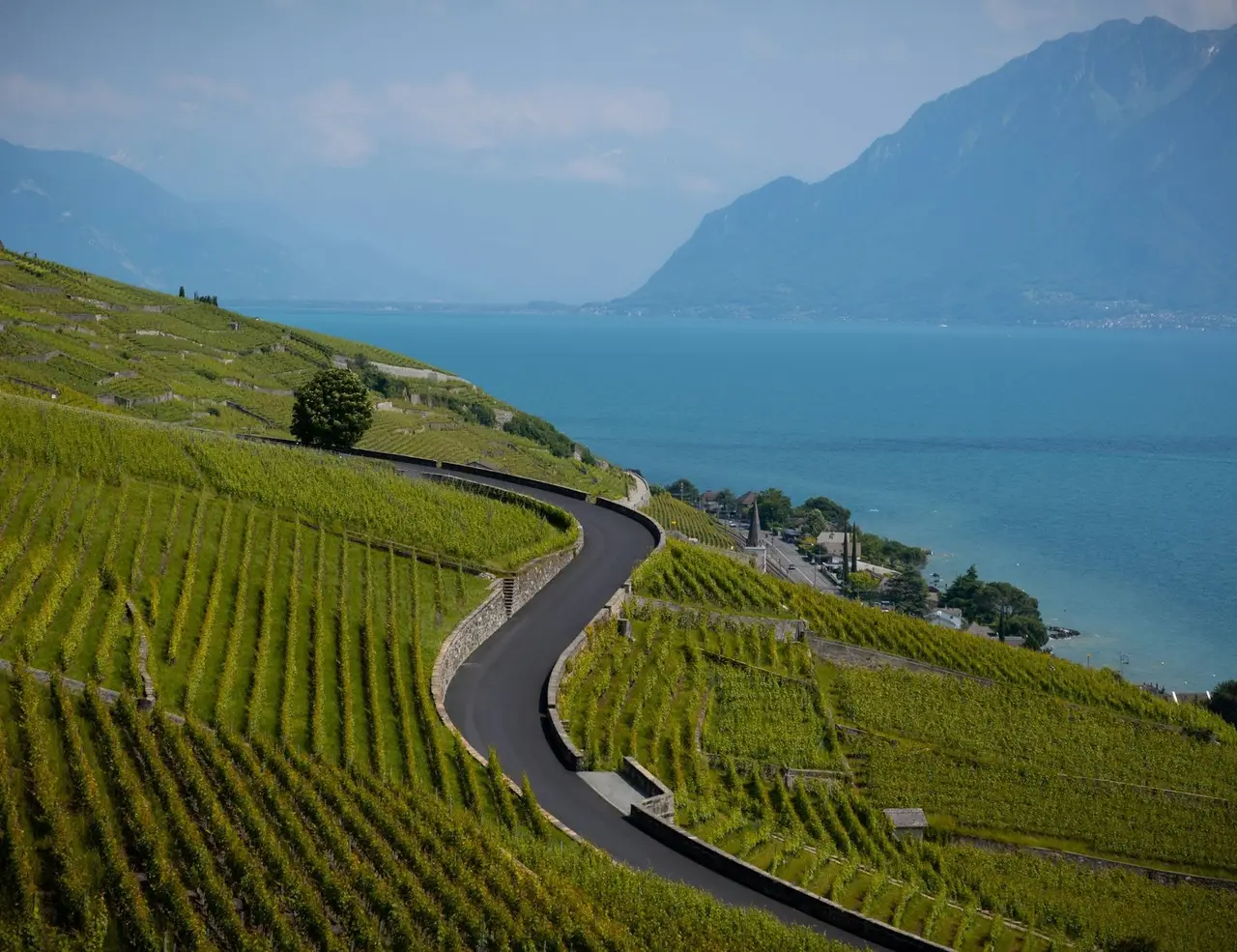
At lower elevations, especially across the Swiss Plateau and along major lakes, the landscape is soft and cultivated. Deciduous forests of beech, oak, maple, and chestnut frame cycling routes, particularly in spring and early summer when fresh green leaves create shaded corridors along roads. Vineyards cover sunny slopes near Lake Geneva, Lake Neuchâtel, and in Valais, where rows of vines cling to terraces built into hillsides. Orchards of apple, pear, and cherry trees are common in rural areas, and during bloom season they turn entire valleys pale pink and white.
As routes climb into the foothills and mid-altitude valleys, forests become denser and more coniferous. Spruce, fir, and pine dominate the slopes, filling the air with resinous scent on warm days. Alpine meadows begin to appear, especially above forest lines, opening into wide grasslands used for seasonal grazing. These meadows are among Switzerland’s most distinctive landscapes for cyclists, dotted in summer with wildflowers such as gentian, alpine roses, edelweiss, and globeflowers. Riding through these areas often feels expansive, with color spreading across open slopes beneath towering peaks.
Higher still, vegetation becomes sparse and resilient. Near mountain passes, plants hug the ground, adapted to cold temperatures, thin soil, and intense sunlight. Mosses, lichens, and hardy grasses dominate rocky terrain, and in early summer small bursts of flowers appear briefly before retreating as snow returns. These zones feel stark yet beautiful, emphasizing the rawness of the high Alps and the effort required to reach them by bike.
Seasonal change is especially pronounced. Spring brings rapid greening in valleys and the release of alpine blooms as snow recedes. Summer is lush and full, with meadows at their brightest and forests offering welcome shade on long climbs. Autumn transforms the landscape into gold and copper, particularly in larch forests that glow against dark mountain rock. Even winter leaves its mark, with frost patterns, bare branches, and snowfields reshaping the visual rhythm of familiar routes.
What makes flora so striking while cycling in Switzerland is its immediacy. Forest edges line narrow mountain roads, alpine flowers grow inches from the tarmac, and cultivated land blends seamlessly into wild terrain. Each ascent reveals a new botanical layer, making the ride not just a physical journey through altitude, but a steady passage through living landscapes shaped by height, season, and climate.
Fauna
Switzerland’s fauna reflects the structure of its landscapes, shaped by altitude, seasonal movement, and long coexistence between wildlife and human settlement. Cycling in Switzerland often brings encounters that feel woven into the terrain rather than staged, where animals appear briefly along forest edges, alpine meadows, or high ridgelines before slipping back into the landscape.
In the Alps, wildlife is most visible in early morning and late evening, when roads are quiet and light is soft. Ibex are among the most iconic sights, moving confidently across steep rocky slopes near high passes. Chamois appear in smaller groups, agile and alert, often silhouetted against ridgelines or grazing just above the tree line. Marmots are common companions in alpine zones, especially in summer. Their sharp whistles echo across meadows as they dart between burrows, sometimes standing upright beside the road to assess passing cyclists.
Forested mid-altitudes support a different cast. Red deer and roe deer move through woodland clearings and valley edges, particularly at dawn. Foxes are frequently seen crossing rural roads, and in more remote regions, lynx quietly inhabit dense forests, rarely seen but present as part of ongoing conservation efforts. Cycling through these areas brings a heightened sense of awareness, where a rustle in the undergrowth or movement between trees hints at unseen life nearby.
Birdlife is constant and varied. Golden eagles soar above alpine valleys, riding thermal currents along sheer cliffs. Bearded vultures, once extinct in the region and now reintroduced, are increasingly spotted gliding across high mountain terrain, their broad wings casting slow-moving shadows over rock and snow. In lower areas, cyclists encounter woodpeckers, jays, and owls in forested zones, while lakes and wetlands attract swans, herons, grebes, and migratory waterfowl.
Rivers and lakes add another dimension. Otters have returned to parts of Switzerland’s waterways, benefiting from improved water quality and habitat protection. Trout and other freshwater fish populate clear mountain streams, and cyclists riding beside rivers often see sudden flashes beneath the surface as fish scatter in the current.
What makes cycling in Switzerland distinctive is how closely wildlife remains tied to working landscapes. Cows with bells define alpine pastures in summer, moving between meadows as part of seasonal transhumance that has shaped the countryside for centuries. Sheep and goats graze along mountain slopes, and their presence forms a living link between ecology, agriculture, and tradition.
Fauna here is not about spectacle but about continuity. Animals live within clearly defined rhythms shaped by altitude, weather, and human respect for protected land. Cycling moves at the right speed to notice these patterns, offering moments where a ride becomes quieter, more attentive, and deeply connected to the living systems that surround the road.
Climate
Switzerland’s climate is shaped by altitude, latitude, and the presence of the Alps, creating clear contrasts that road cyclists feel directly in the legs and lungs. Valleys, lakes, and high mountain passes exist close together, and cycling in Switzerland often means moving through distinct climate zones within a single day. For riders who enjoy long distances and sustained climbs, this variation becomes part of the rhythm of the journey rather than an obstacle.
At lower elevations, particularly around major lakes such as Lake Geneva, Lake Lucerne, and Lake Zurich, the climate is relatively temperate. Summers are warm but rarely extreme, with daytime temperatures typically ranging between 20°C and 26°C (68°F to 79°F). These conditions suit longer riding days and steady endurance efforts, especially on rolling lake roads and valley approaches to the mountains. Spring and early autumn bring cooler air, usually between 12°C and 20°C (54°F to 68°F), with clear light and stable weather that many cyclists consider ideal.
As roads rise into the Alps, conditions change noticeably. Every 1,000 meters of elevation brings a drop in temperature, and high passes can feel dramatically cooler even in mid-summer. On classic alpine climbs, temperatures near the summit often sit between 8°C and 15°C (46°F to 59°F), with wind exposure adding a sharp edge. Descents can feel cold at speed, making layers essential when cycling Switzerland’s long mountain roads. Weather can also shift quickly at altitude, with clouds forming fast and brief showers appearing without warning.
Summer, from June through September, is the prime season for high-mountain riding. Snow clears from most major passes by late June, opening routes such as those connecting central Switzerland with Graubünden and Valais. July and August offer the longest daylight hours, though afternoon thunderstorms are common in alpine regions. These storms tend to build later in the day, which is why early starts are a common and effective strategy for cyclists tackling tougher climbs. Autumn brings cooler temperatures and more stable air. September is especially popular for cycling in Switzerland, as crowds thin, skies often remain clear, and the mountains take on warm tones. Daytime temperatures in valleys hover around 15°C to 22°C (59°F to 72°F), while higher elevations feel crisp and invigorating. October can still offer excellent riding at lower altitudes, though snow may return to the highest passes.
Winter limits high-mountain cycling, as snow and ice dominate alpine roads. However, lower regions remain rideable on clear days, particularly around lakes and in sheltered valleys. Temperatures in winter typically range from 0°C to 8°C (32°F to 46°F), and while conditions are quieter, rides tend to be shorter and more deliberate. Across all seasons, Switzerland rewards preparation. Clear signage, well-maintained roads, and reliable weather forecasts make it easier to plan routes around conditions. For riders drawn to long climbs, extended distances, and the physical satisfaction of alpine riding, the climate of Switzerland does not simplify the experience. Instead, it deepens it, turning each ascent and descent into a conversation with altitude, light, and air.
Economy
Switzerland’s economy is shaped by precision, regional specialization, and a long tradition of balancing innovation with stewardship of land and resources. While the country is globally associated with finance and diplomacy, the economic life encountered while cycling in Switzerland is far more textured and closely tied to geography.
Agriculture remains visible and culturally important, especially in alpine and pre-alpine regions. Dairy farming dominates rural landscapes, with cows grazing on high pastures during summer months as part of seasonal transhumance. These pastures supply milk for iconic products such as alpine cheeses, butter, and yogurt, many of which are still produced in small village dairies. Cycling in Switzerland often means riding past chalets where cheese wheels age in cool cellars, farm shops sell fresh produce, and bells echo across open meadows. Viticulture also plays a role, particularly along lake regions and river valleys, where terraced vineyards produce distinctive white and red wines adapted to steep slopes and cooler climates.
Industry and craftsmanship form another economic pillar. Switzerland is known for high-value manufacturing, including precision engineering, medical technology, and watchmaking. While these industries operate on a global scale, their presence is often felt quietly in small towns where workshops, research facilities, and family-owned firms continue traditions of technical skill and meticulous production. Cycling routes through valleys and industrial edges reveal how manufacturing coexists with agriculture and tourism rather than replacing it.
Tourism is one of the most visible economic drivers for cyclists. Mountain resorts, lakeside towns, and historic cities rely on visitors drawn by outdoor activities, cultural heritage, and seasonal events. Cycling in Switzerland is supported by this infrastructure, with well-maintained bike paths, mountain railways that accommodate bicycles, guesthouses accustomed to active travelers, and cafés positioned perfectly for mid-ride stops. Many alpine communities depend on summer cycling just as much as winter skiing, creating year-round economic rhythms tied to the landscape.
Services and global trade underpin the national economy, particularly in urban centers, where finance, research, education, and international organizations are concentrated. Yet even these sectors feel grounded. Public transport systems are closely integrated with cycling networks, renewable energy projects appear in rural areas, and environmental regulation shapes how development unfolds. This creates a sense of order and continuity that cyclists experience as smooth transitions between city edges, countryside, and high mountain terrain.
For riders, Switzerland’s economy is encountered through everyday details rather than statistics. A farm café serving cheese made from the pasture above the road, a mountain lift adapted for bikes, or a village bakery timing its hours around commuter trains all reflect a system designed for reliability and care. Cycling in Switzerland offers insight into how economic prosperity, environmental responsibility, and regional identity have been woven together, creating landscapes that function as places to live, work, and ride.
DREAMING OF CYCLING IN SWITZERLAND ?
Explore our amazing bike tours in Switzerland now !
Which Are the Best Regions to Cycle in Switzerland?
When it comes to cycling in Switzerland, regions matter as much as individual routes. Each part of the country carries its own riding character, shaped by language, landscape, elevation, and local culture. These broader regions set the tone for long-distance road cycling, challenging climbs, and multi-day journeys that appeal especially to riders who enjoy sustained effort and varied terrain.
1. The Swiss Alps
The Swiss Alps form the backbone of road cycling in Switzerland and are the country’s most iconic cycling region. Towering peaks, deep valleys, and legendary mountain passes define this landscape, making it a magnet for cyclists who seek long climbs and high-altitude riding. Roads here are engineered with care, climbing steadily through hairpin bends that reveal dramatic panoramas at every turn. Regions such as Valais, Graubünden, and the Bernese Oberland offer extended ascents, thin mountain air, and descents that stretch for kilometers. Cycling in Switzerland reaches its most demanding and rewarding form in the Alps, where endurance, pacing, and preparation are key, and where each summit feels earned through sustained effort rather than short bursts.
2. Central Switzerland
Central Switzerland sits at the meeting point of mountains and lakes, creating a region that blends challenging climbs with moments of visual calm. Areas around Lake Lucerne and the surrounding uplands combine steep alpine roads with rolling approaches that allow riders to settle into rhythm before tackling elevation. Climbs often rise sharply from the lakeshore, making elevation gain feel immediate and purposeful. This region is ideal for cyclists who enjoy long-distance rides with repeated climbs rather than a single defining ascent. Cycling in Switzerland here feels intimate and dramatic, with narrow valleys, historic villages, and sudden views over deep blue water framed by rugged peaks.
3. The Bernese Oberland
The Bernese Oberland stands out as one of the most visually powerful cycling regions in Switzerland. Dominated by classic Alpine scenery, it is defined by wide valleys, glacier-fed rivers, and towering mountains that feel ever-present. Long valley roads allow cyclists to build distance and endurance, while climbs toward high passes introduce sustained gradients that reward patience and consistency. The region’s scale suits road cyclists who enjoy long days in the saddle, where mileage accumulates naturally between villages and mountain bases. Cycling in Switzerland takes on a grand, almost cinematic quality here, with constant shifts between open valley riding and demanding alpine ascents.
4. Eastern Switzerland and Graubünden
Eastern Switzerland, particularly the canton of Graubünden, offers some of the country’s most serious road cycling terrain. This is a region of remote valleys, high passes, and long, uninterrupted climbs that appeal to experienced riders. Roads often feel quieter and more expansive, allowing cyclists to focus on cadence and distance rather than traffic or congestion. Elevation changes are significant, and daily rides here tend to be longer and more physically demanding. Cycling in Switzerland reaches a more introspective, endurance-driven form in Graubünden, where landscapes feel vast, weather can shift quickly, and preparation becomes part of the adventure.
5. The Jura Mountains
Running along the northwestern edge of the country, the Jura Mountains offer a different kind of challenge. Elevations are lower than the Alps, but the terrain is far from easy. Long rolling climbs, exposed ridgelines, and wide plateaus create routes that test stamina rather than pure climbing strength. The Jura is well suited to riders who enjoy long-distance cycling with constant elevation change rather than dramatic peaks. Cycling in Switzerland here feels quieter and more pastoral, with open farmland, dense forests, and far-reaching views that unfold gradually over the course of a day.
6. The Swiss Plateau
Between the Alps and the Jura lies the Swiss Plateau, the country’s most populated region and a key connector for long-distance cycling. While flatter than the mountain regions, it is far from featureless. Gentle hills, river corridors, and rolling farmland create ideal terrain for building mileage and linking major regions together. Cities, lakes, and rural stretches blend seamlessly, making it an important base for cyclists planning extended tours across the country. Cycling in Switzerland on the Plateau emphasizes flow, efficiency, and distance, offering recovery days or transitional stages between more demanding mountain sections.
Which Are the Best Routes for Cycling Switzerland?
Switzerland is built for road cyclists who enjoy long distances, sustained climbs, and days shaped by elevation gain rather than shortcuts. The country’s road network is exceptionally well maintained, gradients are engineered with rhythm, and the landscape rewards patience with some of the most dramatic mountain riding in Europe. These routes are widely regarded as the best expressions of cycling in Switzerland for riders who seek challenge, scale, and continuity.
1. The Furka–Grimsel–Susten Pass Loop
This classic high-Alpine circuit is often considered the ultimate road cycling loop in Switzerland. Linking the Furka Pass, Grimsel Pass, and Susten Pass, the route delivers three major climbs in one continuous journey, each with a distinct character. The Furka rises above glacier fields and exposed switchbacks, the Grimsel feels stark and monumental with wide-open rock faces and reservoirs, and the Susten offers a long, steady ascent through forested valleys before breaking into high alpine scenery.
What makes this loop special is not just elevation but flow. Roads are smooth, gradients are consistent, and descents are long and technical without feeling dangerous. Cycling in Switzerland reaches its purest form here, where distance, climbing, and scenery align into a single demanding day or a carefully staged multi-day ride.
2. Alpine Pass Route
Known as National Route 6, the Alpine Pass Route is one of the most ambitious long-distance cycling routes in the country. It crosses Switzerland from east to west, stringing together a succession of major mountain passes across Graubünden, Valais, and the Bernese Alps. Riders encounter sustained climbs, long valley transitions, and repeated elevation gain that rewards endurance and planning.
This route is ideal for cyclists who enjoy committing to long days in the saddle. Each pass feels earned, and the cumulative effect of multiple climbs over consecutive days defines the experience. Cycling in Switzerland along the Alpine Pass Route is less about single highlights and more about the satisfaction of continuous mountain riding across the country’s most dramatic terrain.
3. Gotthard Pass via the Tremola Road
The Gotthard Pass is one of Switzerland’s most historic crossings and a rite of passage for road cyclists. Approaching from the south, riders can climb the famous Tremola, a cobbled road that winds upward in tight hairpins, offering a rare combination of physical challenge and historical atmosphere. The ascent is steady and demanding, and the surface adds an extra layer of difficulty that appeals to experienced riders.
At the summit, the sense of crossing a true geographic divide is unmistakable. Long descents follow into contrasting landscapes, reinforcing the feeling of movement between regions. Cycling in Switzerland on the Gotthard is about tradition, toughness, and immersion in the country’s mountain heritage.
4. Bernese Oberland High Routes
The Bernese Oberland offers some of the longest and most scenic valley-to-pass routes in Switzerland. Roads linking Interlaken, Grindelwald, and the surrounding valleys allow riders to build serious distance before committing to climbs that rise toward high viewpoints and mountain passes. The scale here is expansive, with wide valleys framed by iconic peaks and glaciers.
These routes suit cyclists who enjoy long-distance days with sustained efforts rather than short, explosive climbs. The riding feels rhythmic and immersive, with elevation gained gradually and views unfolding slowly. Cycling in Switzerland through the Bernese Oberland emphasizes endurance, scenery, and a strong sense of progression.
5. Engadin Valley Loop
The Engadin Valley, located in eastern Switzerland, is a high-altitude plateau surrounded by major Alpine passes. Routes here often link long valley stretches with demanding climbs such as the Julier, Albula, or Flüela passes. The altitude keeps temperatures cooler in summer, making it ideal for longer rides during warmer months.
What sets the Engadin apart is continuity. Riders can string together multiple passes over several days without retracing ground, creating a true touring rhythm. Cycling in Switzerland feels more remote and introspective here, with quieter roads, big skies, and a strong sense of scale that appeals to seasoned road cyclists.
6. Jura Crest Route
For riders who prefer long rolling climbs over extreme altitude, the Jura Crest Route offers a different but equally demanding experience. Running along the Jura Mountains near the French border, this route features constant elevation change, exposed ridgelines, and wide panoramic views across forests and farmland.
Climbs here are less dramatic but relentless, rewarding stamina rather than explosive power. The landscape feels quieter and more pastoral, yet physically taxing over distance. Cycling in Switzerland along the Jura Crest Route suits riders who value long days, steady effort, and less crowded mountain roads.
7. Valais Valley and Pass Roads
Valais is home to some of Switzerland’s highest and most demanding road cycling routes. Long valley roads allow riders to accumulate distance before tackling legendary climbs that rise sharply toward high passes. The contrast between wide, sunlit valley floors and steep ascents defines the riding here.
This region is particularly appealing to cyclists training for endurance or looking to combine distance with serious climbing. Cycling in Switzerland reaches a powerful intensity in Valais, where elevation gain stacks up quickly and every route feels shaped by the surrounding mountains.
When Is the Best Time for Cycling Switzerland?
Best Season: June to September
Summer is the prime season for cycling in Switzerland, especially for road cyclists focused on long distances and high mountain passes. From June through September, Alpine roads are fully open, snow has cleared from most major passes, and daylight stretches well into the evening. Daytime temperatures in the valleys typically range between 18 and 26°C (64 to 79°F), while higher elevations remain cooler, often between 10 and 18°C (50 to 64°F), creating ideal conditions for sustained climbing.
July and August are the heart of the season for iconic routes such as the Furka, Grimsel, Gotthard, and Susten passes. These months offer the most reliable weather windows for high-altitude riding, with dry roads, clear visibility, and long uninterrupted riding days. While these are also the busiest months, early starts allow cyclists to enjoy quieter climbs before traffic increases later in the day. For riders planning multi-pass days or long traverses, summer delivers the consistency needed for ambitious itineraries.
Shoulder Season: Late May and October
Late May marks the transition into cycling season, though conditions vary year to year depending on snowfall. Lower-altitude routes, valley roads, and Jura ridgelines become rideable first, while some high passes may still be closed or partially snowbound. Temperatures during this period range from 12 to 20°C (54 to 68°F), making longer endurance rides comfortable, especially for cyclists who prefer cooler conditions.
October brings a quieter, more reflective atmosphere. The crowds thin significantly, mountain villages slow down, and autumn colors begin to spread across forests and vineyards. Daytime temperatures often sit between 10 and 18°C (50 to 64°F), and clear weather can still deliver exceptional riding days. However, daylight shortens quickly, and early snowfall can close higher passes without much notice, making route flexibility essential.
Off Season: November to April
Winter sharply limits road cycling in Switzerland’s mountainous regions. From November through April, snow covers most Alpine passes, and temperatures at elevation frequently fall below freezing. Valley areas may experience daytime highs between 2 and 10°C (35 to 50°F), but icy roads, limited daylight, and unpredictable weather make long-distance cycling impractical in most regions.
That said, some lower-elevation routes in the Jura, parts of the Swiss Plateau, or sheltered lakeside roads remain rideable on clear winter days. Winter cycling here is less about distance and more about short, focused rides in calm conditions. For most road cyclists seeking Switzerland’s signature climbs and long mountain days, winter is best reserved for planning rather than riding.
Enjoying German Cuisine
Swiss food culture is shaped by mountains, seasons, and a deep respect for regional tradition. When cycling in Switzerland, meals feel practical yet deeply comforting, designed to refuel long days of climbing and reward time spent in high landscapes. Alpine pastures, dairy farming, vineyards, and lakes all leave their mark on the table, and each canton brings its own specialties rooted in geography.
Food often appears at exactly the right moment. A warm dish after a high pass, bread and cheese eaten beside a lake, or something sweet in a village bakery becomes part of the rhythm of cycling rather than a pause from it.
Here are some of the most meaningful foods to experience while cycling Switzerland.
1. Cheese Fondue
Fondue is perhaps the most iconic Swiss dish, especially in Alpine regions like Valais and Fribourg. Melted cheese is blended with white wine, garlic, and a hint of kirsch, then shared communally with chunks of bread dipped into the pot. After a day of sustained climbing, fondue feels both restorative and social. Cyclists often encounter it in mountain inns where wooden interiors, low light, and slow conversation match the pace of recovery. It is rich, warming, and deeply tied to alpine life.
2. Raclette
Raclette originates in Valais and is built around simplicity. A wheel of cheese is heated, scraped, and poured over boiled potatoes, pickles, and onions. The dish is hearty without being elaborate, and it reflects the agricultural rhythms of mountain regions where dairy farming dominates. For cyclists riding through high valleys or staying in alpine villages, raclette often appears in small restaurants where meals stretch unhurried into the evening. It feels perfectly suited to tired legs and cool mountain air.
3. Rösti
Rösti began as a farmer’s breakfast and has become a national staple. Shredded potatoes are pan-fried until golden and crisp, sometimes topped with eggs, cheese, or smoked meat. Cyclists encounter rösti in both casual cafés and traditional restaurants, especially in German-speaking regions. It is filling, reliable, and ideal before or after long distances. Eaten at altitude or in valley towns, rösti reflects Swiss food at its most practical and satisfying.
4. Alpine Cheeses and Bread
Beyond fondue and raclette, Switzerland’s everyday cheeses define much of the cycling experience. Gruyère, Emmental, Appenzeller, and dozens of alpine varieties appear in bakeries, farm shops, and village markets. Cyclists often assemble simple meals of bread, cheese, and fruit eaten beside lakes or at mountain viewpoints. These quiet lunches feel deeply connected to the land, where dairy production remains visible in grazing cattle and hillside chalets.
5. Sausages and Regional Meats
Swiss cuisine includes a wide range of regional sausages, from cervelat to St. Gallen bratwurst. These are often served with mustard, bread, or potatoes and appear frequently at roadside cafés or small-town restaurants. For cyclists, they offer a protein-rich, uncomplicated meal that suits long days in the saddle. In wine-growing regions, cured meats are often paired with local whites or light reds, turning a simple lunch into a distinctly regional experience.
6. Chocolate and Pastries
Swiss chocolate is more than a global reputation. It is part of daily life. Cyclists find chocolate bars, truffles, and pastries in village bakeries and convenience shops across the country. Chocolate becomes fuel during rides and a small reward at the end of long stages. Pastries like nut-filled tarts or cream-based desserts appear in cafés along lakes and in alpine towns, offering sweetness that feels earned after sustained effort.
7. Swiss Wines
Though lesser known internationally, Swiss wines are deeply tied to local landscapes. Vineyards line the shores of Lake Geneva, Lake Neuchâtel, and the Valais valley, producing crisp whites and light reds rarely exported beyond the country. Cyclists riding through vineyard regions often stop at small wine bars or cellars where tastings feel informal and rooted in place. A glass enjoyed at sunset after a long ride brings a quiet sense of arrival.
Together, these foods reflect Switzerland’s balance of endurance and comfort. Cycling Switzerland is not just about passes and distance. It is also about the moments when effort gives way to warmth, shared tables, and meals that feel inseparable from the mountains that surround them.
PLANNING A CYCLING HOLIDAY IN SWITZERLAND?
Dive into our curated Switzerland cycling adventures today!
Switzerland Visa Requirements
Switzerland is part of the Schengen Area, which makes entry relatively straightforward for many international travelers planning cycling holidays.
Citizens of countries such as the United States, Canada, the United Kingdom, Australia, New Zealand, Japan, Singapore, and most European nations can enter Switzerland visa-free for short stays of up to 90 days within a 180-day period. This applies to tourism and leisure travel, including cycling in Switzerland. No prior visa application is required, though travelers must meet standard entry conditions.
For travelers who do require a visa, a Schengen short-stay visa must be obtained in advance from a Swiss consulate or authorized visa center. Switzerland does not issue visas on arrival. Applications typically require proof of accommodation, travel insurance, sufficient funds, and a detailed itinerary.
Passports must be valid for at least three months beyond the intended departure date from the Schengen Area and must have been issued within the last ten years. Border authorities may also request evidence of onward travel and financial means during your stay.
Travel insurance covering medical emergencies and repatriation is mandatory for Schengen visa applicants and strongly recommended for all cyclists, especially given Switzerland’s alpine terrain and long-distance mountain riding. Because visa rules can change and requirements vary by nationality, travelers should always confirm the latest regulations with official Swiss or Schengen government sources before planning a cycling trip. This is particularly important if combining cycling in Switzerland with extended travel across neighboring European countries.
Handy Info
Currency
Switzerland’s official currency is the Swiss Franc (CHF). While Switzerland sits at the heart of Europe, it does not use the euro, though euros are sometimes accepted in tourist-heavy areas. Change, however, is almost always given in Swiss francs, so it is best to carry or pay in CHF when cycling in Switzerland.
Card payments are widely accepted across the country, including in cafés, supermarkets, hotels, mountain restaurants, and public transport ticket machines. Visa and Mastercard are the most commonly used, and contactless payments such as Apple Pay and Google Pay are widely supported, even in smaller towns and alpine regions.
ATMs are easy to find in cities, regional hubs, and most villages, making cash withdrawals convenient throughout your journey. That said, cyclists may find it useful to carry a small amount of cash for unmanned farm stalls, mountain huts, or remote alpine cafés where card machines may not always be available.
Switzerland is known for being relatively expensive, so budgeting accordingly is important when cycling in Switzerland. Prices for food, accommodation, and services reflect the country’s high standard of living, but the reliability of infrastructure, quality of facilities, and ease of payment make daily logistics smooth and predictable while on the road.
Transport
Switzerland is widely regarded as having one of the most efficient and cyclist-friendly transport systems in the world, which makes moving around before, during, and after a cycling trip remarkably smooth.
Trains form the backbone of Swiss transport. The national rail network connects cities, mountain towns, and even high alpine valleys with exceptional reliability. Most trains are well equipped to carry bicycles, either with dedicated bike compartments or marked storage areas. On many routes, cyclists can roll bikes directly onto the train, though bike reservations or a bicycle ticket may be required on popular lines or during peak seasons. This flexibility makes it easy to shorten stages, skip weather-affected sections, or return to a base town after long alpine rides.
PostBuses, the iconic yellow buses that reach remote villages and mountain passes, also play an important role. Many routes accept bicycles, especially in summer, and some mountain regions run seasonal bike-friendly services. These buses allow cyclists to access high passes or return from isolated valleys where train lines do not reach.
Cable cars and mountain railways add another dimension. In alpine regions, cyclists often use gondolas or funiculars to gain elevation or access scenic ridgelines before riding long descents. Policies vary by region, but many lifts allow bikes during certain hours or with a small additional fee.
For international arrivals, Switzerland is easily accessed by air via major hubs such as Zurich, Geneva, and Basel. All three airports are directly connected to the rail network, allowing cyclists to assemble bikes and travel onward without needing a car. Many riders arrive via neighboring countries, using cross-border trains from France, Italy, Germany, or Austria, which integrate seamlessly with Swiss services.
While car travel is efficient, it is rarely necessary for cycling-focused journeys. Roads are well maintained, signage is clear, and drivers are generally respectful of cyclists. For those who do use cars, bike racks are common, and parking facilities are available in most towns, though costs can be high in city centers.
Language
Switzerland’s linguistic landscape reflects its position at the crossroads of Europe and adds a distinctive cultural layer to cycling in Switzerland. The country has four national languages: German, French, Italian, and Romansh, each tied closely to specific regions and local identities.
German is the most widely spoken language and dominates much of central and eastern Switzerland, including areas around Zurich, Lucerne, and Bern. In everyday life, you will often hear Swiss German dialects, which sound quite different from standard German but are part of daily conversation. Written communication, signage, and official information usually appear in standard German, making navigation manageable for travelers.
French is spoken primarily in western Switzerland, including regions such as Geneva, Lausanne, and along Lake Geneva. Cycling in these areas feels culturally closer to France, with French used on road signs, menus, and transport systems. Italian is spoken in the southern canton of Ticino, where palm-lined streets, Mediterranean architecture, and Italian cuisine shape daily life.
Romansh, a minority language rooted in Latin origins, is spoken in parts of Graubünden and holds strong cultural significance despite its smaller number of speakers.
English is widely understood across Switzerland, especially in cities, tourist regions, hotels, restaurants, and transport services. Cyclists rarely face communication difficulties, even when moving between language regions, as multilingualism is a normal part of Swiss life. Many signs, especially on cycling routes and public transport, appear in multiple languages, sometimes accompanied by clear symbols that transcend language altogether.
For cyclists, this linguistic diversity adds richness rather than complexity. One day you may order coffee in German, the next in French, and later enjoy an Italian greeting at a mountain café. Place names often shift language as regions change, marking transitions in culture as clearly as changes in landscape. Cycling in Switzerland is not only a physical journey across mountains and valleys but also a quiet passage through Europe’s living languages, each adding texture and character to the ride.
Culture and Religion
Switzerland’s culture is shaped by geography as much as history. Mountain valleys, high passes, and lake basins have fostered strong local identities, a deep sense of independence, and a tradition of coexistence across linguistic and cultural lines. Rather than one single national character, Switzerland is a mosaic of regional cultures, each with its own customs, rhythms, and way of life. Cycling in Switzerland brings these differences into focus gradually, as landscapes, languages, and daily habits shift with each canton crossed.
At the heart of Swiss culture is the idea of community autonomy. Many traditions are rooted in small towns and alpine villages where local decision-making, seasonal festivals, and shared responsibilities remain central. Alpabzug, the ceremonial descent of cattle from high mountain pastures in late summer, is one of the most visible examples. Decorated cows, traditional dress, and village gatherings mark the end of the alpine grazing season and celebrate the relationship between people, animals, and land. Cyclists riding through mountain regions in September often encounter these events unfolding along village streets.
Religion has historically played an important role, particularly Christianity, which arrived early and evolved differently across regions. Catholicism is more prevalent in central and southern areas such as Valais, Ticino, and parts of central Switzerland, while Protestant traditions are stronger in regions like Zurich, Bern, and Basel. This divide shaped architecture, education, and social structures, and it remains visible in church styles, village layouts, and local holidays. That said, Switzerland today is largely secular in daily life. Churches often function as community anchors, cultural landmarks, or quiet spaces rather than centers of strict religious practice.
Migration has added further layers to Swiss society. Over the past century, communities from Italy, Portugal, the Balkans, Turkey, and beyond have settled across the country, especially in urban centers and industrial regions. This diversity appears in food culture, neighborhood life, and multilingual public spaces. Cycling through cities like Zurich, Geneva, or Lausanne reveals a modern Switzerland that balances tradition with global influence, where historic guild houses stand alongside contemporary art spaces and international cafés.
What many visitors notice most is the Swiss relationship with order, precision, and care for shared environments. Public spaces are clean, infrastructure is meticulously maintained, and nature is treated with respect through conservation rules and thoughtful land use. On the road, this translates into well-marked cycling routes, courteous interactions, and a sense that moving through the landscape carries responsibility as well as privilege.
For cyclists, Swiss culture reveals itself quietly. It is felt in an early-morning bakery opening before a mountain ride, a farmer greeting you as you pass through alpine pasture, or a lakeside town settling into evening as church bells mark the hour. Cycling in Switzerland becomes a way to move through living traditions that value balance, coexistence, and respect for both people and place.
Appliances and Devices
Switzerland uses plug types C and J. Type C is the standard two-pin European plug, while Type J has three round pins and is unique to Switzerland. Many modern European plugs fit both systems, but travelers from North America, the UK, Asia, or Australia will usually need a universal travel adapter to keep devices charged smoothly while cycling in Switzerland. Electricity in Switzerland runs on 230 volts at 50 Hz, which is compatible with most modern electronics such as phones, laptops, cameras, GPS units, and bike computers. Travelers should still check device labels, especially for older chargers or specialty equipment, to ensure they support 230V input. Using a high-quality adapter rather than cheap converters helps protect sensitive electronics.
Power supply across Switzerland is exceptionally reliable, even in mountain regions. Hotels, guesthouses, alpine inns, and rural chalets almost always provide steady electricity, though sockets may be limited in older buildings. For cyclists staying in mountain huts or remote valleys, outlets may be shared or available only in common areas, making it wise to charge devices whenever the opportunity arises.
Cyclists often depend on navigation tools, electronic shifting systems, lights, and action cameras, especially on longer Alpine stages. A compact power bank is highly recommended, particularly for long climbs, multi-day rides, or routes where cafés and charging points are spaced far apart. USB charging ports are increasingly common in accommodations and trains, making Switzerland well suited for tech-supported cycling.
With a universal adapter, a power bank, and basic voltage awareness, staying connected and powered while cycling in Switzerland is straightforward, even across high passes and remote Alpine landscapes.
Mobile Coverage
Mobile coverage in Switzerland is excellent and among the most reliable in Europe, making it easy to stay connected while cycling in Switzerland, even across mountainous terrain. Cities, towns, and transport corridors enjoy strong 4G coverage nationwide, with 5G widely available in urban areas and steadily expanding into regional hubs. Data speeds are fast and stable, supporting navigation apps, route downloads, messaging, and live tracking without difficulty.
The main mobile providers are Swisscom, Sunrise, and Salt, all of which offer strong coverage across the country. Swisscom generally provides the widest reach in rural and alpine areas, while Sunrise and Salt offer competitive plans with solid performance along major valleys and populated regions. Prepaid SIM cards can be purchased easily at airports, train stations, supermarkets, and mobile shops. Many travelers now opt for eSIMs, which work well in Switzerland and allow instant setup before arrival.
While coverage is impressive, there are still natural gaps in high alpine terrain. Remote mountain passes, deep valleys, tunnels, and protected wilderness zones may experience brief signal loss, particularly on lesser-used roads or at very high elevations. These moments are usually short-lived, but cyclists planning long climbs or remote routes should download offline maps and GPX files in advance and avoid relying solely on live navigation. Wi-Fi is widely available in hotels, guesthouses, mountain inns, cafés, and even many trains. Mountain huts and simpler alpine lodges may offer limited or shared Wi-Fi, so charging devices and syncing data earlier in the day is a good habit. Overall, Switzerland’s mobile infrastructure supports long-distance and high-altitude cycling extremely well, allowing riders to balance connectivity with the quiet immersion of the Alps.
Time Zone
Switzerland operates on Central European Time (CET), which is UTC+1. During the warmer months, the country observes daylight saving time and shifts to Central European Summer Time (CEST), moving the clock forward one hour to UTC+2. Daylight saving typically runs from late March to late October, in line with most of Europe.
For cyclists, this seasonal shift is especially welcome. When cycling in Switzerland between late spring and early autumn, longer daylight hours allow for early alpine starts and extended afternoons on the road, which is ideal for tackling long climbs, high passes, and scenic descents without feeling rushed. Evening light often lingers well into the mountains, giving riders time to recover, explore villages, or enjoy a relaxed meal after a demanding day in the saddle.
In early spring and late autumn, days are shorter, and alpine temperatures drop quickly after sunset. Cyclists planning rides during these periods benefit from starting earlier, especially in higher regions where shadows fall sooner and weather can change rapidly.
Switzerland’s time zone aligns smoothly with neighboring countries such as France, Italy, Germany, and Austria, making cross-border cycling itineraries easy to manage. For international travelers arriving from outside Europe, jet lag is usually manageable, and the country’s well-structured transport and accommodation systems make settling into the daily rhythm straightforward.
Through the Notes
Read
Begin with Heidi by Johanna Spyri, a classic that captures Switzerland’s alpine innocence, pastoral rhythms, and emotional connection to mountain life. For a deeper sense of place, Swiss Watching by Diccon Bewes offers a warm, humorous, and insightful look at everyday Swiss culture, habits, and contradictions. Riders interested in alpine exploration will appreciate The White Spider by Heinrich Harrer, which traces early mountaineering history in the Alps and reveals the human drive to challenge high terrain. Travel writing such as Slow Train to Switzerland by Diccon Bewes also pairs well with cycling in Switzerland, echoing the pleasure of moving deliberately through landscapes shaped by patience and precision.
Listen
Let your riding soundtrack include Swiss classical traditions and alpine folk music, where yodeling and alphorns reflect the scale of mountain valleys. For something contemporary, artists like Sophie Hunger and bands such as Patent Ochsner bring modern Swiss identity into sound. In cafés and village bakeries, you may hear soft European jazz, classical piano, or understated pop that matches the calm order of daily life. Music here rarely overwhelms; it accompanies, much like the rhythm of steady climbing.
Watch
Watch Heidi adaptations for an enduring visual language of alpine childhood and pastoral beauty. The Eiger Sanction and mountaineering documentaries centered on the Eiger North Face offer insight into Switzerland’s dramatic climbing history. Films such as Journey of Hope provide a more social perspective on Swiss life and migration. Nature documentaries focusing on the Swiss Alps reveal glacial movement, high passes, and seasonal cycles that cyclists experience directly when riding long distances through mountain terrain.
Eat
Taste fondue and raclette, dishes built for alpine climates where warmth, sharing, and simplicity matter. Melted cheese paired with potatoes, pickles, and bread feels especially satisfying after long climbs. Rösti, a crisp potato dish often served with eggs, cheese, or cured meats, is a cyclist’s staple fuel. In mountain regions, you will also find dried meats like Bündnerfleisch, dense breads, and soups designed to sustain energy. Bakeries offer nut-filled pastries, fruit tarts, and fresh bread that make perfect mid-ride stops.
Drink
Sample Swiss wines, especially whites from Valais and Vaud, which grow on steep vineyard terraces above lakes and valleys. After rides, many cyclists enjoy Rivella, a lightly sparkling Swiss soft drink made from milk whey, or strong espresso enjoyed standing at café counters. In cooler weather, hot chocolate and herbal teas appear frequently, reflecting Switzerland’s balance between indulgence and restraint.
Learn
Learn a few greetings depending on the region: Grüezi in German-speaking areas, Bonjour in French-speaking regions, and Buongiorno in Ticino. Understanding Switzerland’s cantonal system helps explain the country’s strong local identities and carefully maintained infrastructure. Precision, punctuality, and environmental care are cultural values you will feel while cycling in Switzerland, from immaculate roads to well-marked routes and respectful trail use.
Experience
Ride high alpine passes early in the morning when roads are quiet and the air is sharp. Pause beside glacial lakes where reflections shift with passing clouds. Visit small mountain villages where cowbells echo through valleys and daily life follows seasonal patterns. Take a cable car or cog railway on a rest day to gain perspective on the climbs you have ridden. Sit lakeside in places like Lucerne, Thun, or Montreux and watch evening light settle over water and peaks. Switzerland reveals itself not through spectacle alone, but through repetition, discipline, and the quiet satisfaction of moving through landscapes shaped by altitude, effort, and time.
READY TO CYCLE SWITZERLAND ?
Get started with your cycling adventure now!
Final Thoughts
From glacier-carved valleys and mirror-still lakes to high mountain passes that test endurance and reward effort, cycling in Switzerland is defined by clarity, precision, and powerful natural scale. Roads rise deliberately through alpine terrain, tunnels and switchbacks reveal long perspectives, and descents carry you into villages where everyday life unfolds with quiet rhythm. The experience is demanding in the best way, especially for riders drawn to longer distances and sustained climbs, where effort becomes part of the landscape itself.
If you would like to explore cycling Switzerland in a way that matches your riding goals, get in touch with us. We design cycling journeys that prioritize strong road riding, thoughtful pacing, and routes that make the most of Switzerland’s world-class infrastructure and alpine terrain. Whether you are drawn to iconic passes, lake-to-mountain transitions, or multi-day journeys through different linguistic regions, we help shape experiences that feel purposeful and deeply rewarding.
Our guided cycling trips focus on careful route planning, reliable logistical support, and well-chosen stays that allow you to recover well and ride strong day after day. Electric bike options are also available, offering flexibility on longer climbs without taking away from the sense of achievement. If Switzerland is on your horizon, we would be happy to help you plan a journey that turns its legendary roads into a ride you will remember long after the final descent.
Plan Your Active Adventure
Create a private trip or join a small-group departure.
