
Table of Contents
- 1. Why Cycling Scotland Stands Apart
- 2. Understanding the Terrain: What Cycling in Scotland Means
- 3. The North Coast 500: Cycling Scotland's Most Famous Route
- 4. Other Major Cycling Routes in Scotland
- 5. Cycling Scotland: Best Regions for Day Rides and Touring
- 6. Best Time for Cycling Scotland
- 7. Wildlife and Natural Landscapes Along Scotland's Cycling Routes
- 8. What to Eat on a Cycling Trip in Scotland
- 9. Practical Information for Cyclists in Scotland
- 10. Accommodation for Cyclists in Scotland
- 11. Read, Watch, Listen, and Experience
- 12. Plan Your Cycling Trip to Scotland with Art of Bicycle Trips
Why Cycling Scotland Stands Apart
The case for cycling Scotland begins with the roads themselves. Outside the central belt connecting Glasgow and Edinburgh, traffic volumes across much of the country are extremely low, particularly on the minor roads and single-track routes that link villages, glens, and coastal settlements. A cyclist on the small roads of the Scottish Borders, Argyll, or Sutherland can ride for hours without encountering more than a handful of vehicles, with the passing places that define single-track roads serving as natural rest stops rather than obstacles. The quality of this solitude, combined with landscapes that shift dramatically over short distances, is what distinguishes cycling in Scotland from cycling almost anywhere else in Europe.
Scotland is also significantly bigger than most visitors expect. The country covers 78,000 sq km (30,000 sq mi), with the Highlands alone accounting for more than half of that area. The distances between towns and villages in the north are considerable, and the terrain is frequently demanding, which means cycling Scotland requires genuine planning rather than casual improvisation. The reward for that planning is access to riding that feels genuinely remote and wild in a way that is difficult to find without traveling much further afield.
The Land Reform (Scotland) Act 2003 enshrined in law the right of responsible access to virtually all of Scotland's land and inland water. For cyclists, this means the ability to ride across open country, through forests, and along unmarked tracks without needing permission, provided the Scottish Outdoor Access Code is followed. This framework of access rights, unique within the United Kingdom and unusual in a wider European context, shapes the entire character of cycling in Scotland and underpins the appeal of bikepacking, gravel riding, and off-road adventure cycling across the country.
Scotland also brings something that no other European cycling destination quite replicates: the atmospheric combination of ancient landscape, layered history, and unpredictable weather. The midges, the dreich, the sideways rain on an exposed ridge, and the startling clarity that follows a Highland downpour are all part of the experience, and experienced cyclists who have ridden here reliably report that they would not have it any other way. Packing for every eventuality is not a cliche for cycling Scotland. It is a practical necessity, and approaching the weather with the right mindset makes all the difference.
DREAMING OF CYCLING IN SCOTLAND ?
Explore our amazing bike tours in Scotland now !
Understanding the Terrain: What Cycling in Scotland Means
The Highlands and Northern Scotland
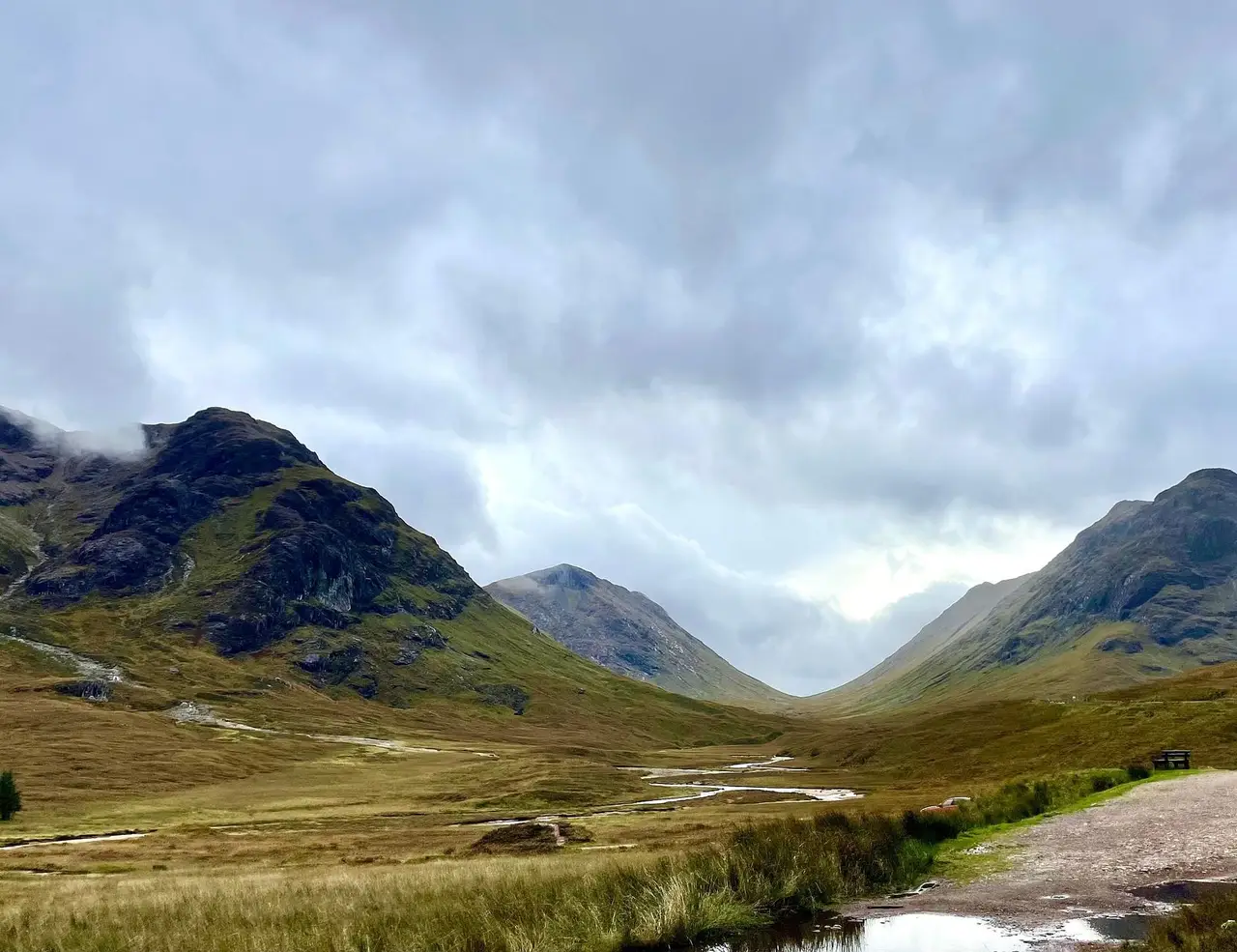
The Highlands represent the most dramatic and demanding cycling terrain in Scotland, and for many riders, the most compelling. The landscape here is defined by ancient mountains, deep glens, sea lochs, and a coastline that is constantly interrupted by peninsulas, headlands, and offshore islands. The roads are narrow, often single-track, and frequently climb to passes that reach 400 m to 600 m (1,312 ft to 1,969 ft) or more. The Bealach na Ba on the Applecross peninsula, climbing to 626 m (2,054 ft) with gradients reaching 20 percent, is the most famous and most feared climb in Scottish cycling, and a defining experience of the North Coast 500 route.
The northern Highlands are also the most remote cycling territory in Scotland. Services, accommodation, and food options are sparse in Sutherland and Caithness, and riders on multi-day routes need to plan resupply points carefully. The reward is a landscape of extraordinary openness, with enormous skies, ancient sandstone mountains, and a quality of light that photographers and painters have been pursuing for centuries. The Flow Country of Caithness, a vast blanket bog that forms the largest peatland in Europe, creates a cycling experience unlike anything else on the continent.
The Islands
Scotland's islands offer some of the most varied cycling in the country. The Isle of Skye, accessible by bridge from the mainland, is the most visited, with dramatic ridge scenery, the Cuillin Mountains visible from almost every road on the island, and a network of roads ranging from quiet single-track to the occasionally busy trunk road around the coast. The Outer Hebrides, stretching over 200 km (124 mi) from Lewis in the north to Barra in the south, offer flat to gently rolling terrain on largely traffic-free roads, with vast Atlantic beaches, machair grassland, and a stark, spare beauty that is quite different from the mainland Highlands. The Inner Hebrides include Islay, Jura, Mull, Arran, and a dozen smaller islands, all accessible by ferry and all offering self-contained cycling itineraries ranging from a day loop to a week-long tour.
The Scottish Borders
The Borders region in southern Scotland, running along the English boundary from the Solway Firth to the North Sea, offers a gentler but thoroughly rewarding form of cycling Scotland. The landscape is one of rolling moorland, river valleys, market towns, and ruined abbeys, with roads that are quiet by national standards and a network of minor lanes that rival anything in rural England for charm and accessibility. Peebles, in the Tweed Valley, is the hub of the Borders cycling scene and has hosted the Tour of Britain multiple times. Glentress, just outside the town, is one of Scotland's premier mountain bike trail centers. The Borders are also the most accessible cycling region for riders arriving from England.
Perthshire and the Central Highlands
Perthshire, known as Big Tree Country for its ancient woodland, sits at the transition between the Lowlands and the Highlands and offers exceptional gravel and road cycling. The Cairngorms National Park, extending east from Perthshire into Aberdeenshire, is the UK's largest national park and home to four of Scotland's five highest mountains. Its internal road network, forest tracks, and disused railway lines provide gravel riding on a scale that is only beginning to be properly explored and mapped. Comrie Croft near Crieff is a well-regarded mountain bike center in the heart of Perthshire, while the wider Strathearn valley provides excellent road loops with moderate elevation and consistently good scenery.
The Central Belt and Lowlands
The Glasgow to Edinburgh corridor and the Fife peninsula between the Forth and Tay estuaries contain surprisingly good cycling once off the main arterial roads. The canal network, including the Forth and Clyde Canal and the Union Canal, provides traffic-free cycling linking the two cities, and the Fife Coastal Path offers scenic riding with sea views. The central belt serves as both a cycling destination in its own right and as a practical arrival point, with both Glasgow and Edinburgh airports providing international connections and both cities offering good cycling infrastructure within their boundaries.
The North Coast 500: Cycling Scotland's Most Famous Route
Overview and Character
The North Coast 500 is Scotland's most celebrated long-distance cycling route and one of the most spectacular road rides in Europe. Starting and finishing in Inverness, the Highland capital, it loops around the entire northern coastline of Scotland, covering 805 km (500 mi) with approximately 10,600 m (34,780 ft) of total elevation gain. The route passes through Wester Ross, Assynt, Sutherland, Caithness, and Easter Ross before returning along the Black Isle to Inverness, taking in a landscape of extraordinary diversity: ancient mountains, sea lochs, white-sand beaches, dramatic sea cliffs, and the vast openness of the northern moors.
The North Coast 500 was launched in 2015 primarily as a driving route, and its success with motorists and motorcyclists has made it one of Scotland's most popular tourist trails. For cyclists, this creates a genuine tension: the route follows some of the most beautiful roads in Scotland, but those roads are also busy with other traffic in peak season, particularly the main A-road sections. Experienced NC500 cyclists typically advise riding in May or early September to avoid the July and August peak, using alternative minor-road variants where the main route follows fast A-roads, and starting early each day to ride ahead of the tourist vehicle convoys.
The Route Stage by Stage
The first section from Inverness heads west through Beauly and Muir of Ord before climbing into the hills toward Garve. From Garve the terrain becomes progressively more dramatic as the road approaches the mountains of Wester Ross. The Applecross peninsula section, which includes the Bealach na Ba climb to 626 m (2,054 ft) with its hairpin bends and 20 percent gradients, is the defining challenge of the entire route and should not be underestimated. The descent to Applecross village and the subsequent coastal road past Shieldaig and through Torridon offer some of the best mountain and coastal scenery in Britain.
From Torridon north to Gairloch and then Ullapool, the route follows roads through some of the oldest and most dramatic landscapes in Europe, with Torridonian sandstone mountains rising sheer from the moorland floor. Ullapool, a fishing port on Loch Broom, is the largest settlement on the western section of the route and an essential resupply and overnight point. North of Ullapool, the road enters Assynt, where the scenery shifts to an almost lunar landscape of isolated quartzite peaks rising from flat moorland. Stac Pollaidh, Suilven, and Quinag are the most distinctive mountains in this section, each visible from the road for long stretches.
The far northwest around Durness, the most northerly village in mainland Britain, brings white-sand beaches and Atlantic views that feel genuinely remote. The Smoo Cave at Durness is a spectacular geological feature worth a stop. Turning east along the north coast, the road passes through Tongue and Bettyhill before reaching Thurso and the northernmost point of mainland Britain at John o'Groats. The eastern section back to Inverness, which many cyclists do via an inland route through the Flow Country to avoid the busy A9, passes through the Forsinard Flows peatland reserve and along the River Helmsdale before descending through Easter Ross and the Black Isle.
NC500 Practical Logistics
The North Coast 500 is typically ridden over seven to ten days by cyclists maintaining a comfortable pace. The Cicerone guidebook to the route, which covers 16 stages with distances ranging from 24 to 89 km (15 to 55 mi), is the most detailed published reference. Accommodation along the route ranges from wild camping on the open hillside under Scotland's access legislation, to bunkhouses and youth hostels, B&Bs, and a small number of hotels. Advance booking is essential from June through August, as accommodation is limited relative to the volume of visitors. The route is accessible from Inverness by train from Edinburgh (approximately 3 hours 15 minutes) or Glasgow (approximately 3 hours 30 minutes), making it viable without a car for riders prepared to transport their bikes on the train.
Other Major Cycling Routes in Scotland
The Lochs and Glens Way (NCN Route 7)
The Lochs and Glens Way connects Glasgow and Inverness over approximately 400 km (249 mi), following the Sustrans National Cycle Network Route 7 through Loch Lomond, the Trossachs National Park, the Tay valley, and the Cairngorms. The route combines traffic-free canal paths, forest tracks, and quiet back roads, and is generally accessible to riders of moderate fitness. Starting from Balloch on the shores of Loch Lomond, the route climbs through the Trossachs to Killin and then north through Perthshire to Pitlochry, Dalwhinnie, and the Cairngorms before descending to Inverness. The combination of national park scenery, accessible terrain, and practical waymarking makes this one of the most popular multi-day cycling routes in Scotland.
The Great Glen Way
The Great Glen Way follows the geological fault line of the Great Glen, a dramatic slash across Scotland from Fort William in the west to Inverness in the east, covering approximately 126 km (78 mi). The route follows the towering Caledonian Canal for much of its length, passing through a chain of lochs including the famous Loch Ness. The canal towpath is well-surfaced and largely flat, making this one of the more accessible long-distance cycling routes in Scotland for riders of varying fitness levels. The cycling route runs alongside a walking path and is generally smooth enough for road bikes with wider tires or hybrid bikes.
The Hebridean Way
The Hebridean Way cycles the full length of the Outer Hebrides from Vatersay in the south to the Butt of Lewis in the north, covering 296 km (184 mi) of islands linked by CalMac ferry crossings. The terrain is largely flat to gently rolling, with Atlantic winds providing the main physical challenge rather than elevation. The landscape throughout is one of the most distinctive in Britain: white-sand beaches, machair grassland covered in wildflowers in early summer, peat moorland, and ancient standing stones. The Callanish Stones on Lewis, comparable in scale and atmosphere to Stonehenge, are passed directly on the route. The Hebridean Way is best suited to bikes with wider tires given the mix of tarmac and occasional unmade track, and requires advance planning for ferry timings.
Bikepacking and Gravel Routes
Scotland's bikepacking scene has grown significantly in the past decade, with route designers including Markus Stitz of Bikepacking Scotland developing a comprehensive network of off-road and mixed-surface routes across the country. The Highland Trail 550 is the most demanding of these, a 885 km (550 mi) unsupported route through the remote western Highlands that is raced annually in June and has become one of the benchmark bikepacking events in the world. For riders seeking something more approachable, the Cateran Trail in Perthshire, the Cairngorms Loop, and the Coasts and Castles route between Edinburgh and Newcastle offer gravel and mixed-surface riding that is achievable on a long weekend or short tour. The Perthshire Gravel Trails Network, developed by Bikepacking Scotland, maps a series of day routes through the glens and forests of Perthshire with downloadable GPX files and accessible by public transport from Perth station.
Cycling Scotland: Best Regions for Day Rides and Touring
1. Wester Ross and Torridon
Wester Ross is widely regarded by experienced cyclists as the finest cycling region in Scotland and one of the best in Europe. The landscape is ancient and dramatic, with Torridonian sandstone mountains, long sea lochs, and a coastline that shifts constantly between open headlands and sheltered bays. The roads are narrow, often single-track, and carry very little traffic outside the summer peak. Kinlochewe, at the head of Loch Maree, is a natural base for rides into the mountains, while Shieldaig and Lochcarron offer coastal starting points. The road over the Applecross peninsula via the Bealach na Ba is the centerpiece of cycling in this region, but the broader network of minor roads through Kinlochewe, Torridon, and around the shores of Loch Maree provides days of riding at a standard that few destinations outside the Alps can match.
2. Skye and the Inner Hebrides
The Isle of Skye, connected to the mainland by the Skye Bridge at Kyle of Lochalsh, is the most visited cycling destination in the Hebrides and one of the most photographed landscapes in Scotland. The Trotternish peninsula in the north, with the Quiraing and the Old Man of Storr visible from the road, and the southern Sleat peninsula, quieter and more wooded, offer contrasting day rides. Arran, reached by ferry from Ardrossan near Glasgow, is often called Scotland in miniature for its range of landscapes from the granite mountains of the north to the gentler south, and its 87 km (54 mi) coastal circuit is a classic Scottish cycling loop. Mull, reached from Oban, has a 96 km (60 mi) coastal circuit with superb wildlife spotting potential including white-tailed eagles, otters, and golden eagles.
3. The Scottish Borders
The Borders offer the most accessible cycling Scotland experience for riders arriving from England or based in Edinburgh. The Tweed Valley around Peebles and Innerleithen has developed into one of the premier mountain biking destinations in the UK, with Glentress and the Traquair trails forming the core of the trail center network. For road cyclists, the quiet lanes of the Lammermuir Hills, the Teviot valley, and the roads around Jedburgh and Kelso provide excellent riding through a landscape of heather moorland, sheep pasture, and the occasional ruined Border abbey. The 4 Abbeys cycle route, connecting Melrose, Dryburgh, Kelso, and Jedburgh Abbeys over approximately 90 km (56 mi), is a structured touring option with a strong cultural dimension.
4. Perthshire and the Cairngorms
Perthshire's combination of accessible terrain, excellent road surfaces, and consistently varied scenery makes it one of the most rewarding cycling regions in Scotland for riders who prefer organized routes to expedition-style adventure. The Lochs and Glens Way passes through the heart of the region. The Pitlochry area offers particularly good road cycling, with the Queen's View over Loch Tummel, the Pass of Killiecrankie, and the roads toward Rannoch Moor all within reach of a day's riding. In the Cairngorms, the Deeside Way follows the route of a disused railway along the River Dee from Duthie Park in Aberdeen to Ballater, covering 40 km (25 mi) on a well-maintained off-road path suitable for family riding. The wilder gravel routes within the national park, particularly those through the ancient Caledonian pinewoods of Abernethy and Mar Lodge, are best explored with a gravel or mountain bike.
5. Argyll and the West Coast
Argyll stretches down Scotland's western flank from Loch Lomond to the Mull of Kintyre, encompassing some of the most complex and fjord-like coastal scenery in the country. The Caledonia Way, part of the Sustrans network, follows the west coast from Campbeltown to Inverness over 234 km (145 mi), linking ferry crossings, canal paths, and quiet roads. Loch Lomond and the Trossachs National Park provides the most accessible cycling in this region, with the West Highland Way cycling route along the eastern shore of Loch Lomond and the roads through Aberfoyle and the Trossachs offering well-established touring terrain. Kilmartin Glen, south of Oban, contains one of the densest concentrations of prehistoric monuments in Scotland and is worth building into any Argyll cycling itinerary.
Best Time for Cycling Scotland
May: The Optimal Month
May is the best single month for cycling Scotland by a considerable margin. The days are long, with light lasting until after 10 PM in the north, the weather is frequently settled and clear, the midges have not yet fully emerged, the tourist traffic on popular routes like the NC500 has not reached its peak, and the landscape is at its most vivid green after the winter rains. Temperatures during May average 10 to 14 degrees C (50 to 57 degrees F) across most of the country, which is cool enough for comfortable sustained cycling and rarely cold enough to be a problem with adequate base layers.
June: Excellent Conditions, Growing Visitors
June extends the good conditions of May, though the midges begin to emerge in earnest in the west Highlands and islands by mid-June and can be severe in sheltered, humid conditions, particularly at dawn and dusk. The long daylight hours of the summer solstice give riders extraordinary flexibility in daily planning, and the settled weather patterns of early summer make June one of the more reliable months for multi-week touring. The NC500 and other popular routes see increasing visitor numbers through June, and accommodation booking should be done well in advance for travel in this month.
September: The Second Peak
September is the second best month for cycling Scotland. The midges decline as the temperature drops, the summer tourist peak has passed, and the landscape transitions through the early stages of autumn color with heather still flowering purple across the moorlands. The weather remains generally reasonable in early September, though the risk of unsettled periods increases as the month progresses. Daylight is still ample, with sunset around 8 PM in early September, and the combination of post-summer quiet and good conditions makes this an excellent time for routes that were too busy in July and August.
July and August: Beautiful but Busy
July and August bring the best guaranteed warmth but also the highest visitor numbers and the worst midge conditions. The NC500 and other popular Highland routes can feel surprisingly congested in peak summer, with the narrow roads shared by campervans, tourist coaches, and motorcyclists. For cyclists willing to ride before 9 AM or after 7 PM, the roads are considerably quieter, and the long summer daylight makes this entirely practical. Riders who prioritize established trail centers for mountain biking, or who ride in the Borders and central Scotland rather than the Highlands, will find conditions more comfortable. The west coast and islands see significantly more midge pressure than the east coast and eastern Highlands in peak summer.
Winter and Early Spring: For the Committed
Cycling Scotland through October, November, and into spring is entirely possible but requires a realistic approach to conditions. Daylight is short, rain is persistent across the west, and the northern roads can become difficult or inaccessible in periods of snow. The east coast and the Borders are more manageable in winter than the Highlands, and the early season from late March through April brings the first signs of improvement. Highland rivers and burns run high after winter, and some minor tracks become waterlogged. Riders who embrace the conditions and arrive prepared find a genuinely wild and beautiful country with empty roads and accommodation readily available without advance booking.
PLANNING A CYCLING HOLIDAY IN SCOTLAND ?
Dive into our curated Scotland cycling adventures today!
Wildlife and Natural Landscapes Along Scotland's Cycling Routes
Scotland has an exceptional density of wildlife visible from the road, and cycling through rather than driving creates significantly better opportunities for sightings. Red deer are ubiquitous in the Highlands and are a constant presence on the moorland roads, particularly around dawn and dusk. Red squirrels, now rare across most of Britain, remain common in the pinewood forests of Perthshire and the Cairngorms, and the forest cycling routes in these areas regularly produce sightings. Otters are present along the western sea lochs and some inland rivers, and spotting one from a bridge or loch shore is one of the great wildlife rewards of cycling in Scotland.
The raptors are perhaps the most spectacular wildlife feature of cycling Scotland. Golden eagles hunt the open hillsides of the western Highlands and are increasingly visible as the population recovers. White-tailed eagles, reintroduced to Scotland from Norway, are now well-established on the west coast and the Isle of Mull, where they can be seen from the road with reasonable regularity. Ospreys, also reintroduced after extinction in Britain, nest around Loch Garten in the Cairngorms and can be watched from viewing platforms during the breeding season from spring through summer. Red kites, reintroduced in the Scottish Borders, are now numerous enough to be a near-constant presence in that region.
The marine environment along Scotland's cycling routes adds another dimension entirely. Bottlenose dolphins are resident in the Moray Firth near Inverness and can be seen from the coast road. Common dolphins, minke whales, and basking sharks are sighted regularly from the western headlands in summer. The beaches of the Outer Hebrides, particularly those on the Atlantic coast of the Western Isles, are home to common and grey seals that can be approached surprisingly closely from the road. The combination of landscape scale, ancient geology, and exceptional wildlife density makes cycling in Scotland an experience that consistently rewards the observant rider.
Scottish Culture, History, and Identity
Cycling in Scotland means moving through a landscape layered with history that becomes visible in a way that driving does not allow. Neolithic standing stones, Bronze Age cairns, Iron Age hill forts, medieval castle ruins, and the more recent remnants of the Highland Clearances all appear from the saddle with an intimacy that the car window cannot provide. The Clearances, in which Highland communities were forcibly removed from their land during the 18th and 19th centuries to make way for sheep farming, left a depopulated landscape of abandoned townships whose ruins are still visible from many cycling routes across the northwest Highlands.
Scotland's Gaelic language and cultural tradition remain alive in the Western Isles, parts of Skye, and some areas of the Highland mainland, and cycling through these communities brings visitors into contact with a living culture that has survived considerable historical pressure. The islands of Lewis and Harris in particular maintain a strong Gaelic-speaking community, and the Sunday quiet of the Outer Hebrides, where many businesses remain closed in observance of the Sabbath, gives the islands a distinctive atmosphere that is part of their character rather than an inconvenience.
Whisky is inseparable from Scottish identity and inseparable from cycling Scotland as a cultural experience. Over 150 operational distilleries are scattered across the country, with the major concentrations in Speyside, the Highlands, Islay, and the Lowlands. Several of Scotland's cycling routes pass directly through distillery country, and the Malt Whisky Trail in Speyside links eight distilleries including Glenfiddich and The Glenlivet on a well-signed road route through some excellent cycling territory. Visiting a distillery, understanding the regional differences between a peaty Islay single malt and a lighter Speyside expression, and sipping a dram at the end of a day's riding is one of the definitive Scottish cycling experiences.
Burns Night on January 25th, the Edinburgh Festival through August, the Highland Games held in villages and towns across the Highlands and Borders through the summer, and the Tweedlove Bike Festival in the Borders are the most significant events on the Scottish calendar that might intersect with a cycling visit. The Highland Games, in particular, are worth building a route around if timing allows: the combination of traditional athletics, pipe bands, and local community around a small event in a Highland town gives a genuine insight into Scottish culture that is more authentic than most tourist experiences.
What to Eat on a Cycling Trip in Scotland
The Full Scottish Breakfast
The full Scottish breakfast is the fuel of choice for a long day in the saddle, and it is served with appropriate seriousness in hotels, guesthouses, and cafes across the country. A proper full Scottish includes eggs, back bacon, link sausages, black pudding, white pudding, baked beans, grilled tomatoes, mushrooms, and the essential tattie scone, a flat potato cake that is unique to Scottish breakfasts and should not be confused with any other form of scone. Many accommodations offer haggis as an alternative to or alongside black pudding, and starting a day's cycling with a plate of haggis, scrambled egg, and tattie scone is entirely defensible on nutritional grounds given the demands of Highland riding. Porridge, made properly with pinhead oatmeal and salt, is the traditional alternative for those preferring a lighter start.
Cullen Skink
Cullen skink is Scotland's most distinctive regional soup and a genuinely excellent cycling recovery meal. Named for the fishing village of Cullen on the northeast coast, it is a thick, creamy chowder of smoked haddock, potatoes, onion, and cream, served with buttered bread and carrying a smoky depth that no other British soup quite replicates. It is found on menus across the country, not just in the northeast, and quality ranges from the excellent to the institutional. A bowl of Cullen skink at a harbourside cafe in Ullapool or Portree after a demanding morning on the bike is one of the small and specific pleasures of cycling in Scotland.
Haggis, Neeps, and Tatties
Haggis is Scotland's national dish and its reputation as something challenging or confronting is largely undeserved. Made from minced sheep offal combined with oatmeal, onions, and spice, it has a peppery, earthy flavor with a crumbly texture that works well with the accompanying mashed neeps (turnip) and tatties (potato). Haggis is served in pubs, restaurants, and chippers across the country and appears in a variety of formats including haggis toasties, haggis pakoras in Glasgow, and the deep-fried haggis supper at Highland fish and chip shops. Vegetarian haggis, made with beans, lentils, and oatmeal, is widely available and is a more than adequate alternative for those who prefer it. Burns Night on January 25th celebrates haggis with formal ceremony, readings from Robert Burns's Address to a Haggis, and considerable quantities of whisky.
Scottish Seafood
Scotland's coastline produces some of the finest seafood in Europe, and cycling near the coast provides repeated opportunities to eat it well. Hand-dived scallops from the western sea lochs, smoked salmon from the Highlands and islands, cold-smoked Arbroath smokies from the east coast, langoustines from the waters around Skye and the Western Isles, and fresh crab and lobster from harbourside fish shacks all represent the best of Scottish food. The Seafood Shack in Ullapool, a simple outdoor operation serving cooked langoustines and crab claws with brown bread, is one of the best places to eat on the entire NC500 route and is routinely cited by cyclists as a highlight of riding through that part of Sutherland. Fresh oysters and mussels are farmed in many of the sea lochs of the west coast and served at local restaurants and fishmongers along cycling routes through Argyll and the Hebrides.
Cranachan, Tablet, and Scottish Sweets
Cranachan is Scotland's national dessert, a combination of whipped cream, toasted oatmeal, fresh raspberries, honey, and whisky that manages to be simultaneously indulgent and almost energetically appropriate for a cyclist. Tablet, a harder and grainier cousin of fudge made from condensed milk, sugar, and butter, is the standard sweet sold at bakeries, farm shops, and tourist outlets across the country and makes an effective pocket snack for long rides. Shortbread, in its proper buttery form rather than the commercial tourist version, is excellent with coffee or tea and is worth buying from local bakeries wherever they appear on a cycling route.
Scotch Whisky
Scotland has five recognized whisky-producing regions, each producing a distinctive style. Speyside, in the northeast, produces the largest volume and the most approachable styles, with fruit-forward single malts from distilleries including Glenfiddich, The Macallan, and Aberlour. The Highlands region covers a huge geographic area and produces a broad range of styles from light coastal malts to rich, sherried expressions. Islay, the small island off the Argyll coast accessible by ferry from Kennacraig, produces the most intensely peated whiskies in Scotland, with distilleries including Lagavulin, Laphroaig, and Ardbeg offering a smokiness that divides drinkers dramatically. The Lowlands produce lighter, often triple-distilled whiskies, while Campbeltown, once one of the most productive whisky towns in the world, retains a handful of distilleries including Springbank that are considered among the most interesting in the country.
Practical Information for Cyclists in Scotland
Getting to Scotland
Edinburgh and Glasgow are Scotland's main international airports, both well-connected to European and transatlantic destinations. Edinburgh Airport, 13 km (8 mi) west of the city center, has a tram link to the city center and frequent bus services. Glasgow Airport, 13 km (8 mi) southwest of the city center, connects to the city by bus. Aberdeen Airport serves the northeast and has good connections to London and some European destinations. Inverness Airport, while small, connects directly to London Heathrow and several other UK airports and is particularly useful for riders starting the NC500 without first traveling through the central belt. The rail network connecting Edinburgh and Glasgow to London is well-developed, and Avanti West Coast and LNER trains carry bikes with advance booking at no extra charge on most services.
Getting Around Scotland by Train
Scotland's railway network, while limited relative to the size of the country, serves several of the most important cycling regions and allows creative point-to-point itineraries that avoid the need for a car. The West Highland Line from Glasgow Queen Street to Fort William and Mallaig is one of the most scenic railway journeys in Europe and allows cyclists to start a Highland tour from Fort William without riding through the central belt. The Kyle of Lochalsh line from Inverness reaches Strathcarron, a useful entry point for the NC500 western section. The Far North Line from Inverness reaches Wick and Thurso, allowing NC500 riders to skip the east coast A9 section entirely. Scotrail allows cycles on most services with advance reservation, though space is limited and filling up early in peak season is common.
Road Safety and the Highway Code
Scotland drives on the left, and cyclists should position themselves on the left side of the road at all times. Single-track roads with passing places are the defining feature of Highland cycling and require a specific approach: when meeting an oncoming vehicle, cyclists should use the passing places to allow vehicles to pass, and it is courteous to pull in at passing places when a vehicle is following closely and looking for an opportunity to overtake. Scottish drivers on rural roads are generally patient and considerate toward cyclists, though the volume of campervans and motorhomes on popular routes in peak season increases the range of driver competence encountered. Lights front and rear are legally required when cycling in low light conditions, and a helmet, while not legally mandated, is strongly recommended.
The Scottish Outdoor Access Code
The Land Reform (Scotland) Act 2003 gives everyone the right of responsible access to most land in Scotland for cycling, walking, and other non-motorized recreation. The Scottish Outdoor Access Code sets out the responsibilities that come with this right: respect private land where access rights do not apply, leave no trace, follow safety guidelines near agricultural operations, and avoid disturbing wildlife. For cyclists specifically, this means staying on established tracks where possible when crossing farmland, keeping to the marked trail in sensitive habitats, and being considerate of walkers on shared paths. The access rights framework makes wild camping and off-road cycling in Scotland uniquely accessible by European standards and is one of the defining features of the cycling experience here.
Language
English is the primary language of everyday life across Scotland, though the accent, vocabulary, and speech patterns vary considerably between regions. Scottish Gaelic, spoken by approximately 57,000 people according to the most recent census, is concentrated in the Outer Hebrides, parts of Skye, and some areas of the Highland mainland. Road signs in Gaelic-speaking areas are bilingual, with the Gaelic name usually appearing first. A few words of Gaelic are warmly received in Gaelic-speaking communities: madainn mhath means good morning, tapadh leat is thank you, and slainte is the standard toast when drinking whisky. The Scots language, distinct from Gaelic and from English, is spoken across the Lowlands and is the language of Robert Burns, whose poetry remains central to Scottish cultural identity.
Connectivity
Mobile coverage across Scotland has improved substantially in recent years but remains genuinely patchy in the more remote Highland and island areas. The main operators provide reasonable 4G coverage on the major roads and in towns, but dead zones on the minor roads of Sutherland, the northwest Highlands, and many of the islands are common. Carrying a paper map or a downloaded offline map on your phone or GPS device is essential for any riding in remote areas where connectivity cannot be assumed. The National Cycle Network routes are available as downloadable GPX files through Sustrans, and Komoot and Ride with GPS are the most widely used platforms among cyclists planning Scottish routes. Wi-Fi is available in most hotels, guesthouses, and cafes across the country.
Currency and Costs
Scotland uses British pounds sterling (GBP). Scottish banks issue their own banknotes, which are legal tender across the United Kingdom but are occasionally met with hesitation in England. Credit and debit cards are accepted across most of Scotland, including in smaller towns and many rural pubs and guesthouses, though carrying some cash is advisable in very remote areas where card machines may be absent or unreliable. Scotland is not a cheap destination by European standards, with accommodation costs in the Highlands and islands reflecting both the remoteness and the high demand in peak season. A mid-range B&B costs in the region of GBP 80 to 120 per night for a double room. Pub meals typically run GBP 12 to 20 for a main course. Wild camping is free under the access rights legislation.
Midges
The Highland midge, a tiny biting insect that emerges in clouds from May through September in sheltered, humid conditions, is one of the most discussed aspects of cycling in Scotland and deserves honest attention. Midges are worst in the west Highlands and islands, in still conditions in the early morning and late evening, near water and in woodland. They do not penetrate the wind, and a breeze of even a few kilometers per hour keeps them grounded. A cyclist moving at normal road speed is entirely safe from midges. The problem arises at stops: a picnic in a sheltered glen, an evening outside the tent on a calm night, or a long roadside mechanical can all become uncomfortable without repellent and protective clothing. The most effective chemical repellent is DEET-based, and many experienced Highland cyclists swear by the Smidge brand, formulated specifically for Scottish conditions.
Time Zone and Daylight
Scotland operates on Greenwich Mean Time (GMT) in winter and British Summer Time (BST, UTC+1) from late March to late October. The latitude of the Scottish Highlands, comparable to the southern tip of Alaska, means that summer days are extraordinarily long. At midsummer in the far north, it is possible to read outside at midnight, and the "gloaming," the slow Highland dusk that extends for hours after sunset, is one of the most atmospheric features of summer cycling in Scotland. By contrast, December days in the Highlands provide as few as seven hours of daylight, which constrains winter cycling significantly. Planning riding itineraries around daylight hours is an important consideration for any Scotland cycling trip outside the core summer season.
Accommodation for Cyclists in Scotland
Scotland's accommodation landscape for cyclists ranges from wild camping under the open sky to castle hotels and everything in between. B&Bs are the traditional staple of Scottish touring, with guesthouses across the country offering the full Scottish breakfast and a culture of genuine hospitality that makes them a qualitatively different experience from commercial hotel chains. Quality varies, but cycling-focused B&Bs have multiplied in recent years, particularly along the NC500, the Lochs and Glens Way, and the Hebridean Way, and can be identified through Cycling UK's accommodation finder and various specialist cycling tour websites.
Youth hostels and bunkhouses provide the most affordable fixed accommodation and are well-distributed across the cycling regions, particularly in the Highlands and islands. SYHA (Scottish Youth Hostels Association) runs hostels in Inverness, Fort William, Skye, and across the Outer Hebrides. Independent bunkhouses, often attached to outdoor centers, farms, or former bothies, are frequently better located for cycling routes than the SYHA hostels and accept cyclists without membership requirements. Bothies, unmaintained open shelters maintained by the Mountain Bothies Association and accessible to anyone, are scattered across the most remote areas of the Highlands and provide basic free shelter in wild and beautiful locations. They are not bookable, have no facilities beyond a roof and sometimes a fireplace, and are intended for genuinely remote situations rather than cycle touring close to settlements.
Wild camping under Scotland's access legislation is legal and free across most of the country, and many cyclists on multi-day Highland routes combine guesthouse nights with wild camping, taking nights in the open wherever the terrain and view offer a compelling pitch. This flexibility is one of the great practical advantages of cycling in Scotland compared to most of Europe, where camping outside designated sites is either illegal or heavily restricted.
Read, Watch, Listen, and Experience
Read
Bikepacking Scotland by Markus Stitz, published by Vertebrate Publishing in 2022, is the definitive guidebook to off-road and mixed-surface cycling adventures across the country, covering 20 multi-day routes from the Ayrshire Alps in the south to the far north, mostly accessible by public transport. Stitz's companion volume Gravel Rides Cairngorms and Perthshire, published in 2025, covers 15 gravel routes of 14 to 77 km in the Cairngorms National Park and Perthshire, and has been endorsed by record-breaking Perthshire cyclist Mark Beaumont. For the NC500 specifically, the Cicerone guidebook Cycling the North Coast 500 by Richard Barrett is the most detailed route resource, covering 16 stages with alternate route options and practical accommodation information. Robert Macfarlane's The Wild Places (2007) and Landmarks (2015), while not cycling books, are the essential reading for understanding the Scottish landscape that surrounds every cycling route, written with a lyrical precision that changes how you look at a hillside or a stretch of coast. Robert Louis Stevenson's Kidnapped (1886) moves through Argyll and the Highlands and gives the western cycling landscape a vivid fictional frame.
Watch
Where Roads End, a short film by Markus Stitz documenting a bikepacking journey along a gravel variant of the NC500, is the best visual introduction to what cycling in the Scottish Highlands actually looks and feels like at the quieter edges of the famous route. It is available online and captures both the beauty and the challenge of riding in remote northern Scotland. The BBC series Hebrides: Islands on the Edge (2013) provides an extraordinary visual account of the natural world of the Outer Hebrides, covering species and landscapes that cyclists on the Hebridean Way will encounter directly. For a sense of Scottish landscape cinema at its most atmospheric, Local Hero (1983), set on a fictional Highland coast that draws on locations across Aberdeenshire and the west Highlands, remains one of the most beautifully shot films ever made about Scotland. The film's famous beach scenes and its portrayal of community life in a remote Scottish coastal village carry a resonance that is difficult to shake while riding similar landscapes.
Eat and Drink
Scotland's whisky regions each produce distinctively different expressions that reward considered exploration. A peated Islay malt, drunk on the island of Islay itself or after a day's riding on the western coast, is different in kind from the same whisky consumed elsewhere. The same applies to a glass of Speyside whisky drunk within sight of the River Spey, or a dram of Campbeltown malt at Springbank distillery, one of the most characterful and independent distilleries in Scotland. Seeking out the local craft beer scene in Edinburgh, Glasgow, and even smaller Highland towns reveals a brewing culture that has expanded dramatically in the past two decades. Overtone, Drygate, and Vault City in Glasgow, and Stewart Brewing and Barney's Beer in Edinburgh, represent the contemporary end of Scottish craft brewing alongside older names like Belhaven and Caledonian. The Seafood Shack in Ullapool, the Oyster Shed on Skye, and any of the waterfront fish and chip shops along the east and west coasts represent the best of simple Scottish seafood eating.
Experiences Worth Planning Around
The NC500 in May or early September, before the midge season peaks and after or before the summer traffic surge, delivers the route at its best and should be on the itinerary of any serious cyclist visiting Scotland. The Highland Games are held in dozens of towns and villages from June through September, with the Braemar Gathering in September being the most famous. The Tweedlove Bike Festival at Peebles in May or June is the premier cycling event in the Scottish Borders and an excellent introduction to both mountain biking and road cycling in the region. A ferry crossing, whether to Skye before the bridge was built living memory, or to any of the islands via CalMac, is a practical necessity for island cycling itineraries and also an experience in itself: arriving on an island by sea changes the character of a cycling trip in ways that driving over a bridge does not. Watching the dawn from a Highland cycling camp, in the long light of a May or June morning with mist still in the glen below, is the experience that most often brings cyclists back to Scotland year after year.
READY TO CYCLE SCOTLAND ?
Get started with your cycling adventure now!
Plan Your Cycling Trip to Scotland with Art of Bicycle Trips
Art of Bicycle Trips has built its reputation on finding the cycling destinations that reward the investment of proper planning with experiences that stay with you. Scotland sits firmly in that category. The roads are real, the weather is real, the climbs are genuinely demanding, and the landscape, the food, the culture, and the light are unlike anywhere else in Europe. Cycling Scotland asks something of you, and what it gives back in return is proportionate to that ask.
Whether you are looking to ride the North Coast 500 in a week, string together a multi-day gravel route through Perthshire and the Cairngorms, ferry-hop through the Inner Hebrides on a sail-and-cycle tour, or combine a Highland road cycling itinerary with island walking and whisky distillery visits, we can help design a trip that matches your riding level, your timeline, and your version of what a cycling adventure in Scotland should look like.
Scotland does not require a specific fitness level or a particular kind of bike to reward you. It requires curiosity, patience with the weather, a willingness to eat haggis with genuine enthusiasm, and the sense that empty roads in dramatic landscapes are worth traveling a long way to find. Get in touch with Art of Bicycle Trips to start planning your Scotland cycling adventure.
Plan Your Active Adventure
Create a private trip or join a small-group departure.
