
Table of Contents
- 1. Why Cycle in Rwanda
- 2. Understanding the Terrain
- 3. The Congo Nile Trail: Cycling Rwanda's Flagship Route
- 4. Key Regions and Routes
- 5. The Tour du Rwanda: Africa's Premier Cycling Race
- 6. Rwanda Cycling Culture: The Bicycle as National Symbol
- 7. Best Time for Cycling Rwanda
- 8. Fitness and Preparation for Cycling in Rwanda
- 9. Bikes and Equipment for Cycling in Rwanda
- 10. Food and Water on the Bike in Rwanda
- 11. Accommodation for Cyclists in Rwanda
- 12. Birdlife and Ecology Along Rwanda's Cycling Routes
- 13. National Parks and Natural Highlights
- 14. Getting to Rwanda and Practical Cycling Information
- 15. Read, Watch, Listen, and Experience
- 16. Plan Your Cycling Trip to Rwanda with Art of Bicycle Trips
Why Cycle in Rwanda
Rwanda is known internationally as the Land of a Thousand Hills, and the name does not oversell the reality. The entire country sits on a high-altitude plateau ranging from around 1,000 m (3,280 ft) in the east to over 4,500 m (14,764 ft) in the volcanic northwest, and the landscape in between is a relentless mosaic of ridges, valleys, terraced hillsides, and crater lakes. For a cyclist, this translates to almost constant elevation change, with very few flat stretches of any length. It is a physically demanding destination, but one that rewards the effort at every turn.
Rwanda cycling sits in a class of its own because of the combination of terrain, culture, and road quality that you will not easily find elsewhere in Africa. The country has invested significantly in its road infrastructure, and many of its key cycling routes now run on smooth tarmac that would not be out of place in a European racing stage. Drivers are generally patient and respectful toward cyclists, and the presence of cycling as a mass participation sport means that riders are an expected part of the road landscape in a way that simply is not true in most countries.
Beyond the roads themselves, the social fabric of cycling in Rwanda makes it a uniquely rewarding experience. Cycling Rwanda means riding through villages where people genuinely understand the difficulty of what you are doing. Locals who ride heavy utility bikes loaded with goods still manage to climb gradients that would humble a well-trained road cyclist, and the mutual respect between riders on all kinds of bikes creates a warmth and camaraderie that stays with you long after the trip ends. In most countries, a touring cyclist is a slightly exotic figure, occasionally met with bemusement or indifference. In Rwanda, you are simply a rider, and that difference in how the world receives you on two wheels is something that experienced cyclists quickly identify as one of the country's defining qualities.
Rwanda also offers the rare combination of world-class cycling and world-class wildlife. The country borders Volcanoes National Park, home to mountain gorillas. The southwest contains the ancient Nyungwe Forest National Park, one of the best-preserved old-growth rainforests on the continent. The east holds the Akagera savannah, home to the full suite of safari mammals. For travelers who want to combine a serious cycling itinerary with something beyond the bike, Rwanda provides options that very few other destinations can match. A single week here can include alpine road climbing, a gorilla trek, and lake-shore riding without any redundancy in the experience.
It is also worth noting that Rwanda is one of the safest and most organized countries in sub-Saharan Africa from a practical travel standpoint. The capital is clean, the roads are well-maintained, the hospitality industry is professional, and the regulatory environment around tourism is clear. For cyclists who want adventure and challenge without the logistical friction that can accompany travel in less-developed destinations, Rwanda sits in a genuinely attractive position. None of this should imply that it is easy. It is not. But it is extremely well-organized for the level of physical challenge it delivers.
DREAMING OF CYCLING IN RWANDA ?
Explore our amazing bike tours in Rwanda now !
Understanding the Terrain
The terrain of Rwanda is defined by altitude and gradient. Kigali, the capital, sits at around 1,567 m (5,141 ft) above sea level, and it is far from the highest point in the country. The Virunga volcanic chain in the northwest pushes above 4,000 m (13,123 ft), and much of the riding in the western provinces takes place between 1,800 m and 2,500 m (5,905 ft and 8,202 ft). Riders coming from sea-level destinations will notice the thin air on climbs, particularly in the first few days. Allowing a day or two in Kigali to acclimatize before heading into the hills is strongly recommended.
The eastern province around Akagera is flatter and warmer, offering a contrast to the mountainous west. Kigali itself sits in the central plateau and provides a starting point for rides in almost any direction, with the terrain becoming progressively more dramatic as you move north or west. The roads heading toward Musanze and the Volcanoes National Park are among the most celebrated in the country, with long sustained climbs and sweeping descents that form the backbone of the Tour du Rwanda course.
Surface quality varies considerably. The main national roads are largely well-paved and suitable for road bikes, while the secondary and tertiary roads used by gravel and mountain bike riders can be rough laterite tracks, some with significant erosion during and after the rainy seasons. The Congo Nile Trail, Rwanda's flagship multi-day ride, mixes tarmac sections with off-road laterite and occasionally singletrack, and is best suited to a gravel or hardtail mountain bike.
Altitude is the variable that catches many first-time visitors to Rwanda off guard. Riders who are fit at sea level often find the first day or two at elevation humbling, with heart rates running higher than usual for equivalent efforts and a general sense of heaviness in the legs on the climbs. This is entirely normal and typically passes within two to three days as the body begins to adapt. Building altitude acclimatization time into the start of any cycling Rwanda itinerary pays significant dividends over the following days of riding.
The Congo Nile Trail: Cycling Rwanda's Flagship Route
Overview and Distance
The Congo Nile Trail is the defining long-distance cycling route in Rwanda, and one of the most scenic rides on the African continent. The trail stretches 227 km (141 mi) along the eastern shore of Lake Kivu, running from Rubavu in the north to Rusizi in the south. It follows the narrow ridge of land that separates Lake Kivu from the Congo Basin watershed, offering constant views over the water to the west and into the forested hills to the east.
Most riders complete the trail over five days, though it is possible to ride individual stages as day trips for those with limited time. The total elevation gain across the full route is substantial, as the trail rarely follows flat ground for long and involves repeated climbs and descents between the lake shore and the surrounding ridges.
What to Expect on the Route
Cycling the Congo Nile Trail means riding through a densely populated landscape where the road and the communities around it are inseparable. You pass through fishing villages, climb past tea plantations, cross small rivers on wooden bridges, and wind along cliff edges with the blue-green surface of Lake Kivu below. The lake itself is enormous, stretching 90 km (56 mi) from north to south, and the scale of the view from the higher sections of the trail is genuinely impressive.
The surface alternates between paved sections near the larger towns, dirt tracks through agricultural areas, and occasional single track. A gravel bike handles the trail comfortably on most sections, though a hardtail mountain bike gives more confidence on the steeper and looser descents. Road bikes are technically possible on the better sections but will struggle on the rougher off-road segments.
Traffic is sparse on most of the trail, with the main hazard being motorcycle taxis moving at speed on narrow tracks. The communities along the route are extremely welcoming to foreign cyclists, and finding food, water, and basic accommodation is rarely a problem, though the quality and comfort level of options outside the larger towns can be basic.
Logistics and Access
Rubavu, the northern starting point, is approximately 155 km (96 mi) from Kigali by road, with a journey time of around two and a half to three hours by car or shared bus. Rusizi at the southern end is close to the Burundi border and has good transport links back to Kigali. Some riders choose to complete the trail in the north-to-south direction to take advantage of a slight net descent over the full distance, though the route can be ridden either way. Specialist operators including Rwanda Bike Tours and Rwandan Adventures offer fully supported trail packages covering guiding, accommodation, and luggage transfers.
Five days is the standard itinerary for the full Congo Nile Trail, but riders looking to sample a section without committing to the entire route have options at both ends. The northern stages around Rubavu and the lake-shore riding near Karongi are among the most scenic, and single-stage day rides from accommodation at either town give a genuine flavour of the trail without requiring a full week. The sections closest to Rusizi in the south tend to be more remote and less frequently ridden, offering a wilder and more demanding experience for riders seeking genuine solitude.
Key Regions and Routes
Kigali and the Central Plateau
Kigali is a surprisingly good base for day rides, offering access to rolling countryside within 20 km (12 mi) of the city center. The hills surrounding the capital provide challenging short climbs without requiring long travel times, and the city itself has a growing cycling culture anchored around cafes and community rides. The Gisozi to Nyacyonga loop northeast of the city is a popular 72 km (45 mi) circuit combining paved roads with some gravel, covering 740 m (2,428 ft) of elevation gain. Riders looking for a gentler introduction to Rwanda cycling will find the roads around Kigali manageable while still delivering the hilly character the country is known for.
Kigali also makes a compelling cycling destination in its own right for those interested in the cultural and historical dimensions of the country. A bike tour of the city taking in the Kigali Genocide Memorial, the Nyamirambo neighborhood, and the Kimironko market covers terrain that is deeply meaningful for understanding Rwanda's modern history. Several operators run guided city cycling tours that combine these landmarks with an introduction to the neighborhoods and daily rhythms of the capital, offering a more immediate and personal engagement with the city than any motorized tour can provide. The hills within and between Kigali's neighborhoods are steep enough to feel like genuine cycling in Rwanda, even on a short urban route.
Musanze and the Volcanoes Region
Musanze, located 115 km (71 mi) north of Kigali at an altitude of around 1,875 m (6,152 ft), is the unofficial capital of cycling in Rwanda. The town sits at the foot of the Virunga volcanic chain and is surrounded by some of the most spectacular roads in the country. The Africa Rising Cycling Center, formerly home to Team Rwanda, is based here and has served as a training hub for elite African cycling for nearly two decades.
The road from Kigali to Musanze, which forms Stage 2 of the Tour du Rwanda, climbs through increasingly dramatic scenery before reaching the high plateau around the Virungas. The final push toward Kinigi, at around 2,196 m (7,205 ft), is one of the most iconic climbs in East African cycling. The twin lakes of Burera and Ruhondo, a short ride from Musanze, offer a stunning half-day circuit with views of the volcanoes reflected in the water.
Lake Kivu and the Western Province
The western province, anchored by Lake Kivu, is the most dramatic region for cycling Rwanda. The road along the lake shore between Rubavu and Karongi passes through some of the most densely green and visually intense landscapes in the country. Rides in this region combine steep climbs away from the lake with long, rewarding descents back to the water's edge. Karongi, roughly halfway down the lake, is a popular overnight stop and offers a range of accommodation options suitable for touring cyclists.
Lake Kivu itself is a significant geological feature, sitting at 1,460 m (4,790 ft) above sea level and bordered by steep forested hillsides that reflect in the water on calm mornings. The lake is dotted with small islands accessible by boat from the lakeside towns, and riders with a rest day in the itinerary often combine a morning cycling loop with an afternoon boat trip to one of the islands. The islands support small fishing communities and offer an unusual perspective on the landscape from the water side. The combination of cycling the hills above the lake and then descending to it and crossing part of its surface by boat is one of the more distinctive multi-modal experiences available to visitors to this part of Rwanda.
The section of the Congo Nile Trail passing through this region represents some of the best off-road cycling in Rwanda. The route here is less frequented by motor traffic than the main tarmac road and gives access to villages and viewpoints that the road misses entirely. It is also where the trail is most physically demanding, as the laterite tracks climb steeply away from the lake on gradients that require low gearing and good traction to manage without dismounting.
Nyungwe Forest and the Southwest
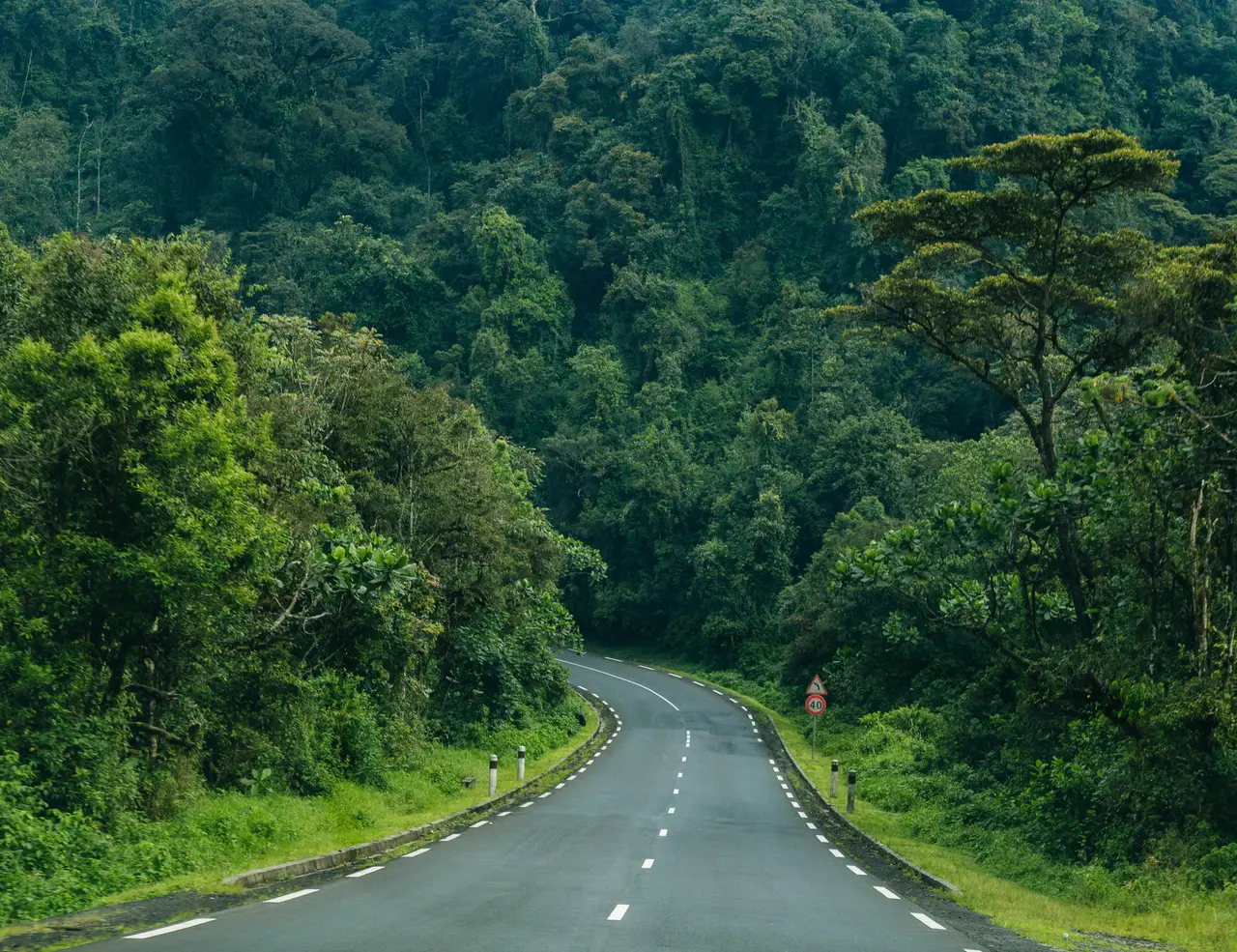
The road through Nyungwe National Park in the southwest is one of the most memorable cycling experiences Rwanda has to offer. A paved route crosses the park from north to south, covering around 60 km (37 mi) through ancient montane rainforest rising to 2,950 m (9,678 ft). The climb through the canopy at altitude is genuinely challenging, and the combination of forest scenery, birdlife, and the physical demand of the gradient creates something that is hard to replicate anywhere else. Temperatures in the park are significantly cooler than in the valleys below, and riders should plan for cold and potentially wet conditions at the upper elevations regardless of the broader seasonal weather pattern.
The park road is the watershed between the Congo and Nile river systems, and on a clear day, cyclists can look east toward the Nile basin and west into the Congo Basin from the same ridge. Nyungwe sees fewer visitors than the Virunga region, and the relative solitude adds to the experience. The road through the park is good quality tarmac, and the combination of its gradient, altitude, and natural surroundings makes it a benchmark climb for any cyclist touring Rwanda. Riders who have done the Kigali to Musanze stage and want an equally demanding but entirely different experience should plan a day or two in the Nyungwe region.
The Eastern Province and Akagera
Cycling Rwanda's eastern province around Akagera National Park is a very different experience from the mountainous west. The terrain is gentler, the climate warmer and drier, and the landscape shifts from densely terraced hillsides to open savannah. Some operators offer guided cycling safaris within sections of the park itself, where it is possible to encounter zebras, giraffes, and a variety of antelope from the saddle. The town of Rwamagana is a regional hub with road cycling routes that form some of the flatter training loops in the country, including the Little Flanders loop, a 122 km (76 mi) circuit covering 1,450 m (4,757 ft) of elevation.
The Tour du Rwanda: Africa's Premier Cycling Race
The Tour du Rwanda is the most important cycle race in Africa and one of the most challenging stage races anywhere in the world relative to its size. First run in 1988 as a regional amateur event, it became a UCI-classified professional race in 2009 and currently holds UCI 2.1 status, the same tier as top-level continental events in Europe. The race takes place every February, covering approximately seven stages across the breadth of Rwanda, with cumulative elevation gains that rival any major European stage race. Stages typically start in or near Kigali and move through Musanze, Rubavu, and the northern Virunga region before returning to finish in the capital.
The characteristic that defines the Tour du Rwanda for both riders and spectators is the mountain stages. The queen stages involve multiple categorized climbs above 2,000 m (6,562 ft), and the final climb to Kinigi at 2,196 m (7,205 ft) is considered the decisive point of the race in most editions. The Kigali to Musanze stage, running 113 km (70 mi) with sustained climbing and three summit finishes in the final 30 km, is regarded by many riders as one of the hardest single stages in world cycling relative to its distance. The combination of altitude, gradient, and the rough surface of some transitional sections creates conditions that expose the limits of any rider.
In 2025, Kigali hosted the UCI Road World Championships for the first time on the African continent, a watershed moment for cycling Rwanda and for the sport on the continent as a whole. The city built a dedicated circuit course for the event, and the championships drew elite riders and global media to a race that showcased Rwanda's roads and landscapes to an international audience. Rwanda's cycling infrastructure, its altitude training facilities, and its competitive domestic race calendar have all benefited from the country's sustained investment in the sport.
For amateur cyclists visiting Rwanda, watching or riding part of the Tour du Rwanda course is a compelling option. The queen stages, typically involving multiple climbs above 2,000 m (6,562 ft) in the Virunga region, can be ridden by any competent cyclist outside of race periods and give a direct sense of what professional riders confront on this brutal terrain. The race atmosphere, with hundreds of thousands of spectators lining the roadsides across the country, offers a window into how deeply cycling Rwanda has embedded itself in national life. Riders who time their visit to coincide with the Tour du Rwanda in February gain access to one of the most authentic and electrifying race atmospheres in international cycling.
Rwanda Cycling Culture: The Bicycle as National Symbol
Rwanda is one of the few countries in the world where cycling is genuinely a mass participation activity at every level of society. Utility cycling is ubiquitous: the bicycle taxi, known locally as a velo taxi, is a primary mode of transport across much of the country, and heavily loaded bikes carrying everything from bananas to construction materials are a constant presence on roads and tracks. Riders pushing steel bicycles weighing 30 kg (66 lbs) up near-vertical slopes at altitude is simply part of the Rwandan landscape, and the skill and strength required to do so regularly without complaint is remarkable to witness.
This culture of functional cycling coexists with an increasingly sophisticated competitive and recreational cycling scene. The Tour du Rwanda has produced riders who have gone on to compete professionally in Europe. The Africa Rising Cycling Center in Musanze has trained dozens of professional riders over nearly two decades and serves as a model for cycling development programs across the African continent. The UCI World Cycling Center has recognized Rwanda as a key hub for African rider development, and training camps in Musanze regularly attract riders from Eritrea, Ethiopia, Cameroon, and elsewhere on the continent, all drawn by the altitude and the quality of the local roads.
The Tugende Bikes cafe, hostel, and workshop in central Kigali serves as a social hub for the cycling community in the capital, where road cyclists, mountain bikers, and touring riders converge. Community rides and social group events increasingly form part of the cycling Rwanda calendar, with a growing middle-class rider base in Kigali seeking recreational cycling experiences beyond the purely competitive framework that has historically dominated the sport here.
Rwanda's cycling scene is also home to the Umunyonzi brand, a locally made collection of cycling apparel and accessories designed in Kigali and sold both domestically and internationally. Representing the country's growing creative economy around the sport, it embodies a wider shift in how cycling Rwanda is understood: not just as a form of transport or competitive training, but as an identity and a lifestyle. For visiting cyclists, being on a bike in Rwanda connects you to this cultural reality in a way that travelling by car simply cannot. People recognize what you are doing, and they know it is hard.
The greeting "yego" from a farmer with a hoe on his shoulder or a school-aged rider overtaking you on a loaded utility bike carries more weight here than almost anywhere else you might ride.
Best Time for Cycling Rwanda
Dry Season: June to September
The long dry season from June to mid-September is the best time for cycling in Rwanda. Days are clear and warm, roads dry quickly after any light showers, and the higher altitude routes into the Virunga region and across Nyungwe are at their most accessible. July and August represent the peak of the dry season and the peak of the tourist calendar. Temperatures in Kigali average around 21 degrees C (70 degrees F) during the day, with the higher altitude areas sitting several degrees cooler, particularly in the early morning. Expect clear views of the volcanoes from Musanze and good surface conditions on the off-road sections of the Congo Nile Trail.
Short Dry Season: December to February
The short dry season between December and early February is the second best window for cycling Rwanda. The roads are drier, visibility is good, and the lower temperatures in the highland areas make the climbing more comfortable. This period sees fewer international visitors than the June to September peak, which translates to quieter roads and a more relaxed atmosphere at popular accommodation. The Tour du Rwanda takes place in February, offering the option to watch or base a trip around the race.
Rainy Seasons: March to May and October to November
The main rainy season runs from March through May, with heavy and persistent rainfall that makes the laterite tracks of the Congo Nile Trail very difficult and significantly increases the erosion on unsealed roads. The shorter rains from October to November are less severe but still bring regular downpours. Road cycling on tarmac routes remains possible during both rainy seasons, and the landscape turns intensely green and lush, which has its own visual rewards. Riders comfortable with wet conditions and willing to adjust expectations on off-road routes can still have a rewarding trip, though the dry season is unambiguously better for cycling.
PLANNING A CYCLING HOLIDAY IN RWANDA ?
Dive into our curated Rwanda cycling adventures today!
Fitness and Preparation for Cycling in Rwanda
Cycling in Rwanda is not easy terrain for any fitness level. Even riders who are in good condition will find the combination of altitude and gradient demanding, particularly in the first few days. The key variable is altitude: Kigali sits at around 1,567 m (5,141 ft), Musanze at around 1,875 m (6,152 ft), and many of the key climbs reach 2,000 m to 2,500 m (6,562 ft to 8,202 ft). At these elevations, aerobic capacity is noticeably reduced compared to sea-level conditions, and climbing efforts that would feel manageable at home require more perceived effort. The Kinigi summit at 2,196 m (7,205 ft) feels considerably harder at altitude than its gradient alone would suggest.
Riders planning multi-day itineraries should build a base of regular hill training beforehand and factor in one or two days in Kigali to acclimatize before starting serious climbing. Day rides around Kigali or flat sections in the eastern province are a sensible way to assess how the altitude is affecting you before heading into the mountains. Staying well hydrated is critical at altitude, and altitude-related headaches in the first 24 to 48 hours are common and normal. Reducing alcohol consumption and avoiding heavy meals in the first day or two at elevation can also accelerate the acclimatization process.
For the Congo Nile Trail specifically, expect a daily average of 40 to 50 km (25 to 31 mi) with 1,000 m to 1,500 m (3,281 ft to 4,921 ft) of elevation per day across the five stages. Riders on organized tours benefit from luggage transfers and a support vehicle, but the climbing itself cannot be avoided. A reasonable level of off-road bike handling is also useful, as sections of the trail involve loose or rutted surfaces where confident descending makes a significant difference. Riders newer to off-road cycling should practice on gravel or dirt tracks before attempting the full trail unsupported.
For road cycling in Rwanda focused on the Musanze and Virunga area, the challenge is pure climbing. The main roads in this region are paved and well-surfaced but are unrelentingly hilly. The Kigali to Musanze stage involves around 1,800 m (5,906 ft) of total elevation gain over 113 km (70 mi). Riders who regularly train on hilly terrain and are comfortable with long sustained climbs will find this achievable, but those whose training has been predominantly flat will struggle. Building specific hill work into preparation for at least six weeks before the trip is the minimum recommendation.
Bikes and Equipment for Cycling in Rwanda
Choosing the Right Bike
The ideal bike for cycling Rwanda depends on the routes you plan to ride. For the Congo Nile Trail, a gravel bike with at least 38 mm tires is the most versatile choice, handling the tarmac sections efficiently while coping comfortably with the dirt and gravel portions. A hardtail mountain bike provides more confidence on the rougher descents and eroded track sections but requires more effort on the paved roads. Full-suspension mountain bikes are overkill for all but the most technical off-road variants of the trail.
For road cycling in Rwanda, particularly on the Tour du Rwanda course roads around Musanze and the main national highways, a standard road bike is perfectly appropriate. The tarmac quality on these routes is genuinely good, and road bikes can also handle the main road through Nyungwe Forest without difficulty. Gearing is an important consideration regardless of bike type: the climbs in the Virunga region are long and steep, and arriving with a lowest gear that allows you to maintain a reasonable cadence on extended 8 to 10 percent gradients at altitude will make a significant difference to your experience. A compact chainset and a wide-range cassette are strongly recommended for any bike being brought to Rwanda for touring or multi-day riding.
Bike Rental and Local Resources
Bike rental is available in both Kigali and Musanze, with quality having improved significantly in recent years. Options range from carbon road bikes suitable for the high-altitude training routes around Kinigi to hardtail mountain bikes configured for the Congo Nile Trail. If bringing your own bike, box it according to airline requirements and check the baggage policy carefully, as fees for oversized bags vary considerably. Spare parts, particularly tires in larger sizes, inner tubes, and quality cables, are worth bringing from home, as availability in smaller towns can be limited.
Food and Water on the Bike in Rwanda
Rwanda's roadside food culture is extremely accessible to cyclists. Small local restaurants, often identifiable by a curtain across the entrance, serve generous plates of rice, red beans, plantain, cassava, and sweet potato that are well-suited to refueling during or after a long ride. Brochettes, grilled meat skewers typically served with roasted potatoes or plantain, are available at most roadside stops and are a reliable source of protein. Rwandan coffee, grown at altitude in the western highlands, is excellent, and ginger tea known locally as chai tangawizi is a warming option in the cooler mountain elevations.
The local banana and sorghum beer, consumed through a shared straw from communal containers at village stalls, is a part of daily life you will encounter on any rural route, and while it is not a recovery drink for serious cyclists, it is worth understanding as part of the cultural landscape you are riding through.
The agricultural landscape you ride through is one of the most productive and intensively worked in Africa. Rwanda's farmers have mastered multi-layer cultivation: banana trees overhead, corn and beans beneath, all planted on carefully terraced slopes that catch and direct rainwater. The variety of crops visible from the road is impressive: cassava, sugar cane, sweet potatoes, tree tomatoes, cabbage, carrots, avocados, mangoes, and papaya all appear in the lowland and mid-altitude zones, while coffee and tea dominate at higher elevations. Riding through this landscape gives a vivid sense of where your food at the local guesthouse actually comes from.
Water is available throughout the country, and bottled water is inexpensive and widely sold. Carrying at least two bottles on the bike is advisable for the longer mountain stages, as the combination of altitude and exertion increases fluid loss faster than most riders expect. Fresh fruit including bananas, mangoes, avocados, and guavas is sold at roadside stalls along most routes and makes an ideal cycling snack.
Rwanda bans plastic bags, making it one of the cleanest countries in Africa and a remarkably pleasant environment to ride through. The ban, in place since the early 2000s, means shopping is done with kraft paper bags, and the roadsides are free of the litter that plagues cycling in many neighboring countries.
Accommodation for Cyclists in Rwanda
Rwanda has a well-developed accommodation infrastructure relative to its size, ranging from basic guesthouses along rural routes to upscale lodges near the national parks. For cyclists riding the Congo Nile Trail, accommodation options are available at each major stage stop, including Rubavu, Kibuye, and Karongi, covering everything from budget guesthouses to comfortable lake-view hotels. Advance booking is advisable during the June to September peak season, particularly near Volcanoes National Park where gorilla trekking drives high demand.
Kigali offers the widest range of options and is well-stocked with hotels that can store bikes securely. Musanze, as the main cycling hub in the northwest, has a range of guesthouses and mid-range hotels that cater to visiting riders and training camps, and is a natural base for anyone planning to ride the Virunga routes or the Tour du Rwanda course roads.
For multi-day tours, staying with local communities along the route provides an immersive experience and directly supports rural livelihoods. Several operators offer community-stay options as part of their Congo Nile Trail packages, combining the practicalities of the route with an authentic insight into Rwandan village life. These stays typically involve a simple but filling dinner, a private or shared room in a family compound, and breakfast before the next stage. The quality is basic but the experience of waking to the Rwandan hillside landscape and setting off from a private home rather than a hotel is genuinely memorable.
Birdlife and Ecology Along Rwanda's Cycling Routes
One of the quieter pleasures of cycling Rwanda is the birdlife encountered along the routes. Rwanda sits within one of the most biodiverse bird zones in Africa, and the variety of species visible from the saddle throughout the day is remarkable. In the highland zones above 2,000 m (6,562 ft), the dawn chorus from the forest edge is genuinely extraordinary, with layer upon layer of calls overlapping in the early morning before the day's heat builds. Egrets and herons are common along the lake shores of Lake Kivu, and raptors circle the thermal currents above the ridgelines with visible patience.
The Nyungwe Forest is recognized as one of the most important birding sites in Africa, with over 300 recorded species in the park alone. Cycling through the forest road puts you inside this ecosystem rather than observing it from a vehicle, and the variety of forest birds audible from the road, combined with the occasional sighting of a colobus monkey group moving through the canopy directly overhead, makes for an immersive natural experience. The park's canopy walkway, accessible from the main road, offers a different perspective on the forest structure that is worth building into a rest day during any cycling itinerary through the southwest.
In the eastern province near Akagera, the bird life transitions to savannah species, with hornbills, kingfishers, and a wide range of wading birds concentrated around the park's chain of lakes. The openness of the landscape here, combined with the early morning light over the water, makes the eastern cycling routes some of the most visually distinctive in the country, offering a complete contrast to the dense green hillsides of the west and north. Riders who extend their cycling Rwanda itinerary to include a morning ride in the Akagera area will find it unlike anything else in the country.
Rwanda's compact size and central location in East Africa make it an ideal component of a broader regional cycling itinerary. The country borders Uganda to the north, Tanzania to the east, Burundi to the south, and the Democratic Republic of Congo to the west, and all four borders offer potential for extending a cycling trip. Combined Uganda and Rwanda itineraries are popular, particularly those linking the cycling around Musanze and the Virungas with mountain biking and wildlife riding in Uganda's western highlands. The Congo Nile Trail ends at Rusizi, which sits at the border with Burundi, offering the possibility of continuing south for riders with the time and logistics to do so.
The East African Tourist Visa, available to citizens of many countries, allows entry into Rwanda, Uganda, and Kenya on a single visa, substantially simplifying logistics for riders planning cross-border itineraries. A combined cycling route taking in Rwanda's hill roads, Uganda's Bwindi forest approaches, and the Kenyan highlands makes for one of the most diverse and physically demanding cycling experiences available anywhere on the continent.
Rwanda's highland altitude makes it an excellent acclimatization base for riders planning to attempt serious high-altitude objectives elsewhere in the region, such as cycling routes around Mount Kenya or in the Ethiopian highlands. A week or two spent riding at 1,500 m to 2,500 m (4,921 ft to 8,202 ft) in Rwanda provides meaningful physiological preparation for higher elevations elsewhere. The combination of good roads, reliable accommodation, and supportive local cycling infrastructure makes it a more practical acclimatization base than some of the higher but less organized alternatives elsewhere in East Africa.
National Parks and Natural Highlights
One of the most compelling aspects of a cycling trip to Rwanda is the proximity of world-class wildlife to the main cycling routes. Volcanoes National Park, home to mountain gorillas, sits directly adjacent to the Musanze cycling hub, and gorilla trekking permits can be arranged to combine with a multi-day riding itinerary. The trekking itself is done on foot, but the combination of cycling the volcanic foothills in the morning and standing a few meters from a silverback gorilla group in the afternoon is an experience that very few other cycling destinations on earth can offer.
Nyungwe Forest National Park, which the main road crosses by bicycle, is home to chimpanzees, L'Hoest's monkeys, colobus monkeys, and over 300 bird species. The forest canopy visible from the saddle while climbing the park road is one of the most intact old-growth rainforests in East Africa. Akagera National Park in the east hosts the classic safari wildlife of the savannah, including lions, elephants, zebras, and hippos, and some operators run guided cycling safaris on designated tracks within the park boundaries.
Getting to Rwanda and Practical Cycling Information
Arrival and Transfers
Kigali International Airport connects Rwanda to major hubs including Amsterdam, Brussels, Nairobi, Addis Ababa, Dubai, and London. RwandAir operates international routes and has a good network of connections to other African cities. The airport is located approximately 10 km (6 mi) from the city center, with taxi services and arranged transfers readily available. Cyclists arriving with boxed bikes can typically arrange transfer to accommodation without difficulty.
Visas and Entry
Rwanda operates a straightforward visa system. Citizens of many countries can obtain a visa on arrival or an e-visa online before travel. An East African Tourist Visa is available for travelers combining Rwanda with Uganda and Kenya, allowing movement between all three countries on a single visa. Check the current requirements for your nationality before departure, as policies can change.
Safety and Road Conditions
Rwanda has a strong reputation for safety by regional standards, and cycling on the main roads is generally comfortable. Traffic volumes are lower than most other African capitals outside Kigali, and drivers are accustomed to sharing roads with cyclists. The country's comprehensive road infrastructure investment has improved surface quality on the main national routes significantly over the past decade. Riding after dark is not recommended on unfamiliar roads, and independent riders venturing onto remote tracks should inform accommodation or a contact of their planned route.
Rwanda has a monthly community work day known as Umuganda, held on the last Saturday of each month, during which roads are typically very quiet as most people participate in local cleaning and maintenance activities. Riding on Umuganda morning, while in principle permitted, means navigating groups of people working on roadsides and paths, and is better avoided for the first half of the day. On all other days, cyclists on the main national roads can expect relatively light and predictable traffic with drivers who are generally courteous.
Health and Vaccination
Malaria is present in Rwanda, particularly at lower altitudes and in the warmer east. Anti-malarial prophylaxis is strongly recommended for most travel, and a mosquito net and repellent are standard precautions. Yellow fever vaccination is required for entry. Other recommended vaccinations include hepatitis A, typhoid, and tetanus. Altitude considerations apply for riders moving into the higher zones above 2,000 m (6,562 ft), where acclimatization and adequate hydration are important.
Currency and Costs
The Rwandan franc (RWF) is the local currency. Credit cards are accepted in Kigali and at larger hotels and lodges, but cash is essential for roadside food, local guesthouses, and small towns along cycling routes. ATMs are available in Kigali and larger towns. Rwanda is not a budget destination by African standards, particularly around the national parks where gorilla trekking permits alone run to several hundred US dollars, but daily cycling costs, food, and basic accommodation remain reasonable.
Language
Rwanda has four official languages: Kinyarwanda, English, French, and Swahili. Kinyarwanda is the national language spoken by virtually the entire population and the language you will hear most frequently on the road. English is widely spoken in Kigali, in tourism, and among the educated professional class, and has been the primary language of instruction in schools since 2008. French remains present in some parts of the country, particularly among older generations, and is useful in more rural areas where English is less common. A few words of Kinyarwanda go a long way with locals encountered on cycling routes: the word yego means yes and functions as a general affirmative greeting, and muraho is the standard hello. Amakuru is the common phrase for how are you, to which the expected reply is ni meza, meaning fine or good. Cyclists who make the effort to use even basic Kinyarwanda on the road are consistently met with warmth and appreciation.
Connectivity
Mobile coverage in Rwanda is good by regional standards. The main networks, MTN Rwanda and Airtel Rwanda, cover the majority of the country including most of the cycling routes in the west and north. Coverage becomes more patchy in the remote sections of the Congo Nile Trail and in the deep valleys between ridgelines, but in general you can expect a usable signal on the main tarmac roads and in all towns. Buying a local SIM card on arrival at Kigali airport is straightforward, inexpensive, and highly recommended for navigation and emergency communication on longer routes. Data is cheap by international standards and widely available. Wi-Fi is available at most mid-range and upper accommodation options in Kigali and Musanze, and increasingly in guesthouses along the main touring routes.
Time Zone
Rwanda operates on Central Africa Time (CAT), which is UTC+2 year-round with no daylight saving adjustment. Sunrise is consistently between 5:30 and 6:00 AM throughout the year, and sunset falls between 6:00 and 6:30 PM, giving riders a reliable and predictable window of daylight. This consistency is one of the practical advantages of cycling near the equator: you can plan daily stages with confidence that you have roughly 12 hours of usable light regardless of the time of year. Starting early is recommended both to avoid the midday heat at lower elevations and to maximize time on the road before afternoon cloud builds in the mountain regions.
Read, Watch, Listen, and Experience
Read
We Wish to Inform You That Tomorrow We Will Be Killed With Our Families by Philip Gourevitch is the essential starting point for understanding Rwanda’s recent history. Published in 1998, it is a detailed and unflinching account of the 1994 genocide and its aftermath, told through interviews and on-the-ground reporting. It is not cycling reading, but any visitor to Rwanda who arrives without some understanding of the country’s history will miss an important dimension of what they encounter on the road. Left to Tell by Immaculee Ilibagiza is a survivor’s memoir that provides a personal account of the same period and is widely available internationally. For a more contemporary perspective on Rwanda’s transformation, The Remarkable Ruru by various Rwandan authors and essays published through the Kigali-based literary community offer insight into a country that has changed faster in thirty years than almost any other on earth.
Watch
Rising from Ashes (2012) is the documentary that introduced many international viewers to the story of Team Rwanda, following the creation of the national cycling team in the years after the genocide and the riders who came to represent the country on the world stage. It remains one of the most compelling cycling documentaries ever made and provides essential context for anyone visiting Rwanda with an interest in cycling. The film follows Adrien Niyonshuti and other early Team Rwanda riders under the guidance of Jonathan Boyer, and it captures the transformation of cycling from utility transport to national pride with genuine emotional force. The Tour du Rwanda itself is covered annually by international media, and recent editions are available online and offer a vivid visual introduction to the roads and landscapes you will encounter.
Eat and Drink
Rwanda’s specialty coffee is among the best on the African continent, and sampling it properly means going beyond the instant coffee served at roadside stops. Rwanda’s high-altitude growing regions, particularly in the west near Nyungwe, produce washed Arabica beans with a clean, bright acidity and distinctive fruit notes. Specialty coffee shops in Kigali roast and serve these beans to a high standard and are worth visiting before setting out on a cycling itinerary. Urwagwa, the traditional banana beer fermented from ripe bananas with sorghum flour, is a local staple with deep cultural roots and is encountered in its communal form at village stalls throughout the country. Inyenzi, the Rwandan term for the small dried lake fish often served alongside rice and beans, is a cycling-friendly protein that appears in local restaurants along the Congo Nile Trail and lake shore routes. For something more structured, Kigali’s restaurant scene has grown considerably in recent years and includes a range of options covering Rwandan cuisine, East African staples, and international food suited to pre or post-ride meals.
Experiences Worth Planning Around
The Tour du Rwanda in February is the single most compelling event on the Rwanda cycling calendar. Watching a stage finish in Kigali or lining the road in Musanze during the mountain stages offers an atmosphere that is unlike most professional cycling events in the world: dense crowds, intense noise, and a level of passion from spectators who ride these same roads every day. The Kigali Genocide Memorial is a profoundly important site that takes approximately two hours to visit and should be considered essential context for any extended trip to Rwanda. The gorilla trekking permits in Volcanoes National Park require advance booking, often months ahead for popular dates, and should be arranged before arrival if you plan to combine cycling with a trek. Umuganda, the monthly community work morning, is worth witnessing if timing allows: the sight of an entire city pausing its activity for collective civic work is a genuine expression of Rwanda’s social values and unlike anything you will encounter elsewhere.
READY TO CYCLE RWANDA ?
Get started with your cycling adventure now!
Plan Your Cycling Trip to Rwanda with Art of Bicycle Trips
Art of Bicycle Trips has been curating cycling experiences across the world's most compelling destinations for over a decade, and Rwanda sits firmly in the category of destinations that deserve wider attention from serious cyclists. The terrain is challenging in the most rewarding sense, the cycling culture is authentic and deeply embedded in daily life at every level, and the combination of mountain roads, lake trails, national park scenery, and genuine wildlife encounters makes for an itinerary that covers extraordinary ground in a small physical space.
Rwanda rewards preparation. Riders who arrive having done their research, who understand the altitude challenge, who have brought appropriate gearing, and who have left room in the schedule for a day of acclimatization in Kigali will have a considerably better experience than those who underestimate what the terrain asks of them. The hills are real, the elevation is real, and the effort required is real. But so are the rewards: the views from the high passes above Musanze, the descent to Lake Kivu through green agricultural terraces, the forest silence on the Nyungwe road, and the warmth of local communities who meet visiting cyclists with a level of recognition and respect that is hard to find anywhere else in the world.
Whether you are looking to ride the Congo Nile Trail over five days, tackle the climbing circuits around Musanze that form the backbone of the Tour du Rwanda, combine a cycling Rwanda itinerary with gorilla trekking in Volcanoes National Park, or design a multi-week East African adventure that uses Rwanda as a base and extends into Uganda and beyond, we can help build a trip that fits your fitness level, timeline, and travel ambitions. Rwanda is not yet as well known on the international cycling circuit as it deserves to be. That is changing rapidly, and riders who discover it now will find roads, routes, and a welcome that are hard to match anywhere on the continent. Get in touch with Art of Bicycle Trips to start planning your Rwanda cycling adventure.
Plan Your Active Adventure
Create a private trip or join a small-group departure.
