
Table of Contents
- 1. Overview
- 2. Terrain and Landscape
- 3. Cycling Infrastructure and Racing Culture
- 4. Climate and the Best Time to Ride
- 5. Wildlife and Natural Landscapes Along Belgium Cycling Routes
- 6. Economy, Brewing Heritage, and Regional Identity
- 7. Why Go Cycling Belgium?
- 8. Best Regions for Cycling in Belgium
- 9. Top Routes for Cycling Belgium
- 10. Month by Month: When to Cycling Belgium
- 11. What to Eat While Cycling Belgium
- 12. Racing History and the Flandrien Identity
- 13. Practical Information for Cyclists
- 14. Through the Notes
- 15. Plan Your Belgium Cycling Journey with Art of Bicycle Trips
Overview
Belgium is one of Europe's most layered cycling destinations: a country that holds cobbled Classics climbs, First World War battlefields, medieval canal cities, and deep Ardennes forest within a territory smaller than most American states. The contrast between its two main cycling worlds, the flat, race-saturated roads of Flanders in the north and the forested river valleys of Wallonia in the south, gives riders of different abilities and interests a genuinely distinct experience within a single country.
Cycling in Belgium is not one experience but several, layered into a country whose two main regions could hardly feel more different. In the north, Flanders is broad, flat, and canal-crossed: the land of cobblestones, spring classics, and a cycling culture so embedded in daily life that team kit outnumbers soccer shirts on weekend roads.
In the south, Wallonia rises into forest and river valley, the Ardennes offering sustained climbs through beech and pine country that belongs to a different world entirely. Between these two realities sits the haunted landscape of the Ypres Salient, where the flat fields of West Flanders hold the remains of one of history's most catastrophic conflicts, and where cycling past row upon row of white headstones gives the sport a gravity few other destinations can match.
This guide is for riders who want to understand Belgium beyond its most famous roads. The cobbled bergs of the Flemish Ardennes are extraordinary and deserve their reputation. But the forests of the High Fens, the river valleys of the Ourthe and the Meuse, the hop fields of Poperinge, and the quiet lanes of the Condroz are equally compelling and considerably less crowded. Belgium rewards riders who stay long enough to move between its worlds.
DREAMING OF CYCLING IN BELGIUM ?
Explore our amazing bike tours in Belgium now!
Terrain and Landscape
Belgium sits at the geographic and cultural crossroads of Western Europe: bordered by France to the south and west, Germany and Luxembourg to the east, the Netherlands to the north, and facing the North Sea at its narrow northwestern coastline. It covers approximately 30,500 square kilometers, an area that a committed cyclist could theoretically cross in two days, though no rider with any sense of place would rush.
The country is formally divided into three regions: Flanders in the north (Dutch-speaking), Wallonia in the south (French-speaking), and the Brussels-Capital Region in the center (officially bilingual). A small German-speaking community occupies the eastern cantons near the German border. This linguistic complexity is not merely administrative. It reflects a genuine cultural divergence between the Flemish and Walloon identities that shapes everything from architecture to food to the way cycling is celebrated. In Flanders, cycling is heritage. In Wallonia, it is exploration. The visiting rider benefits from both.
Belgium's defining philosophical contribution to cycling culture is the concept of the Flandrien: the rider who endures. Not the strongest, not the most aerodynamically gifted, but the one who keeps turning the pedals on the cobbles in driving rain and crosswind until everyone else has cracked. This ideal pervades the country's relationship with the sport. Cycling here has always been about character as much as speed, and it is this quality, more than any specific route, that gives riding in Belgium its particular atmosphere.
Flanders: The Flat Country and Its Hidden Climbs
The Flemish plain stretches from the coast inland with remarkable consistency: wide agricultural land interrupted by canals, windmills, and the occasional modest hill. The Flemish Ardennes, a belt of short, sharp climbs between Ghent and Oudenaarde, represent the most dramatic topographic event in northern Belgium, and even here the highest point barely exceeds 150 m (492 ft). What the terrain lacks in elevation it compensates in character: every road in this region carries weight. The famous bergs, including Koppenberg, Paterberg, Oude Kwaremont, and Warre, have been ridden by every generation of cyclists since the first professional races rolled through a century ago. The cobbles on these climbs have not been maintained for the comfort of those who ride them.
The West Flanders coast adds a third dimension to the Flemish riding landscape: 67 kms (42 mi) of flat, sandy coastline from De Panne in the southwest to Knokke-Heist in the northeast, backed by dunes and accessible on a continuous coastal cycle path. This is leisure cycling at its most straightforward, with wind and sea to one side and the occasional ice cream stop on the other.
Wallonia: Forests, River Valleys, and the Ardennes Massif
Cross the invisible language border south of Brussels and the landscape transforms immediately. Wallonia is Belgium's larger, wilder, less-visited half. The Ardennes, a broad plateau of forested upland occupying the southeast, rise gradually from the Condroz (a transitional zone of rolling farmland between the Meuse Valley and the high forest) to the High Fens (Hautes Fagnes) in the east, where the Signal de Botrange at 694 m (2,277 ft) represents Belgium's highest point. The terrain here is serious cycling country: river valleys cut deep into the plateau, creating climbs of 5 to 15 kms (3 to 9 mi) on roads that see little traffic except on summer weekends.
The Meuse River bisects Wallonia from northeast to southwest, creating a flat corridor between the hills that makes for accessible riding between the dramatically sited riverside cities of Namur, Dinant, and Liege. The Ourthe, Lesse, Ambleve, and Semois rivers drain the Ardennes plateau, each carving its own valley character. The Ourthe is wide and forested; the Semois is serpentine and deeply wooded on the French border. Riding along these river valleys and then climbing out onto the plateau is the essential Ardennes cycling experience.
Ypres and the Salient: Cycling Through Flanders Fields
The area around Ypres (Ieper) in West Flanders occupies a distinct category. The terrain is flat, part of the same Flemish plain that extends to the coast, but the landscape carries a weight that distinguishes it entirely from the rest of Belgium. Between 1914 and 1918, this relatively small area of Belgian countryside absorbed some of the most devastating fighting in human history. The German front line encircled Ypres in a salient, and the territory between the city and the surrounding ridges was contested with extraordinary violence. Tyne Cot Cemetery at Passchendaele, the largest Commonwealth war cemetery in the world, holds nearly 12,000 graves and sits on terrain that was fought over for months in 1917 for gains measured in hundreds of meters.
Riding through the Salient today is riding through a landscape that has been restored from total destruction. The fields are green again. The farms are rebuilt. But the cemeteries come every few kilometers, the headstones white against the grass, and the names of the missing are carved into memorials at a scale that demands time to absorb. This is not cycling as escape from history. It is cycling as encounter with it.
Cycling Infrastructure and Racing Culture
Belgium has one of the most sophisticated cycling networks in the world, and the system is best understood in regional terms, because Flanders and Wallonia have developed their infrastructure differently, each in keeping with the character of the terrain.
Flanders uses the knooppunten system: a numbered node network covering the entire region with over 2,000 junction points connected by marked cycle routes. Riders plan their own routes by stringing together node numbers, and the network has been so well maintained and promoted that it is genuinely possible to navigate rural Flanders by bicycle with nothing more than a list of numbers and a regional map. The node signs are consistent, reliable, and frequent. Dedicated cycle highways (fietssnelwegen) have been developed between major cities. The concept originated in Flanders and has since been exported across Europe. At peak hours on a sunny weekend, the cycle highway between Ghent and Kortrijk moves more cyclists than cars.
Wallonia's network is centered on the RAVeL system, short for Reseau Autonome de Voies Lentes (Autonomous Slow Routes Network): a vast web of converted railway lines, towpaths, and canal paths that offer traffic-free cycling across the region. Over 1,500 kms (932 mi) of RAVeL routes exist in Wallonia, providing access to river valleys, forest corridors, and historic routes that would otherwise require sharing narrow roads with traffic. The RAVeL along the Meuse and Ourthe rivers rank among the finest flat cycling routes in the Benelux.
SNCB/NMBS (Belgian Railways) accepts bicycles on most regional trains, and the country's small size means combining a train with a cycling day is straightforward. The Blue-bike bicycle rental network operates at most train stations, providing convenient on-demand bikes for shorter excursions.
The Spring Classics, including the Tour of Flanders (Ronde van Vlaanderen), Paris-Roubaix, Gent-Wevelgem, and Liege-Bastogne-Liege, shape cycling culture in ways that go beyond race watching. These events make Belgian cycling feel like a living thing, not a historical artifact. Local clubs ride the same roads on weekend mornings. Cafes on the approach to famous climbs stock energy bars and serve strong coffee. The sport has a constituency here in a way that few other countries can claim.
Climate and the Best Time to Ride
Belgium's climate is maritime temperate: mild, moist, and highly variable. Annual rainfall is distributed fairly evenly across the year, and the country sees relatively few uninterrupted sunny periods. The experienced rider learns to accept this and carry appropriate kit. What Belgium's climate offers in return is a long, viable riding season, because temperatures rarely reach extremes in either direction.
Prime Window: May Through September
The window from May through September covers Belgium's most reliable cycling conditions. Temperatures in Flanders average 15 to 22 degrees C (59 to 72 degrees F) through this period. In the Ardennes, elevations above 400 m (1,312 ft) keep temperatures 2 to 4 degrees C (4 to 7 degrees F) cooler, which is a welcome contrast in July and August. Daylight extends to around 17 hours in June, allowing long days in the saddle. May and June offer the greenest landscapes. The beech forests of the Ardennes are at their most vivid, and late September brings autumn color to the same forests, particularly the larches in the High Fens, which turn gold through mid-October. Spring (April through May) aligns with the professional Classics season, creating a festival atmosphere along the roads of Flanders.
Spring Riding: April and May
Spring cycling in Belgium is atmospheric. The Classics calendar runs from late February through mid-April, and even after the professional races have passed, their energy lingers on the roads. The bergs of the Flemish Ardennes are at their most evocative in April: the fields still bare, the cobbles slick after rain, and the cafes warm with riders who have just come off Koppenberg or Oude Kwaremont. May brings warmer conditions, blooming hedgerows, and the full reopening of the cycling cafe culture. Carry a windproof and accept that rain is possible on any day. The upside is emptier roads and a more local atmosphere.
Summer Cycling: June Through August
June and early July offer Belgium's finest cycling weather: long days, warm afternoons, and the countryside at its fullest green. July and August bring the warmest conditions, typically 20 to 26 degrees C (68 to 79 degrees F), and the coastal route in particular becomes very busy with Belgian and Dutch summer tourists. The Ardennes is at its most pleasant in summer: the forests offer shade, the climbs are challenging without being oppressive in heat, and the swimming spots in the Ourthe and Lesse provide natural rest-day options. Book accommodation well in advance for July.
Autumn in the Ardennes: September and October
September is arguably Belgium's finest cycling month. The summer crowds have thinned, temperatures have moderated to 14 to 18 degrees C (57 to 64 degrees F), and the Ardennes forests begin their transformation. The larches of the High Fens, rare at this latitude, start to turn golden in the second week of October. Cycling the Vennbahn route through the High Fens in mid-October, with the larch color at its peak and mist in the valley, is one of Belgium's great seasonal cycling experiences. The Ardennes country looks its most dramatic in autumn, and the quieter roads make this an excellent time to explore at your own pace.
Off Season: November Through March
Winter cycling in Belgium requires commitment. Rain is more persistent from November, and temperatures drop to 3 to 8 degrees C (37 to 46 degrees F) in Flanders and below freezing in the Ardennes. Snow is uncommon on the plain but regular in the High Fens from December through February. The omloop season, the early Belgian Classics, begins in late February and provides motivation for those who want to train on the Flemish bergs in conditions that approximate race day. For most international visitors, the practical touring season runs April through October.
Wildlife and Natural Landscapes Along Belgium Cycling Routes
Belgium's ecological diversity reflects its topographic range. The coastal dunes and polders of Flanders, the agricultural heartland, the river valleys of Wallonia, and the boreal plateau of the High Fens each support distinct plant and animal communities.
The coastal dunes between De Panne and Knokke-Heist are among the most species-rich dune systems in northwest Europe. Marram grass, sea holly, and sand-binding mosses anchor the mobile dunes, while behind them, dune slacks hold rare orchids and amphibians. The Zwin Nature Reserve at Knokke marks the Belgian-Dutch border and hosts significant populations of migratory and breeding waders. Avocets, spoonbills, and black-tailed godwits can be seen from the cycle path in spring and summer.
The Flemish agricultural heartland is hop country. The Westhoek around Poperinge grows some of Europe's finest hops, and the climbing bines on their tall wooden frames are one of the region's most distinctive agricultural spectacles from June through September. Cycling through this hop landscape, with the Ypres spires visible on the horizon, is an experience unique to this corner of Belgium.
The Ardennes plateau hosts the most complex ecology in Belgium. The beech-dominated forests transition at higher altitude to the blanket bog and heath of the High Fens, a remarkable sub-alpine landscape with cloudberry, dwarf birch, and black grouse. The forests shelter red deer, wild boar, and roe deer, which are visible in the early morning at forest edges throughout the Ardennes. The river valleys support kingfishers, grey herons, otters, and the occasional beaver, reintroduced to the Ourthe in the 1990s. In spring, the forest floor through the Ardennes is carpeted with wild garlic (ransons) before the beech canopy closes overhead. The scent is detectable from the saddle on warm mornings.
Wildflowers along the cycle routes follow the agricultural calendar: cowslips and hawthorn blossom in May, red poppies in the grain fields of Flanders in June (an image loaded with historical resonance in this landscape), and the heather of the High Fens blooming purple in August. The Commonwealth memorial cemeteries along the Ypres routes are maintained by the Commonwealth War Graves Commission to extraordinarily high horticultural standards. The rose plantings and lawn margins at Tyne Cot are among the most carefully tended open spaces in Belgium.
Economy, Brewing Heritage, and Regional Identity
Belgium punches well above its weight economically. It is one of the founding members of the European Union, hosts the EU institutions in Brussels, and has a highly developed industrial base rooted in the Walloon steel and coal tradition, now largely restructured into service and technology sectors. For the visiting cyclist, this economic sophistication is felt in the quality of infrastructure, accommodation, and food across the country.
Flanders has developed into one of the most prosperous regions in Europe. Its economy is built on port logistics (the Port of Antwerp is the second largest in Europe), chemicals, food processing, and a strong diamond trade centered on Antwerp. The prosperity shows in the quality of the cycling infrastructure: the knooppunten network is maintained to a standard that would be impossible in less wealthy regions. The Flemish identity is strongly tied to the land and to cycling. The cultural pride in being the home of the Tour of Flanders is genuine and pervasive.
Wallonia's economic history is a different story. The coal and steel industries that powered Belgian industrialization for 150 years have been in decline since the 1970s, and the region has undergone a painful but largely successful transition. What remains is an economy rooted in agriculture, forestry, tourism, and a growing technology sector. For the cyclist, this means quieter roads, lower prices, and a genuine authenticity in small-town cafe culture that has not yet been overlaid by heavy tourism.
Belgium's brewing tradition deserves its own paragraph. The country produces over 1,500 different beers from approximately 350 breweries, the highest density of distinct beer styles per capita in the world. Six certified Trappist monasteries produce beer in Belgium: Chimay, Orval, Rochefort, Westmalle, Westvleteren, and Achel. The Ardennes cycling route through Wallonia passes within reach of several of these monasteries, and a stop at the cafe outside the Orval Abbey, where a golden tripel is served alongside the monastery's pressed cheese, is one of the defining experiences of cycling in this region. The abbey itself, with its 12th-century ruins reflected in a still lake, is among the most beautiful religious buildings in the Benelux.
Why Go Cycling Belgium?
The Cobbled Bergs of the Flemish Ardennes
The cobbled climbs of the Flemish Ardennes are, quite simply, unlike anywhere else in the world. The bergs (Dutch for mountains, which is an aspirational term for what are essentially short, sharp hills rising 50 to 100 m / 164 to 328 ft) are defined not by their height but by the quality of their suffering. The Koppenberg (600 m / 0.4 mi at 11.6% average, with sections above 20%) is a wall of setts designed to reduce the most committed cyclist to walking pace. The Paterberg (360 m / 0.2 mi at 12.9% average) is compact and brutal. The Oude Kwaremont (2.2 kms / 1.4 mi of alternating cobble and asphalt at 4% average) demands constant bike-handling focus even at moderate pace. The Tour of Flanders Museum in Oudenaarde provides context and motivation before any ride in the region, and the three color-coded sportive loops from Oudenaarde allow riders to assemble their own Ronde experience at whatever distance suits their form.
The WW1 Peace Route Through Flanders Fields
No cycling experience in Belgium carries the emotional weight of riding through the former battlefields of the Ypres Salient. The Peace Route from Ypres is a 45 kms (28 mi) loop that visits the major First World War sites on a circuit accessible to all fitness levels. The terrain is flat, but the stops are many and substantial. From the Cloth Hall on the Grote Markt, where the In Flanders Fields Museum provides the best single overview of the Great War in this region, riders follow the canal path north to Essex Farm Cemetery, where Canadian doctor John McCrae wrote the poem that gave the poppy its association with remembrance. The route continues through Langemark to Tyne Cot Cemetery before returning south through Zonnebeke, where the Passchendaele 1917 Museum reconstructs the trenches and dugouts of the Third Battle of Ypres. Each evening at 20:00, beneath the Menin Gate, volunteers of the Ypres fire brigade sound the Last Post, a ceremony that has taken place every evening since 1928, interrupted only by the Second World War. Attending it after a day on the Peace Route is an experience that stays with riders for years.
Forest Roads and River Valleys in the Ardennes
The Belgian Ardennes offer a style of cycling that stands in complete contrast to Flanders: sustained climbing, forest solitude, and a landscape that rewards the rider willing to earn their views. The Vennbahn, a converted railway line running 125 kms (78 mi) through the High Fens from Aachen to Luxembourg, was named European Cycling Route of the Year in 2014 and provides an accessible entry point into the Ardennes on flat-to-rolling converted track. For riders who want the full climbing experience, the roads between La Roche-en-Ardenne, Houffalize, Durbuy, and the Ourthe Valley offer a network of long, quiet ascents, typically 5 to 10 kms (3 to 6 mi) at 4 to 8% on smooth asphalt, through forests that in autumn turn into one of the great color spectacles of northern Europe. The Trappist monastery towns of Orval, Rochefort, and Chimay are all reachable by bike from the main Ardennes route network.
Canal Touring Between Bruges, Ghent, and Antwerp
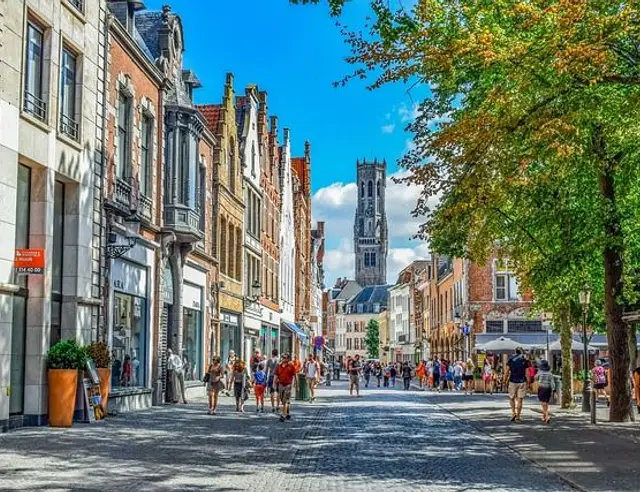
The cycling network between Bruges, Ghent, and Antwerp represents Belgium's most accessible multi-day touring experience. Canal paths, converted towpaths, and dedicated cycle highways connect three of Europe's great medieval cities across a landscape of polders, windmills, hop fields, and roadside friteries. Bruges, the best-preserved medieval city in northern Europe, with its concentric canal system and Gothic skyline, is the natural starting point. Ghent, with its Gravensteen castle and the painters' villages of the Leie valley, offers a second city's worth of cultural weight. The polders north of Bruges, flooded during the First World War to halt the German advance, are now a labyrinth of tiny canals, cycle paths, and bird reserves accessible on the Bruges-Coast loop. Daily distances of 30 to 60 kms (19 to 37 mi) connect these cities at a pace that allows proper exploration of each.
Wallonia's RAVeL Network: Where the Terrain Changes
The Meuse Valley RAVeL from Namur to Dinant is one of Belgium's great cycling corridors: flat, traffic-free, and lined with some of the most dramatic river scenery in the Benelux. The Citadel of Namur rises above the confluence of the Meuse and Sambre. Dinant's Gothic collegiate church and the cliff-face citadel above the river are among the most photographed views in Belgium. The Leffe Abbey brewery sits in the valley immediately south of Dinant, and the beer brewed here has been poured since 1152. Branching off the Meuse RAVeL, the Ourthe Valley route south toward La Roche-en-Ardenne is where the terrain begins to climb seriously. The flat river path becomes rolling, then hilly, as the Ardennes plateau asserts itself. This transition from river flat to forest hill over 50 to 80 kms (31 to 50 mi) makes the Wallonia RAVeL network exceptional for riders who want to build difficulty into their tours gradually.
PLANNING A CYCLING HOLIDAY IN BELGIUM ?
Dive into our curated Belgium cycling adventures today!
Best Regions for Cycling in Belgium
The Flemish Ardennes: Oudenaarde and the Berg Circuit
The spiritual home of Flemish cycling. The area around Oudenaarde, Ronse, and Geraardsbergen contains the highest concentration of famous cobbled climbs in Belgium, and the road network between them is well-suited to circuit riding. Base yourself in Oudenaarde, which also contains the Tour of Flanders Museum (Centrum Ronde van Vlaanderen), and use the three color-coded routes as a framework. The Blue Route (71 kms / 44 mi) covers the southern bergs; the Yellow (143 kms / 89 mi) adds the Warre and Taaienberg; the Red (232 kms / 144 mi) approximates the full professional race route. The Geraardsbergen Muur is a chapel-topped climb at 19 to 21% that has appeared in the race repeatedly and remains one of the most atmospheric bergs in Flanders. Suitable for strong and experienced riders; the surface demands careful bike handling.
Ypres and the Westhoek: The Great War Cycling Trails
The Westhoek around Ypres is not demanding cycling. The terrain is flat and the distances manageable. What makes it exceptional is its density of historical significance. Ten dedicated First World War cycling trails have been mapped in the region, covering everything from the Peace Route (45 kms / 28 mi, all major WW1 sites) to the Legacy Route (exploring the Passchendaele battlefield) and the Hops Trail (cycling through the hop fields of Poperinge toward the French memorial at Kemmelberg). Ypres itself, with the In Flanders Fields Museum, the Menin Gate, and the medieval Cloth Hall, deserves at least a day before or after the cycling. Poperinge, 12 kms (7 mi) west, is a hop-farming town with a strong cafe culture and several good brasseries. Suitable for all fitness levels.
Bruges and the Coastal Polders
The triangle between Bruges, the coast, and the Dutch border offers the most accessible multi-day touring in Belgium. The knooppunten network is dense and well-maintained; the terrain is almost entirely flat; and the cultural stops, including Bruges itself, Damme, the Zwin Nature Reserve, and the Belle Epoque seaside resort of Knokke-Heist, are exceptional. The 67 kms (42 mi) coastal cycle path from De Panne to Knokke runs alongside the sea for its entire length, past dunes, beach cafes, and the occasional concrete World War Two bunker still embedded in the dune landscape. The Flemish coast is best ridden outside July and August when the beach towns are at capacity. Suitable for all fitness levels, including families.
Ghent and the Painters' Villages of the Leie
Ghent, Belgium's most underrated city, is an ideal cycling base. The medieval center, with its Gravensteen castle, the Cathedral of St. Bavo (which houses Van Eyck's Adoration of the Mystic Lamb), and the Graslei and Korenlei canal quays, rewards a rest day's walking after cycling. The painters' villages of Sint-Martens-Latem and Deurle, 10 kms (6 mi) south along the Leie river, inspired a generation of Belgian expressionists and offer a cycling experience of meadow, willow, and winding water. The knooppunten network connects Ghent north to Bruges (approximately 50 kms / 31 mi on well-surfaced paths) and south through the Flemish Ardennes. Suitable for most fitness levels; some cobble sections on the approach to the Ardennes.
Namur, Dinant, and the Meuse Corridor
The Meuse corridor from Namur to Dinant is Wallonia's most accessible cycling route and the gateway to the Ardennes. The RAVeL along the river is flat, traffic-free, and approximately 25 kms (16 mi) between the two cities. Namur, set at the confluence of Meuse and Sambre, has a citadel and old town worth exploring. Dinant, 25 kms (16 mi) south, is one of the most dramatically sited towns in Belgium: Gothic church, sheer cliff face, riverside citadel. The Leffe Abbey brewery is in the Dinant valley. From Dinant, roads climb into the Ardennes proper. The Ourthe Valley route toward La Roche-en-Ardenne (50 kms / 31 mi, with significant elevation) is the natural continuation for riders wanting to extend into the forest. Suitable for all fitness levels on the RAVeL; moderate to sporty for the Ardennes extension.
La Roche-en-Ardenne and the Deep Forest Rides
La Roche-en-Ardenne, a small town of 4,500 people in a dramatic meander of the Ourthe, is the hub of Ardennes cycling. The castle ruins above the town, the river beach below, and the roads radiating in every direction through dense beech and oak forest define the experience. Houffalize (30 kms / 19 mi southeast, with significant climbing) and the Barrage de l'Eau d'Heure reservoir system (accessible via Ciney) extend the network. The Ardennes Grand Tour sportive route (approximately 620 kms / 385 mi, linking the major towns and climbs of the region) provides a framework for multi-day itineraries. Wild boar and red deer are genuine wildlife encounters on early morning rides, and the local restaurants serve venison, wild boar pate, and smoked Ardennes ham. Suitable for intermediate to experienced riders; significant daily elevation.
The High Fens and the Vennbahn Corridor
The Vennbahn corridor in eastern Belgium, running from Aachen through the High Fens to Luxembourg on a converted railway line, provides the most distinctive and least-visited cycling experience in Belgium. The terrain here is genuinely sub-alpine: open heath, blanket bog, and the transition into larch and spruce forest as the route descends from the plateau. The Signal de Botrange (694 m / 2,277 ft) is Belgium's highest point, accessible from the Vennbahn route via a short detour. The German-speaking cantons give the towns and signage a cultural character found nowhere else in Belgium. The route passes through Eupen, Malmedy, and St. Vith, towns that changed nationality multiple times in the 20th century and carry that history in their architecture. Suitable for most fitness levels on the Vennbahn itself; more demanding on roads climbing to the plateau.
Top Routes for Cycling Belgium
1. The Peace Route: Ypres Salient WW1 Circuit
Distance: 45 kms (28 mi) | Terrain: Flat | Duration: 1 day | Difficulty: Easy
Starting and finishing at the In Flanders Fields Museum on Ypres' Grote Markt, the Peace Route visits the essential sites of the First World War Salient in a single manageable day. Key stops include Essex Farm Cemetery (where John McCrae wrote his poem in 1915), Langemark German Cemetery, Tyne Cot Cemetery (nearly 12,000 graves, the wall inscribed with 35,000 names of the missing), the Passchendaele 1917 Museum at Zonnebeke, and the Sanctuary Wood preserved trenches at Hill 62. The terrain is flat throughout. The emotional and historical weight is considerable: plan stops of 30 to 60 minutes at each major site. End the day with the 20:00 Last Post ceremony under the Menin Gate, where buglers have sounded the tribute every evening since 1928. The route is signed throughout; maps and guides are available from the Ypres Tourist Office.
2. The Classic Routes from Oudenaarde: Ronde van Vlaanderen
Distance: 71 to 232 kms (44 to 144 mi) (Blue, Yellow, or Red route) | Terrain: Cobbled hills | Duration: 1 to 2 days | Difficulty: Moderate to Hard
Three color-coded routes based at the Tour of Flanders Museum in Oudenaarde take riders through the bergs of the Flemish Ardennes with increasing difficulty. The Blue Route (71 kms / 44 mi) covers the southern section and includes several classic bergs, making it the natural choice for first-time riders in the region. The Yellow (143 kms / 89 mi) adds the Warre and the Taaienberg. The Red (232 kms / 144 mi) follows the professional race route and includes nearly every berg in the Flemish Ardennes. The Koppenberg, Paterberg, Oude Kwaremont, Steenbeekdries, Taaienberg, Kanarieberg, and Warre are among the climbs encountered on the full route. Cobbled sections require careful bike handling; a gravel or road bike with 28 to 32 mm tires and a compact crankset (34-tooth inner chainring minimum for the steep cobbles) is strongly recommended.
3. Bruges to Ghent: Canals, Polders, and Medieval Cities
Distance: 55 kms (34 mi) direct | Terrain: Flat canal paths | Duration: 1 day or leisurely 2 days | Difficulty: Easy
The most accessible multi-city cycling route in Belgium follows the canal corridor between Bruges and Ghent, passing through the medieval village of Damme, Maldegem, and the painters' landscape of the Leie valley approaching Ghent. The route uses dedicated cycle paths and converted towpaths throughout, with minimal road crossings. Both cities deserve significant time on foot: Bruges for its medieval canal network and the Groeningemuseum (Flemish Masters collection); Ghent for the Gravensteen, the Cathedral of St. Bavo, and the atmospheric Graslei quay. The return can be made by train (direct service, bikes accepted). Suitable for all fitness levels.
4. Namur to Dinant on the Meuse Valley RAVeL
Distance: 25 kms (16 mi) one way (RAVeL section) | Terrain: Flat converted rail path | Duration: Half day | Difficulty: Easy
The RAVeL 1 along the Meuse between Namur and Dinant is one of Belgium's finest and most scenic car-free cycling corridors. The route follows the east bank of the river on a wide converted railway, passing through farmland and below limestone cliffs before entering the long meander approach to Dinant with the Gothic collegiate church visible from several kilometers away. This can be extended south from Dinant into the Ourthe Valley on RAVeL 3 and on toward La Roche-en-Ardenne on a combination of RAVeL paths and quiet roads. The full extension from Namur to La Roche is approximately 80 kms (50 mi) with 600 m (1,969 ft) of accumulated elevation, a rewarding full-day ride that captures the transition from Meuse valley to Ardennes plateau. Suitable for all fitness levels on the RAVeL section; moderate for the full extension.
5. The Vennbahn: High Fens Through the German-Speaking East
Distance: 125 kms (78 mi) full length | Terrain: Converted railway, flat to gently rolling | Duration: 2 to 3 days | Difficulty: Easy to moderate
The Vennbahn follows a former railway line through the Belgian Ardennes and High Fens from Aachen (just across the German border) to Troisvierges in Luxembourg, with a branch to Eupen. The surface is compacted gravel throughout, suitable for touring and gravel bikes. The route passes through the German-speaking cantons of eastern Belgium, the open heath and bog of the High Fens Nature Reserve, and the forested valleys of the Ambleve and Warche. Named European Cycling Route of the Year in 2014, the Vennbahn combines outstanding natural scenery with historical depth. The autumn larch color in the High Fens (late September to mid-October) makes this one of the most beautiful seasonal cycling routes in Belgium. Suitable for most fitness levels.
6. Deep into Wallonia: The Namur to Orval Route
Distance: approximately 300 kms (186 mi) over 5 to 6 days | Terrain: Varied (river valley, rolling Condroz, Ardennes forest) | Duration: 5 to 6 days | Difficulty: Moderate to sporty
This route traces a south-to-southwest journey through Wallonia's most characteristic landscapes: from Namur down the Meuse to Dinant, into the Condroz (the rolling agricultural zone between Meuse and Ardennes), through the karst formations and Han-sur-Lesse caves of the Famenne, up into the Ardennes proper via converted railway paths, and finally to Orval, the Cistercian abbey brewery near the French border whose beer is one of the six certified Trappist products in Belgium. Each section brings a different natural character. The total elevation is manageable across five riding days, approximately 500 to 700 m (1,640 to 2,297 ft) per day, and the RAVeL network reduces road exposure significantly. This is deep Wallonia cycling: quiet roads, stone villages, forest light, and the smell of hops from the river valleys. Suitable for intermediate to experienced riders.
7. The Belgian Coastal Route: De Panne to Knokke-Heist
Distance: 67 kms (42 mi) | Terrain: Flat coastal path | Duration: 1 day | Difficulty: Easy
The full Belgian coastal cycle path connects the French border at De Panne with the Dutch border at Knokke-Heist along a dedicated segregated path parallel to the coastline. Dunes, sea views, and the Belle Epoque architecture of resorts including De Haan and Blankenberge punctuate the ride. The Zwin Nature Reserve near Knokke is a significant birdwatching stop, particularly during spring and autumn migration. Wind is the only variable: with a westerly the full route is comfortable; against an easterly it demands more effort. The coastal route is best combined with an inland loop through the polder landscape north of Bruges to add character to what is otherwise a linear experience. Suitable for all fitness levels.
Month by Month: When to Cycling Belgium
Belgium's riding season runs broadly from April through October, with the character of each month sufficiently distinct to merit careful consideration when planning your trip.
April: Classics Season on the Bergs
April is the month of the Spring Classics: Tour of Flanders typically falls in the first week, Roubaix a week later, Fleche Wallonne and Liege-Bastogne-Liege follow later in the month. The roads carry a festival atmosphere, the cycling cafes are full, and the bergs of the Flemish Ardennes are at their most theatrically bleak: bare fields, grey skies, and riders fighting crosswinds in conditions the professional race was designed for. Temperature ranges from 8 to 14 degrees C (46 to 57 degrees F). Rain is likely. Carry everything.
May: The Ideal Month to Start
May is arguably Belgium's finest cycling month. The Classics have passed, the roads are quiet again, temperatures climb to 13 to 18 degrees C (55 to 64 degrees F), and the countryside comes into full spring green. The beech forests of the Ardennes are at their most translucent in early May, before the canopy fully closes. The hop bines begin their climb up the training wires in Poperinge. Wild garlic carpets the Ardennes forest floor. Services are fully open, accommodation is available, and the knooppunten networks carry their first peak-season traffic. This is the recommended month for first-time visitors wanting the best version of Belgium's cycling landscape.
June and July: Long Days and Open Roads
June brings the longest days (16 to 17 hours of light) and reliable warmth: 18 to 23 degrees C (64 to 73 degrees F) in Flanders, 15 to 20 degrees C (59 to 68 degrees F) in the Ardennes. July is Belgium's warmest month but also its busiest: coastal routes fill with Belgian and Dutch summer vacationers, and the tourist towns of Bruges and Ghent operate at capacity. The heat in Flanders can be uncomfortable on unshaded roads. The Ardennes forest provides natural relief. July is high season for Wallonia tours, and the combination of warm evenings, outdoor terrace culture, and long summer light makes it an excellent time for riverside routes.
August: Beer Festivals and Village Fairs
Belgium's village festival calendar peaks in August. Almost every commune has its annual kermesse, and the cycling culture intersects directly with this tradition, as many kermesse races still run in small Flemish villages in late summer. Beer festival season is active across both regions. The Ardennes forests begin to shift toward autumn in late August, particularly above 400 m (1,312 ft). Temperatures remain warm: 17 to 23 degrees C (63 to 73 degrees F). A strong month for combining cycling with evening culture and local events.
September and October: Autumn Color and Quiet Roads
September is the month that rewards those who know Belgium well. The summer crowds have gone, the weather cools to 13 to 18 degrees C (55 to 64 degrees F), and the Ardennes begins its color transformation. The first larch gold appears in the High Fens around the second week of October: a brief, brilliant spectacle before the rains arrive. Accommodation is easier to find, cafes are quieter, and the roads of both Flanders and Wallonia return to their local character. The cycling season closes for most visitors in late October as temperatures drop below 10 degrees C (50 degrees F) and the days shorten rapidly.
What to Eat While Cycling Belgium
Belgian cuisine occupies a position between French sophistication and Flemish heartiness, and the result is a food culture that takes quality seriously without taking itself too seriously. Belgium has more Michelin-starred restaurants per capita than France. It also has more friteries per capita than anywhere else on earth. These two facts are not in contradiction. They reflect a country that devotes genuine attention to food at every price point, from the double-fried cone of frites eaten standing at a roadside friture to the seven-course tasting menu in a centuries-old Bruges townhouse. For cyclists, the caloric richness of Belgian food is a feature rather than a problem: this is cuisine built for people who spend their days working in fields or on cobbled roads.
1. Frites
The Belgian claim on the fried potato is ancient, contested by France, and almost certainly correct. Belgian frites are double-fried, first at 160 degrees C (320 degrees F) to cook the interior, then at 175 degrees C (347 degrees F) to create the crisp exterior, in beef tallow or high-grade vegetable oil, from specific starchy potato varieties (Bintje is traditional). The result is a fry with a genuinely distinct texture: crisp, golden, and fluffy within. Served in a paper cone with a spoonful of sauce, including classic mayonnaise, andalouse (with tomato and peppers), samurai (spiced), or sauce americaine, and eaten from the cone on a street corner, this is one of the great cycling snack foods. Every town has a friterie, and in Belgium the queue outside at noon is an honest indicator of its quality.
2. Moules-Frites
Belgium's unofficial national dish arrives in a large pot, black shells opening in a broth of white wine, garlic, celery, and herbs, served with a bowl of frites alongside and a loaf of bread for soaking the liquid. The mussels traditionally come from Zeeland, just across the Dutch border, where the tidal waters produce sweet, plump specimens from August through spring. The brasserie moules-frites experience, a large zinc pot, a cold blonde beer, and an afternoon with nowhere to be, is the most quintessentially Belgian meal a cyclist can have. Order it in coastal Ostend for the full harbor context, or at a waterfront brasserie in Ghent for the urban version. The season runs roughly September through April.
3. Carbonade Flamande
The Flemish beef stew is the most deeply satisfying post-ride meal in Belgium. Chunks of beef shin are slow-cooked for three to four hours in dark Belgian beer, traditionally an abbey ale or a regional dark ale, with onions, bay, and a slice of mustard-spread gingerbread (pain d'epices) that dissolves into the sauce as it cooks, thickening and sweetening it. The result is profoundly rich, the beer's bitterness absorbed and transformed into something unctuous and dark. Served with frites and a small pot of mustard, with a matching beer on the side, it is the canonical Flemish brasserie dish. After a day on the Flemish bergs, it is the correct thing to eat.
4. Brussels and Liege Waffles
Two varieties exist and they are not interchangeable. The Brussels waffle (gaufre de Bruxelles) is rectangular, light, crisp, and airy: eaten as a dessert or afternoon treat, typically with whipped cream, strawberries, or warm chocolate sauce. The Liege waffle (gaufre de Liege) is rounder, denser, chewier, and embedded with pearl sugar that caramelizes in the iron, creating a sticky, caramelized crust around the outside. Eaten hot from a street vendor, the Liege waffle is in a completely different category from anything exported internationally under the name 'Belgian waffle.' In Belgium, waffles are a snack and a street food, not a breakfast item. The waffle stand outside the train station at Namur or in the covered market in Liege will recalibrate expectations permanently.
5. Belgian Chocolate and Pralines
Belgian chocolate is defined by the legal requirement to use a minimum of 35% cocoa, combined with pure cocoa butter (no vegetable fat substitutes), which gives it a lower melting point and a creamier texture than most internationally produced chocolate. The praline, a filled chocolate with a soft ganache, marzipan, or nut-cream interior, was invented in Brussels in 1912 by chocolatier Jean Neuhaus and has been a Belgian export ever since. In Bruges and Brussels, dozens of independent chocolatiers produce pralines in small batches; the best of them achieve a fineness and balance that is genuinely different from mass-produced alternatives. A small box of local pralines fits in a jersey pocket and serves as a self-contained cycling reward.
6. Waterzooi
Ghent's signature dish is a creamy stew of chicken (or, in the original coastal version, fish) with leeks, carrots, celery root, and potatoes, bound with egg yolk and cream to a texture that sits between stew and thick soup. The name comes from the Dutch wateren (to boil) and zooien (to make a mess of). It is a dish of remarkable delicacy considering its simplicity: the vegetables stay distinct, the broth is light and fragrant, and the chicken has enough flavor to carry the dish. Waterzooi is considered the city dish of Ghent and is served in the traditional Ghentse taverns of the Patershol neighborhood, making a stop in the city's oldest quarter the natural accompaniment to a day of cycling along the Leie.
7. Trappist Beer
Belgium produces six of the world's Authentic Trappist Products (beers brewed within a monastery, by or under the supervision of monks, with profits directed to the monastery and social programs): Chimay, Orval, Rochefort, Westmalle, Westvleteren, and Achel. Each produces a range of styles: generally a Dubbel (brown, malty, moderate alcohol), a golden Tripel (lighter in color, stronger at 7 to 9% ABV), and a Quadrupel (dark, complex, 10 to 12% ABV). The rarest is Westvleteren 12, consistently rated among the best beers in the world, produced in such limited quantities that it can only be purchased directly from the abbey near Poperinge. A cycling route through the Ardennes that includes a glass of Orval at its source, or a Chimay Triple at the abbey cafe outside Chimay, is not merely a cycling route. It is a pilgrimage.
Racing History and the Flandrien Identity
The relationship between Belgium and professional cycling is older and deeper than anywhere else on earth. The Tour of Flanders (Ronde van Vlaanderen) has been raced since 1913, making it one of the sport's oldest monuments. The Classics calendar, including Tour of Flanders, Paris-Roubaix, Gent-Wevelgem, Dwars door Vlaanderen, Fleche Wallonne, and Liege-Bastogne-Liege, collectively constitutes the most prestigious collection of single-day races in cycling and takes place almost entirely on Belgian and immediately adjacent roads.
The Flandriens, the term for riders who thrive on the cobbled, windswept terrain of northern Belgium, represent a specific cultural ideal: the rider who refuses to be broken by conditions. Eddy Merckx, born in Brussels but racing through Flanders in the 1960s and 1970s, remains the greatest rider in the sport's history: five Tour de France victories, five Giro d'Italia victories, and 11 monument victories. Johan Museeuw, Tom Boonen, and more recently Wout van Aert and Mathieu van der Poel have sustained this tradition across generations.
The Tour of Flanders Center (Centrum Ronde van Vlaanderen) in Oudenaarde is the best cycling museum in Europe and arguably the world. It tells the story of the race, the riders, and the cobbled landscape through interactive exhibits, historical footage, and a permanent collection of race memorabilia. The stone monument in the town square inscribed with the names of every Tour of Flanders winner provides a moment of perspective for any rider who has just come off the Koppenberg.
In Wallonia, the Ardennes classics carry different energy. The narrow, steep climbs of the Cote de la Redoute, the Cote des Forges, and the Cote Saint-Nicolas that feature in Liege-Bastogne-Liege are not cobbled bergs but long, sustained road climbs through forested country. The race is called 'La Doyenne,' the Old Lady, as the oldest monument of all, first raced in 1892. Riding any section of the LBL course in spring is to understand what distinguishes Walloon from Flemish cycling: it is the difference between violence and endurance.
Practical Information for Cyclists
Visa Requirements
Belgium is a member of the Schengen Area. EU and EEA citizens enter freely. Most other nationalities, including UK, US, Canadian, and Australian passport holders, may enter for up to 90 days within a 180-day period without a visa for tourism purposes. Check the Belgian Federal Public Service Foreign Affairs website for current requirements.
Currency and Payment
Belgium uses the Euro (EUR). Credit and debit cards are widely accepted, though some rural friteries and farm stalls may be cash only. ATMs are accessible in all towns and most large villages. Tipping is appreciated but not mandatory: 10% in a restaurant is considered generous, and rounding up the bill at a cafe is sufficient acknowledgment of good service.
Getting There and Getting Around
Belgium's rail network (SNCB/NMBS) is extensive, punctual, and bike-friendly. Regional trains accept bicycles in the bike compartment for a flat fee per journey (approximately 5 to 8 EUR one way). Eurostar serves Brussels from London St. Pancras, Paris Gare du Nord, and Amsterdam Centraal. International trains from Paris (1 hr 20 min), Amsterdam (1 hr 50 min), and Cologne (2 hrs) make Belgium one of the most accessible cycling destinations in Europe for visitors arriving by rail. Bicycles on Eurostar require advance reservation.
Languages Spoken
Belgium has three official languages: Dutch (Flemish) in the north, French in Wallonia, and German in the eastern cantons. Brussels is officially bilingual. Language borders are real and can be abrupt. Signage can switch from Dutch to French within a single intersection. In practice, most people in the tourism and cycling industry speak functional English. Learning a few phrases in both Dutch and French is received warmly.
Culture and Local Customs
Belgium is predominantly Catholic in heritage, with a strong tradition of abbey culture. The Trappist monasteries are active religious communities that produce beer as a means of economic support, not primarily for tourism. Cycling as a sport and cultural practice transcends regional and linguistic lines and is one of the few genuinely national passions in Belgium.
Electrical Adapters
Belgium uses the Type E European standard plug (two round pins with a grounding hole) at 230V/50Hz. UK visitors need a plug adapter. US and Canadian visitors need both an adapter and a voltage converter for most appliances.
Mobile Coverage
4G/LTE coverage is comprehensive across Flanders and most of Wallonia. Some forest tracks in the deep Ardennes have limited signal. Download offline maps using Komoot, Strava, or OsmAnd before setting out for forest sections.
Time Zone
Belgium operates on Central European Time (CET), UTC+1 in winter and UTC+2 during daylight saving (late March to late October).
Through the Notes
Read
Stijn Streuvels' De Teleurgang van den Waterhoek (The Decline of the Waterhoek) is the defining Flemish literary portrait of the landscape around the Leie valley, the same country through which the Ghent-to-Bruges cycling route passes. For the Ypres Salient, Sebastian Faulks' Birdsong places its central narrative within walking distance of the Peace Route. In Wallonia, Georges Simenon, born in Liege, set several of his Maigret novels in the Ardennes and Meuse valley landscapes that form the backdrop to the RAVeL routes.
Listen
Jacques Brel, the Belgian singer-songwriter who described Flanders in his song Le Plat Pays with piercing precision, is the essential audio companion to the Flemish plain. For the Ardennes, the silence is the music, but the keyed fiddle traditions of neighboring regions offer a useful atmospheric reference. Stromae, the contemporary Brussels artist, brings a different kind of Belgian cultural intelligence to the same flat country.
Watch
De Ronde, the documentary film following the 2012 Tour of Flanders, captures the bergs and the culture of Flemish cycling better than any written description. Eddy Merckx: The Cannibal follows the greatest cyclist of all time through archival race footage. For Flanders Fields context, the BBC documentary Passchendaele, the Lost Victory is a rigorous account of the Third Battle of Ypres and the landscape the Peace Route crosses.
Eat and Drink
In Bruges: Den Dyver restaurant serves classic Belgian cuisine with a beer-pairing philosophy, with every dish matched to a specific Belgian ale. In Ghent: the traditional Ghentse stamcafe In 't Nieuw Quartier serves waterzooi in the Patershol neighborhood. In Namur: the Wednesday market beside the Citadel sells Ardennes smoked ham and local cheeses. Along the Ourthe Valley: stone farmhouse restaurants serve wild game in autumn. At the Orval Abbey cafe: the beer, the pressed cheese, and the view over the ruins. For beer beyond the Trappists: Cantillon Gueuze in Brussels is the benchmark lambic; Dupont Saison is the essential farmhouse ale.
Learn Before You Go
The In Flanders Fields Museum in Ypres is the best single introduction to the Great War in Belgium and one of the finest war museums in Europe. Plan at least two hours. The Tour of Flanders Center in Oudenaarde is the best cycling museum in Europe. Visit Flanders (visitflanders.com) and Visit Wallonia (visitwallonia.be) maintain comprehensive cycling route information in English. The Vennbahn website (vennbahn.eu) provides detailed route information, GPX files, and stage suggestions.
Experiences Worth Planning Around
The Last Post ceremony at the Menin Gate in Ypres takes place every evening at 20:00, without exception, and has done so since 1928. It requires no planning beyond being in Ypres before 8 p.m. On the cobbles of the Koppenberg in the Flemish Ardennes, alone on a weekday morning, working through a 20% gradient: this is cycling as the Flandriens understand it. At the Orval Abbey at dusk, with a bottle of Orval Triple and the 12th-century ruins reflected in the water: this is Wallonia at its most complete.
Plan Your Belgium Cycling Journey with Art of Bicycle Trips
Belgium does not ask to be rushed. It asks to be understood, in the slow way that a morning on cobbles in driving rain teaches you something about persistence, or the way a silent hour in Tyne Cot Cemetery teaches you something about scale. The country rewards riders who move between its worlds: from the flat Flemish plain to the beech forests of the Ardennes, from the canal cafes of Ghent to the Trappist silence of the Orval valley.
Art of Bicycle Trips offers guided and supported cycling journeys through Belgium, with itineraries designed to capture the full character of the country. Our tours follow the most rewarding roads and the quietest lanes, supported by local knowledge. Electric bike options are available on all itineraries, allowing riders to choose their level of effort and focus on the experience rather than the gradient.
If Belgium is calling, we are glad to help you plan the journey. Contact us to discuss your preferred style of riding, the regions you most want to explore, and the kind of cycling experience you are looking for.
