Table of Contents
- 1. Understanding Corsica
- 2. Terrain and Landscape: What Cyclists Encounter
- 3. The GT20: Cycling Corsica's Grand Traverse
- 4. GT20 Stage by Stage
- 5. GT20 Logistics
- 6. Cycling in Corsica: Climate and Best Seasons
- 7. Wildlife and Natural Landscapes
- 8. Corsican Culture, History, and Identity
- 9. Why Go Cycling in Corsica?
- 10. Best Regions for Cycling in Corsica
- 11. Top Cycling Routes in Corsica
- 12. Month by Month: When to Cycle in Corsica
- 13. What to Eat on a Cycling Trip in Corsica
- 14. Practical Information for Cyclists
- 15. Read, Watch, Taste, and Experience
- 16. Plan Your Corsica Cycling Trip with Art of Bicycle Trips
Understanding Corsica
Corsica is the fourth largest island in the Mediterranean, covering approximately 8,680 square kilometers, roughly the size of Devon and Cornwall combined. It sits in the northwestern Mediterranean, about 170 kms (106 mi) from the French mainland, 90 kms (56 mi) from the Italian coast, and 12 kms (7 mi) north of Sardinia. Administratively, it is a French territorial collectivity, with its own regional government and a strong tradition of cultural and political autonomy. Corsican, a language closely related to Italian and distinct from French, is spoken alongside French across the island.
The island's Greek name, Kalliste, meaning the most beautiful, is one the Corsicans have claimed with some justification. The interior is dominated by a central mountain spine: 120 peaks exceed 2,000 m (6,562 ft), and the highest, Monte Cinto, reaches 2,706 m (8,878 ft). The coastline extends to over 1,000 kms (621 mi) and encompasses more than 200 beaches, ranging from the white sand of the south to the red porphyry cliffs of the Calanques de Piana and the small fishing harbors of Cap Corse. Between these two worlds, a dense maquis scrubland covers the lower slopes: a fragrant mix of rosemary, myrtle, lavender, cistus, and wild herbs that gives Corsica part of its distinctive character. Napoleon Bonaparte, born in Ajaccio in 1769, is said to have been able to identify the island by its scent alone.
The population of around 340,000 is concentrated in the coastal cities of Ajaccio (the capital, in the southwest) and Bastia (the commercial center, in the northeast), with smaller settlements along the coast and in the mountain valleys. Corte, in the geographic center of the island, is the historic Corsican capital and the seat of the island's university: a natural stopping point on the GT20 and a town that carries more of Corsica's historical identity than the coastal cities. The interior villages, many of them perched on hillsides above valleys, are often small and quiet; some have lost significant population over the past century, but they retain their stone architecture, their churches, and their local food traditions.
Terrain and Landscape: What Cyclists Encounter
The Mountain Interior
Corsica's defining cycling terrain is its mountains. The central ridge runs roughly north to south, with passes that regularly exceed 1,000 m (3,281 ft) and the highest paved road, the Col de Vergio, reaching 1,477 m (4,846 ft). This is the high point of the GT20 and one of the most significant climbs on the island: a sustained ascent of around 32 kms (20 mi) from Porto on the west coast, gaining approximately 1,450 m (4,757 ft). The descent on the eastern side drops through the Niolu region, passing the Calacuccia reservoir, into the Scala di Santa Regina gorge, one of the most dramatic road corridors in the Mediterranean.
The interior forests change with altitude. At lower levels, the Laricio pine of Corsica, a species that grows to extraordinary heights on the island, dominates: the Valduniellu Forest, the largest in Corsica, contains specimens over 500 years old. Above the treeline, the landscape opens to mountain pasture and granite ridgeline, with frequent encounters with free-ranging cattle, pigs, and the semi-wild black Corsican donkeys. At the Col de Bavella in the south, the road passes beneath the Aiguilles de Bavella, a set of granite needles that rise dramatically above the forest and are among the most photographed landscapes on the island.
Coastal Roads and the Calanques
The coastal roads of Corsica offer a different kind of cycling experience: the D81 road through the Calanques de Piana on the northwest coast is one of the most spectacular in Europe. This stretch of approximately 15 kms (9 mi) runs along cliff faces carved from red porphyry rock above the Gulf of Porto, a UNESCO World Heritage Site. The road is narrow, with tight bends and short climbs, and the views at each turn are genuinely remarkable. Traffic in high season requires care, but outside July and August the road is quiet enough to ride at your own pace.
Cap Corse, the narrow peninsula at the northern tip of the island, offers a loop of approximately 120 kms (75 mi) around its full circumference. The east coast is gentler and more agricultural, with vineyards dropping to the sea near Patrimonio. The west coast is more abrupt, with cliffs and small fishing ports including Centuri, the starting point of the GT20's first stage from Bastia. The interior road over the spine of Cap Corse adds significant climbing to any circuit of the peninsula.
The Maquis Roads
Below 600 m (1,969 ft) on much of the island, the roads pass through the maquis. This dense Mediterranean scrubland, sometimes impenetrable off the road, is rich in wild herbs that give Corsica its distinctive scent: rosemary, myrtle, cistus, strawberry tree (arbutou), heather, and broom. The maquis roads of the Alta Rocca in the south, the Balagne in the northwest, and the Castagniccia in the northeast are some of the best cycling in Corsica for riders who want quiet roads with varied elevation and direct contact with the island's flora. Wild boar are common in the maquis and can appear on the road without warning, particularly around dawn and dusk.
The Balagne: The Garden of Corsica
The Balagne region in the northwest, bordered by Calvi in the west and extending inland toward Belgodere and the Rousse, is known as the Garden of Corsica for its relatively fertile landscape of olive groves, vineyards, and terraced hills. The village roads through the Balagne, connecting hilltop settlements like Pigna, Sant'Antonino (considered one of the most beautiful villages in France), and Speloncato, provide some of the island's most rewarding cycling: short, steep climbs to villages perched above the plain, long views over the Mediterranean, and very little traffic. This is also Corsica's olive oil region, and the combination of scent, scenery, and light in spring makes the Balagne one of the island's most appealing cycling areas for non-specialist cyclists.
DREAMING OF CYCLING IN CORSICA?
Explore our amazing bike tours in Corsica now !
The GT20: Cycling Corsica's Grand Traverse
The GT20, La Grande Traversee de la Corse, is Corsica's flagship long-distance cycling route and the clearest expression of what makes cycling on the island distinctive. Inaugurated in August 2019 at the Col de Vergio, its highest point, the route was created to do for Corsica what the Loire Valley cycle route, the Canal du Midi, and the Via Rhona have done for their respective regions: establish the island as a serious cycling destination with a defined itinerary, proper signage, and supporting infrastructure.
The GT20 runs from Bastia in the north to Bonifacio in the extreme south, covering approximately 600 kms (373 mi) of road cycling with around 9,500 m (31,168 ft) of total elevation gain. The route prioritizes secondary roads and departmental roads with minimal traffic, and is fully signed at all intersections with distinctive brown signs and white lettering, making navigation possible without GPS. It was designed in 12 stages, though riders can complete it in 6, 8, or 12 days depending on fitness and the depth of exploration they want along the way.
GT20 Stage by Stage
Stage 1: Bastia to Centuri, 55 to 69 kms / 34 to 43 mi, 717 to 1,040 m elevation / 2,352 to 3,412 ft
The opening stage heads north from Bastia along the east coast of Cap Corse before crossing the spine of the peninsula to reach the west coast and the charming fishing port of Centuri. It is a gradual introduction to the GT20, alternating between coastal road and wooded interior, with views of the sea throughout. Centuri is one of the most attractive overnight stops on the entire route.
Stages 2 to 4: Centuri to Belgodere via Saint-Florent, approximately 180 kms / 112 mi total
These stages leave Cap Corse and head south toward Saint-Florent, a small, lively coastal town at the edge of the Agriates Desert. The Agriates, a vast area of wild scrubland with virtually no habitation, is crossed on a stage that is flat to rolling but remote. From there, the route climbs into the Balagne through stages linking Belgodere to Calenzana, with the hilltop villages of the region providing memorable stops.
Stages 5 to 6: Calenzana to Porto via Galeria, approximately 82 kms / 51 mi
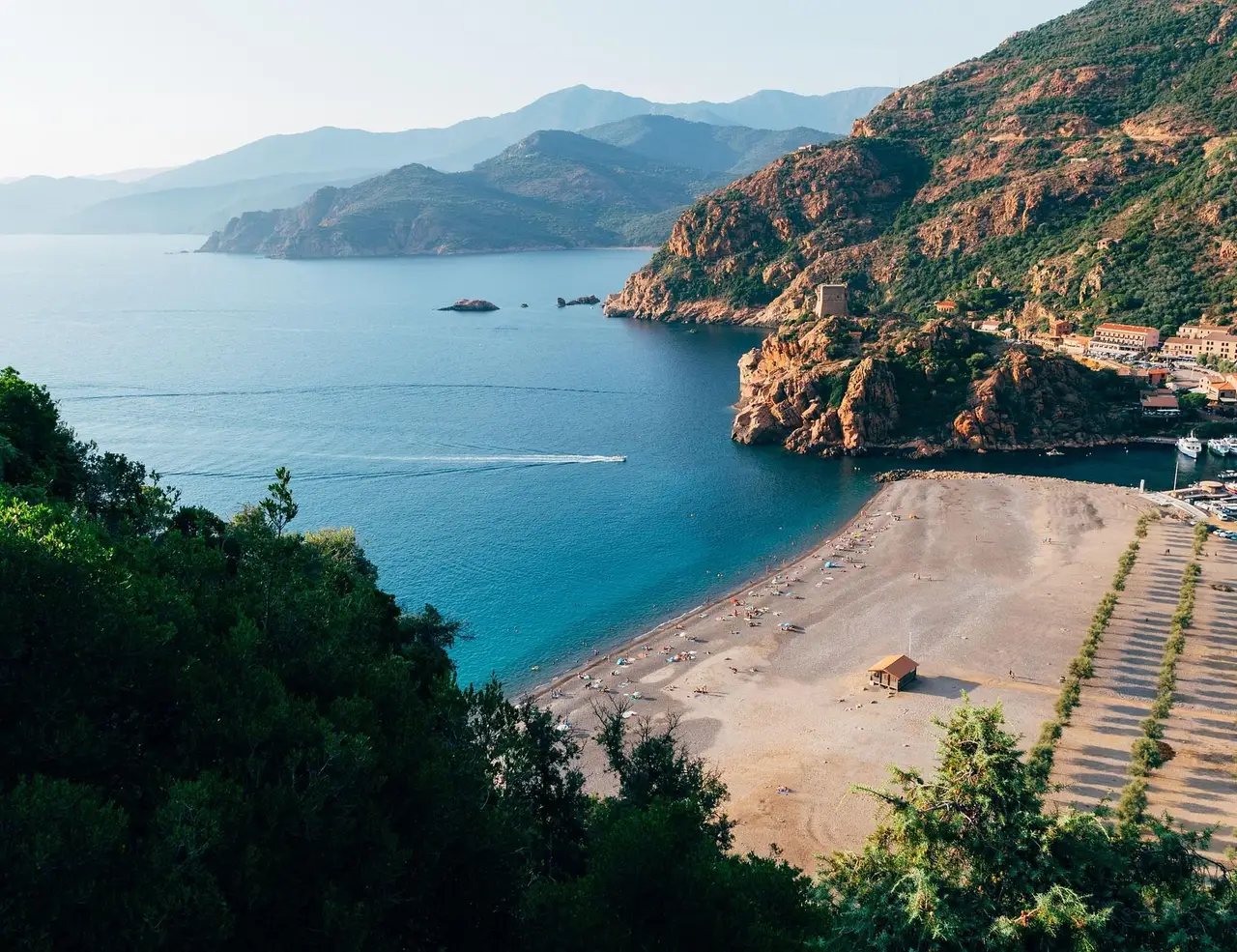
This section of the GT20 brings the route to one of the most visually dramatic sections of the Corsican coast. The stage from Galeria to Porto (51 kms / 32 mi, 921 m elevation / 3,022 ft) follows a road that travels along the cliffs above the Gulf of Porto with views of the UNESCO heritage coastline and the possibility of seeing the village of Girolata, accessible only by sea or on foot, from the road above. Porto itself, at the head of a deep inlet surrounded by red rock, is a natural rest point with good accommodation.
Stage 7: Porto to Corte, approximately 83 kms / 52 mi, 2,895 m elevation / 9,498 ft
This is the most demanding day on the GT20 and one of the most memorable. From Porto, the route climbs through Evisa and the Aïtone Forest to the Col de Vergio (1,477 m / 4,846 ft), the highest point of the entire route. From there, it descends through the Niolu region, past the Calacuccia lake and through the granite gorge of the Scala di Santa Regina before arriving at Corte. The elevation gain is significant and the stage is long; experienced cyclists complete it in around 6 to 7 hours of riding time. E-bike riders may need to charge en route; charging stations are available at several points.
Stages 8 to 10: Corte to Zonza via Ghisoni and Zicavo, approximately 146 kms / 91 mi
The central section of the GT20 passes through the mountains of the island's interior, including the Col de Verde (1,289 m / 4,229 ft) on the stage between Corte and Zicavo. These stages are quieter than the northern sections, passing through mountain villages that see very few tourists: Ghisoni, Zicavo, and the Alta Rocca villages of the south are some of the most authentically Corsican stops on the entire route.
Stage 11 to 12: Zonza to Bonifacio, approximately 71 kms / 44 mi, 1,014 m elevation / 3,327 ft
The final stage crosses the Bonifacian plateau, a relatively open limestone landscape that feels different from the rest of Corsica. The descent into Bonifacio, a town perched on white chalk cliffs above a natural harbor, provides one of the most dramatic arrivals of any cycling route in France. The medieval citadel, the narrow streets of the old town, and the view back along the chalk cliffs from the sea are a fitting end to a route that has crossed every major landscape type the island has to offer.
GT20 Logistics
The GT20 can be ridden in either direction, though Bastia to Bonifacio is more common, partly for transport logistics (both are well-connected to ferry services) and partly because the prevailing wind tends to assist northbound riders less. Several tour operators, including the route's original creator at cycling-corsica.com and gt20-corsica.com, offer full GT20 packages including luggage transfer between hotels, GPX files, route dossiers, and bike hire. The standard road bike hire for a GT20 package runs approximately 290 to 470 euros for 9 days depending on bike type; e-bike hire is available at the upper end of that range. E-bike charging stations are located at strategic intervals along the route, generally at hotels and restaurants, and are available at no extra cost during meal or accommodation breaks.
The GT20 is signposted well enough to navigate without GPS, but most riders use the route dossier and a GPS backup for the more complex mountain sections. The route is recommended between April and October; July 15 to August 20 is specifically not recommended by most operators due to heat and traffic on coastal sections.
Cycling in Corsica: Climate and Best Seasons
Corsica has a Mediterranean climate at sea level: hot, dry summers and mild, wetter winters. The mountain interior modifies this significantly, with temperatures 8 to 10 degrees C cooler at altitude and snow on the higher passes from November through April. The practical cycling season runs from March through October, with distinct character in each season.
Spring (April to May): The Prime Window
April and May are widely considered the best months for cycling Corsica. Temperatures at sea level range from 14 to 22 degrees C (57 to 72 degrees F), the maquis is in full bloom, and the mountain passes have largely cleared of snow by mid-April. The roads are quiet, accommodation is available without advance booking on most days, and the light on the coastal roads in spring has the clarity of a season that has not yet been burned by summer heat. Wild flowers, particularly the yellow broom and the pink and white cistus, cover the hillsides from April through June. This is also the best season for Corsican charcuterie, which is at its peak from March through early summer.
Early Summer (June): Good Weather, Growing Crowds
June brings warming temperatures (20 to 26 degrees C / 68 to 79 degrees F at sea level) and the arrival of early summer tourists. The coastal roads and popular beaches begin to see more traffic, but the interior roads remain quiet. June is a reliable month for cycling Corsica in terms of weather, and the longer days allow for more time on the bike. The GT20 through the mountain interior is particularly good in June, when the Aïtone Forest is at its greenest and the Niolu valley is clear.
Summer (July to August): Hot, Busy, and Best Avoided for Most
July and August are the peak tourist months and bring temperatures of 28 to 35 degrees C (82 to 95 degrees F) at sea level. Coastal roads near popular beaches can become congested, and the heat makes midday cycling genuinely uncomfortable. Most serious cycling operators specifically advise against the GT20 between July 15 and August 20. That said, the mountain interior remains cooler and the roads through the Alta Rocca and the central range are significantly less crowded than the coast. Early morning starts (before 8:00) and careful route planning can make summer cycling in Corsica work.
Autumn (September to October): The Second Peak
September and October offer conditions comparable to spring and are the second-best window for cycling Corsica. Temperatures moderate to 20 to 28 degrees C (68 to 82 degrees F) in September and 14 to 22 degrees C (57 to 72 degrees F) in October. The crowds have largely gone, the chestnut forests of the Castagniccia begin to color in October, and the wine harvest in the Patrimonio region is active through September. The sea remains warm enough for swimming in September, making coastal cycling particularly rewarding in this month. October can bring the first rains of autumn to the mountains; check forecasts for the high passes.
Winter (November to March): Limited but Possible
Winter cycling in Corsica is limited to the coastal and low-altitude roads. The mountain passes of the GT20 can be snowed in from November and are generally impassable by bicycle from December through March without specialist equipment. At sea level, the climate remains mild (8 to 14 degrees C / 46 to 57 degrees F) and dry days occur frequently, particularly in the south. Bonifacio and the Alta Rocca enjoy some of the driest, clearest winter weather on the island.
Wildlife and Natural Landscapes
Corsica has one of the highest concentrations of endemic species in Europe: plants and animals found nowhere else in the world, a consequence of the island's long isolation and diverse habitats. For cyclists, this translates to a route through landscapes that feel genuinely wild in a way that is increasingly rare in Europe.
The maquis is the most immediately present natural feature for cyclists at low altitude. More than just a landscape, it is an olfactory environment: the rosemary, myrtle, cistus, and wild lavender create a scent that is detectably Corsican, particularly after rain or in the heat of mid-morning. The strawberry tree (arbutou in Corsican), which produces its red berries in late autumn at the same time as its white flowers, is one of the maquis's most distinctive plants. Honey made from the maquis flowers, particularly the arbutou honey produced in autumn, is one of Corsica's most prized food products.
The forests of the interior are home to red deer (reintroduced to Corsica in the 1980s after being hunted to extinction), wild boar (sanglier, common and frequently seen from the road, particularly around dawn and dusk), mouflon (the wild mountain sheep that is the symbol of Corsica), golden eagles, and the Corsican nuthatch, a bird found only on this island and the most famous of Corsica's endemic species. Rivers and streams support populations of the Corsican trout, a freshwater species whose presence in the cold, clear mountain streams is an indicator of the quality of the island's inland water.
The coastal waters are part of the Pelagos Sanctuary for Mediterranean Marine Mammals, and the Corsican coast sees regular sightings of fin whales, sperm whales, striped dolphins, and loggerhead sea turtles. The Scandola Nature Reserve on the northwest coast, accessible only by boat, is one of the most protected marine areas in Europe, and the road above it on the GT20 route provides views of the reserve's red rock coastline from above. The Calanques de Piana, on the same section of coast, are a UNESCO World Heritage Site: porphyry rock formations of extraordinary color and form that are at their most dramatic in the horizontal light of early morning or late afternoon.
Corsican Culture, History, and Identity
Corsica's cultural identity is the product of its geography and its history of changing sovereignty. Greek traders established coastal settlements from the 6th century BC; Carthaginian, Roman, Vandal, Byzantine, Pisan, and Genoese rule followed in succession. The island was purchased by France from the Republic of Genoa in 1768, just in time for Napoleon Bonaparte to be born a French citizen the following year. The Corsican independence movement, which remained politically active through the late 20th century and into the 21st, reflects a genuine sense of cultural distinctiveness that permeates daily life: in the use of the Corsican language, in the persistence of traditional food and farming practices, and in an attitude toward outsiders that is welcoming but reserved.
The Genoese left a visible legacy on the cycling landscape: the watchtowers (Genoese towers) that punctuate the coastline were built in the 16th century as a defense against pirate raids, and you will see them from the road on Cap Corse, the Balagne coast, and the southern beaches. The citadel towns of Bonifacio, Calvi, and Porto-Vecchio preserve Genoese military architecture that is among the most distinctive in the Mediterranean. Corte, the Corsican capital during the brief period of independence under Pasquale Paoli in the 18th century, has a citadel perched on a granite outcrop above the town that is worth the short climb on foot.
Chestnut cultivation, introduced by the Genoese in the 14th century as a food crop for the interior populations, shaped Corsican cuisine and landscape in ways that are still visible today. The Castagniccia, a region of the eastern interior whose name means the chestnut grove, contains some of the oldest chestnut forests in France. In autumn, the harvest provides the raw material for chestnut flour, which underpins a significant part of Corsican cooking: pulenta (chestnut polenta), chestnut fritters, chestnut bread, chestnut cake, and Pietra beer, all reflect the centrality of the chestnut tree to the island's food culture.
The Tour de France's 2013 visit to Corsica was a significant moment for cycling in Corsica. The race used the island for its first three stages, bringing international television coverage to roads that most professional cyclists had never ridden. The attention accelerated the development of cycling tourism infrastructure on the island, and the GT20 inauguration six years later built on that foundation.
Why Go Cycling in Corsica?
Roads That Are Genuinely Quiet
Outside of the main coastal highway (the RN198 on the east coast, which cyclists should avoid) and the approach roads to the major beach resorts in summer, Corsica's road network is remarkably quiet. The secondary roads that make up the GT20 and the best cycling routes on the island carry very little traffic even in high season. In the mountain interior, it is common to ride for an hour without passing a car. This combination of road quality, which is generally good on the main routes, and minimal traffic is unusual in a Mediterranean destination of Corsica's reputation and proximity to mainland France.
Terrain Variety Within a Single Island
Cycling Corsica offers a range of terrain that most continental cycling destinations spread across an entire country. In a single week, it is possible to ride coastal cliff roads above UNESCO heritage landscapes, climb to mountain passes through ancient forests, descend through granite gorges, and finish on quiet roads through hilltop villages overlooking the sea. The GT20 by design takes riders through every major landscape type on the island. For cyclists who want diversity without the logistics of crossing multiple countries or regions, Corsica cycling is unusually efficient.
The GT20: A Defined and Supported Route
The existence of the GT20 changes the planning equation for visiting cyclists significantly. A signed, supported, long-distance cycling route with luggage transfer services, a network of e-bike charging stations, and a range of operators offering packaged itineraries means that cycling Corsica is now much more accessible than the terrain might suggest. The GT20 makes it possible for a rider with intermediate fitness and no expedition experience to complete a cross-island traverse with good logistics and comfortable accommodation, on either a road bike or an e-bike.
Corsican Food and Wine
Corsican food is specific, seasonal, and deeply tied to the island's terrain. The charcuterie, the brocciu cheese, the chestnut-based dishes, the mountain honey, and the wines of the Patrimonio and Ajaccio appellations are all products of a food culture that has maintained its identity in the face of tourism and modern supply chains. Cycling through the regions that produce these foods, stopping at a village bar for a plate of local charcuterie, or buying honey directly from a producer on the roadside, gives a quality of food experience that is difficult to replicate in more touristically developed destinations.
E-Bike Accessibility
Corsica's terrain, with its sustained climbs and cumulative elevation, can seem daunting for riders who are not regular climbers. The development of e-bike infrastructure along the GT20, including free charging stations at partner businesses along the route, has made Corsica cycling genuinely accessible to a much wider range of riders. E-bike riders report that the route becomes a cultural and scenic experience rather than a physical test, with the assistance making the climbs manageable and leaving energy for the stops, the food, and the landscapes that are the real substance of the ride.
PLANNING A CYCLING HOLIDAY IN CORSICA ?
Dive into our curated Corsica cycling adventures today!
Best Regions for Cycling in Corsica
1. Cap Corse: The Northern Peninsula
Cap Corse, the long, narrow peninsula that forms the northern tip of the island, is one of the most distinctive cycling areas in Corsica. A full loop of the peninsula is approximately 120 kms (75 mi) on road, with the interior crossings adding significant elevation. The east coast is gentler, with vineyards and fishing villages; the west coast is more dramatic, with cliffs and the small port of Centuri (the first overnight stop on the GT20) as its highlight. The Col de la Serra at the northern tip offers a view across the entire peninsula. Cap Corse feels different from the rest of Corsica: more intimate, more obviously Italian in its architecture, and extremely quiet outside August. Suitable for most fitness levels on the coastal circuit; more demanding with interior crossings.
2. The Balagne: Villages and Olive Groves
The Balagne occupies the northwest of the island between Calvi and Ile-Rousse, and its network of hilltop villages connected by small roads through olive groves, vineyards, and maquis is the best area on the island for relaxed, exploratory cycling. The main Balagne villages, including Sant'Antonino (perched at 500 m / 1,640 ft with 360-degree views), Pigna (known for its artisan workshops), Speloncato, and Lumio, are connected by quiet roads with manageable elevation. Calvi, at the western end of the Balagne, is a proper town with a Genoese citadel, a beach, and good food. The Balagne Cycling Train (Trinighellu) runs between Calvi and Ile-Rousse in summer and allows cyclists to use it as a shuttle. Suitable for intermediate riders and above.
3. The Niolu and Col de Vergio: Mountain Heart of the GT20
The central mountain section of the GT20, from Porto through the Col de Vergio to Corte, represents the most demanding and most rewarding single day on the route. The Niolu is the remote valley on the eastern side of the Col de Vergio, centered on the village of Calacuccia and its reservoir. This area is among the most isolated in Corsica and sees very few cycling tourists who have not arrived via the GT20. The road through the Scala di Santa Regina gorge descending from the Niolu toward Corte is one of the most remarkable road sections in the island. Suitable for experienced, fit cyclists; e-bikes strongly recommended for less experienced riders on this section.
4. The Calanques de Piana and Gulf of Porto
The D81 road through the Calanques de Piana, the UNESCO-listed red rock formations above the Gulf of Porto, is one of the most photographed sections of road cycling in France. The route runs for approximately 15 kms (9 mi) along the cliff face with constant views of the rock formations and the sea below. Outside of high summer, traffic is minimal and the road can be ridden at a pace that allows proper appreciation of the landscape. The town of Porto, at the base of the descent, has good accommodation and serves as the overnight stop between Stage 6 and Stage 7 of the GT20. Suitable for all cyclists comfortable with narrow roads; note that sections are exposed and there is no barrier between the road and the cliff in places.
5. Alta Rocca: The Quiet South
The Alta Rocca is the elevated interior of southern Corsica, a plateau of granite and forest between the Aiguilles de Bavella and the coastal lowlands around Porto-Vecchio. The villages of Zonza, Quenza, Levie, and Sainte-Lucie-de-Tallano are connected by quiet roads through a landscape of cork oak, holm oak, and maquis that is distinctly different from the pine and beech forests of the north. This is also an area with significant prehistoric history: the site of Cucuruzzu near Levie contains some of the best-preserved Bronze Age castelli in Corsica. The Col de Bavella, reached from Solenzara on the east coast on the D268, is the most famous climb in the Alta Rocca and arguably the most dramatic road ascent on the island. Suitable for intermediate to experienced riders.
6. Corte and the Central Mountains
Corte is the geographic and historical heart of Corsica: a university town set in a valley at the junction of three gorges, with a citadel on a granite spike above the old town. As the GT20's central waypoint, it is also a natural base for day rides into the surrounding mountains. The Gorges de la Restonica, a narrow valley climbing south from Corte through forests to mountain lakes at 1,700 m (5,577 ft), is one of the most popular natural sites on the island and a good day's cycling with a bike before switching to hiking at the upper end. The Gorges du Tavignano to the west offer similar scenery on a quieter road. Corte has the best range of accommodation, restaurants, and services of any town in the mountain interior. Suitable for all cyclists for the valley roads; more demanding for the higher ascents.
7. Bonifacio and the Extreme South
Bonifacio is one of the most distinctive towns in France: a medieval citadel built on chalk cliffs at the southern tip of Corsica, with a harbor below and the Sardinian coast visible on a clear day just 12 kms (7 mi) across the Bouches de Bonifacio. The town is the endpoint of the GT20 and a natural base for exploring the far south. The roads around Bonifacio and Porto-Vecchio, through cork oak forests and toward the beaches of Palombaggia and Rondinara, are among the most agreeable cycling in the south: relatively flat, quiet in shoulder season, and with access to some of the finest beaches in the Mediterranean. The cycling becomes more demanding on the roads north toward the Alta Rocca. Suitable for all fitness levels for the coastal roads; more demanding inland.
Top Cycling Routes in Corsica
1. The GT20: La Grande Traversee de la Corse
Distance: 600 kms (373 mi) | Elevation: 9,500 m (31,168 ft) total | Duration: 6, 8, or 12 days | Difficulty: Challenging (road bike) / Moderate to challenging (e-bike)
The full GT20 from Bastia to Bonifacio is the defining cycling experience in Corsica and one of the most significant long-distance cycling routes in France. The route covers every major landscape type on the island: Cap Corse, the Agriates Desert, the Balagne, the Gulf of Porto coastline, the Col de Vergio mountain crossing, the Niolu valley, the central mountain villages, the Alta Rocca, and the Bonifacian plateau. Fully signed throughout, with luggage transfer services and e-bike charging infrastructure along the route. The 12-stage version is the recommended format for riders who want to explore each section properly; the 6-stage sportive version averages over 100 kms (62 mi) per day and is reserved for fit, experienced cyclists. The period from April to June and September to mid-October is recommended; July 15 to August 20 is specifically not advised due to heat and traffic.
2. Cap Corse Circuit
Distance: 120 kms (75 mi) loop | Elevation: 1,500 to 2,000 m (4,921 to 6,562 ft) depending on interior crossings | Duration: 1 to 2 days | Difficulty: Moderate to challenging
The circuit of Cap Corse begins and ends in Bastia, following the east coast north through Erbalunga, Macinaggio, and the lighthouse at Cap Corse before descending the west coast through Centuri, the Moulin Mattei, and Saint-Florent. The east coast is flatter and more sheltered; the west coast has more climbing and more dramatic scenery. Adding the interior crossing roads between the two coasts adds significant elevation but opens up the peninsula's mountain character. Centuri, with its harbor and fish restaurants, makes the obvious overnight stop on a two-day circuit. The vineyard roads near Patrimonio at the base of Cap Corse, close to Saint-Florent, are worth adding for riders with an interest in Corsican wine.
3. The Calanques de Piana: D81 Coastal Road
Distance: 50 kms (31 mi) one way (Calvi to Porto or Porto to Ajaccio) | Elevation: Variable, approximately 800 to 1,200 m (2,625 to 3,937 ft) | Duration: Full day | Difficulty: Moderate
The D81 road through the Calanques de Piana is the most visually spectacular coastal cycling in Corsica. The route from Porto south through the Calanques and on to Sagone and Ajaccio, or north from Porto toward Calvi on the reverse of the same coastal road, includes both the UNESCO heritage rock formations and the extraordinary Gulf of Girolata viewpoint. The road is narrow, with no cycle path, and requires attention in traffic; outside high season it is manageable and the views reward the effort. Many riders do this section as part of the GT20 Stage 6 (Galeria to Porto), which approaches the Calanques from the north on the same road.
4. Col de Bavella from Solenzara
Distance: 35 kms (22 mi) one way | Elevation: 1,289 m (4,229 ft) gained | Duration: Half day (ascent) | Difficulty: Hard
The climb to the Col de Bavella on the D268 from Solenzara on the east coast is one of the most challenging and most rewarding ascents on the island. The road climbs from sea level through maquis and pine forest, eventually breaking above the treeline to the col at 1,218 m (3,996 ft), where the Aiguilles de Bavella rise in granite needles above the road. The views from the col across to the Alta Rocca and back toward the east coast are among the best in southern Corsica. A small restaurant at the col serves basic food. The descent is fast and technically demanding. This climb is often included as a day ride from a base in Porto-Vecchio or Solenzara.
5. The Balagne Villages Loop
Distance: 60 to 80 kms (37 to 50 mi) depending on route | Elevation: 1,200 to 1,800 m (3,937 to 5,906 ft) | Duration: Full day | Difficulty: Moderate
A day in the Balagne linking the hilltop villages between Calvi and Ile-Rousse is the most accessible and culturally rich cycling day on the island. The route from Calvi climbs into the hills through Lumio and Lavatoggio before reaching Sant'Antonino, then continues through Pigna, Feliceto, Speloncato, and Belgodere before descending to Ile-Rousse on the coast. Reverse the route using the Balagne Train (Trinighellu) in summer. The village of Sant'Antonino, with its single cobbled lane and views to the sea, is one of the most beautifully positioned settlements in France. Suitable for riders comfortable with repeated short climbs and descents; no single climb is very long.
6. Gorges de la Restonica from Corte
Distance: 18 kms (11 mi) one way to the end of the driveable road | Elevation: 680 m (2,231 ft) | Duration: Half day by bike | Difficulty: Moderate to hard
The D623 road into the Gorges de la Restonica from Corte is one of the island's most dramatic valley rides. The road climbs through pine and chestnut forest alongside the Restonica river, with the gorge walls narrowing as the altitude increases. The road becomes restricted to traffic at the Bergeries de Grotelle (1,375 m / 4,511 ft), but cyclists can continue further on foot to the mountain lakes of Lac de Melo (1,711 m / 5,614 ft) and Lac de Capitello (1,930 m / 6,332 ft). The ride back down the gorge is fast and scenic. In summer, a traffic restriction allows cycling without cars on the upper section; arrive early or late to avoid the shuttle bus convoys.
7. Bonifacio to Porto-Vecchio Coast Road
Distance: 25 kms (16 mi) one way | Elevation: 200 to 400 m (656 to 1,312 ft) | Duration: Half day | Difficulty: Easy to moderate
The coast road between Bonifacio and Porto-Vecchio through cork oak forest and past the approach roads to Palombaggia and Rondinara beaches is the most accessible cycling in the far south. The terrain is rolling rather than demanding, the roads are quiet in shoulder season, and the detours to the beaches provide natural rest stops with some of the clearest water in the Mediterranean. This section suits riders based in Bonifacio or Porto-Vecchio who want a day in the saddle without the commitment of major climbing. Combine with a boat trip to the white cliffs of Bonifacio from the sea for a full day.
Month by Month: When to Cycle in Corsica
March: Early Season
March sees the earliest spring days in the south and along the coast, with temperatures of 10 to 16 degrees C (50 to 61 degrees F). The mountain passes are still closed in most years. Good for early season coastal riding and the Balagne; the GT20 south from Corte is manageable. Charcuterie is at its best from March onward as the season's production becomes available. Roads are almost entirely empty and accommodation is inexpensive.
April to May: Optimal
The best two months for cycling Corsica. Temperatures of 14 to 22 degrees C (57 to 72 degrees F), maquis in flower, mountain passes clearing by mid-April, and roads that have not yet filled with summer visitors. The GT20 in its full form is best tackled from April onward. Brocciu cheese is in its freshest season from late April.
June: Excellent Conditions
Temperatures of 20 to 26 degrees C (68 to 79 degrees F). The coast starts to fill with French and Italian visitors but the interior remains quiet. An excellent month for the full GT20 or multi-day mountain routes. Longest daylight hours of the year, allowing for late afternoon arrivals at each stage.
July to August: Avoid Coastal Roads; Manage Mountain Sections
Peak heat and peak tourism. Interior roads are manageable with early starts (before 7:00); coastal routes near major resorts are congested and hot from mid-morning. GT20 operators specifically advise against the July 15 to August 20 window. If visiting in this period, focus on high-altitude routes and avoid the GT20 coastal sections.
September to October: Second Best Season
September matches April and May for conditions. The sea is warm, the crowds have thinned, and the chestnut forests begin to color in October. The Patrimonio wine harvest is active in September; a good month to combine cycling and wine tourism in the Cap Corse/Saint-Florent area. October can bring autumn rain to the mountains from mid-month onward; check forecasts for high passes.
November to February: Off Season
Mountain passes closed or unreliable. Coastal cycling in the south is possible on good days. Very limited tourist infrastructure; many hotels and restaurants close from November to March. Suitable for a limited number of days in the Bonifacio area or Cap Corse on a fine winter week.
What to Eat on a Cycling Trip in Corsica
Corsican food is unlike anything else in France, and it is one of the genuine rewards of cycling in Corsica. The island's cuisine is the product of its terrain, its history of Genoese rule, and a pastoral economy based on semi-wild pigs, sheep, goats, chestnuts, and the aromatic plants of the maquis. What you eat on the GT20 changes as you move through the island's regions, from the seafood of Cap Corse and the Porto coast to the charcuterie and mountain cheese of the interior.
Charcuterie Corse
Corsican charcuterie is considered among the finest in France and carries AOC status since 2012. The pigs, known as porcu nustrale, are raised semi-wild in the forests, fed on chestnuts and acorns, and crossed with wild boar. The result is a pork that is darker and more flavored than commercially raised breeds, and the cured products reflect that quality. The main types are coppa (cured neck, with a smooth, mildly smoky flavor), prisuttu (dry-cured ham, similar to prosciutto), lonzu (cured pork loin), figatellu (liver sausage, eaten grilled in winter and spring), and salciccia (the island's saucisson). These are eaten as an aperitif course, typically with a glass of Patrimonio red and local bread, and are available at village bars, road stalls, and almost every restaurant on the island. The season for freshly made charcuterie runs from March through early summer.
Brocciu
Brocciu is the emblematic Corsican cheese, the only one to hold AOC status on the island. Made from the whey of goat or sheep milk with added fresh milk, it has a texture similar to ricotta: soft, fresh, and milky, with a slight acidity. It is used across every course of Corsican cooking: in ravioli, in cannelloni, stuffed into courgettes or artichokes, as a filling for the migliacci pancakes of northern Corsica, in the fiadone cheesecake that is the island's most iconic dessert, and in the falculelle small cakes baked on chestnut leaves from Corte. Fresh brocciu is available from late autumn through spring; in summer, it is replaced by aged brocciu with a stronger, more complex flavor. The poet Emile Bergerat wrote that you do not know Corsica if you have not tasted brocciu, and the cycling tourist who passes through the island without eating it has missed something genuinely important.
Chestnut Dishes
Chestnut flour is the foundation of a significant part of Corsican cooking, a legacy of the Genoese who planted the trees as a food crop in the 14th century. Pulenta castagnina, chestnut polenta, is the most fundamental: a dense, slightly sweet porridge served alongside grilled figatellu, fried eggs, or brocciu. Chestnut fritters (fritelli castagnini) appear at village fairs and markets. Chestnut flour is also the base for several biscuits and cakes, including the canistrelli shortbread cookies that appear at every cafe counter on the island. Pietra beer, brewed with chestnut flour added to malt, is the island's most distinctive beer and is available everywhere. The chestnut harvest in October is the occasion for fairs across the Castagniccia region in the northeast.
Civet de Sanglier
Wild boar (sanglier) is the protein that defines Corsican mountain cooking. The civet de sanglier, a slow-braised stew of wild boar with onions, carrots, chestnuts, fennel, and red wine, is the most significant dish in the interior mountain villages along the GT20 route. It appears on restaurant menus from autumn through spring and is at its best in the weeks after the October hunting season opens. A full portion, served with chestnut polenta, is one of the most substantial and satisfying post-ride meals on the island. Wild boar terrine is available year-round at charcuterie stalls and shops.
Seafood: Aziminu and Fresh Fish
On the coastal sections of the GT20, including Cap Corse, the Balagne coast, and the Porto and Ajaccio areas, the cooking shifts from mountain charcuterie to fresh Mediterranean seafood. Aziminu, the Corsican bouillabaisse, is a rich fish soup made with a variety of small local fish, seasoned with saffron and fennel and served with croutons and a rouille sauce. It is particularly good in Bastia and along the Cap Corse coast. Fresh red mullet, sea bream, sardines, and the lobster (langouste) of the western coast are served grilled or baked with local herbs at harbor restaurants throughout the island. Oysters are produced at the Etang de Diana on the east coast.
Corsican Wine and Pietra Beer
Corsica produces wines across ten AOC designations and a vin de pays category, from around 8,000 hectares of vineyard. The most important appellations are Patrimonio (the oldest and most prestigious, in the northwest near Saint-Florent, producing Nielluccio-based reds and Vermentino whites), Ajaccio (known for Sciacarello-based reds), and Muscat du Cap Corse (a fortified sweet wine from the peninsula). The indigenous grape varieties, including Nielluccio (closely related to Sangiovese), Sciacarello, and Vermentino, give Corsican wines a character that is recognizably different from mainland French wine. A glass of cold Vermentino with a plate of seafood at a harbor restaurant on Cap Corse is one of the finer pairings available on the GT20 route. Pietra beer, made with malt and chestnut flour, is available everywhere and is worth trying as the island's most distinctive non-wine beverage.
Maquis Honey and Local Preserves
Corsican honey holds AOC status as Mele di Corsica and is produced in seven different varieties reflecting the seasonal flowering of the maquis: spring maquis, chestnut, arbutou (autumn), maritime pine, and others. Arbutou honey, made from the flowers of the strawberry tree in autumn, is the rarest and most distinctive: slightly bitter, with a complex aromatic character that reflects the maquis plants. It is sold at markets, roadside stalls, and at the farms of beekeepers throughout the island. Myrtle liqueur (liqueur de myrte), made from the berries of the wild myrtle that grows throughout the maquis, is the traditional digestif and is served in many mountain village restaurants as a complimentary end to a meal.
Practical Information for Cyclists
Getting to Corsica
Corsica is served by two main airports: Ajaccio Napoleon Bonaparte Airport in the southwest and Bastia Poretta Airport in the northeast. Seasonal airports also operate at Figari (near Bonifacio, good for GT20 arrivals), Calvi, and Propriano. Air France, Air Corsica, and several low-cost carriers serve these airports from Paris, Lyon, Marseille, Nice, and several other European cities. Flights from Paris to Bastia or Ajaccio take approximately 1 hour 45 minutes. Ferry services operate from Marseille, Nice, Toulon, Savona, Livorno, and Piombino to Bastia, Ajaccio, Calvi, and Porto-Vecchio. The ferry from Nice to Bastia takes approximately 3.5 to 6 hours depending on the service; from Marseille, approximately 11 hours overnight. Bikes are accepted on all ferries as checked luggage with prior booking. The ferry option is strongly recommended for cyclists, as it eliminates the complications of airline bike transport and allows you to arrive directly in the port where the GT20 begins or ends.
Getting Around the Island
Corsica has two narrow-gauge railway lines operated by the CFC (Chemins de Fer de la Corse): the main line from Bastia to Ajaccio (158 kms / 98 mi, approximately 3.5 hours) stopping at Corte, and the Balagne line from Ponte-Leccia to Calvi (73 kms / 45 mi). These trains accept bikes in a bike bag (maximum 120 cm by 90 cm when disassembled), which is a significant restriction for most touring cyclists. The main train stations on or near the GT20 are at Bastia, Corte, and Venaco. Bus services connect the major coastal towns and are useful for one-way route returns. Taxis are available in the main towns and can be arranged in advance for luggage transfers between stages.
Bike Rental
Road bikes, mountain bikes, hybrid bikes, and e-bikes are available for hire from operators in Bastia, Ajaccio, Calvi, Porto-Vecchio, and Bonifacio. The main GT20-specific operators, including Europe Active (cycling-corsica.com and gt20-corsica.com), AppeBike (multiple locations including Ajaccio, Bastia, Calvi, and Bonifacio), and BicyCorsica (Porto-Vecchio), all offer GT20 packages with bike hire and luggage transfer. Delivery of bikes to your hotel in Bastia or Imabari at the start of a package is standard. Road bike hire for a 9-day GT20 package costs approximately 290 to 470 euros.
Visa and Entry
Corsica is part of France and therefore part of the Schengen Area. EU, EEA, and Swiss citizens enter freely. UK, US, Canadian, and Australian citizens may visit France for up to 90 days within a 180-day period without a visa for tourism. The EU's ETIAS electronic travel authorization system for visa-exempt non-EU nationals is expected to be introduced in 2025 or 2026; check the current status before traveling. Currency is the euro. Credit and debit cards are accepted in all towns, but cash is recommended for village cafes, roadside stalls, and smaller guesthouses in the interior.
Language
French is the official language. Corsican, a Romance language closely related to Italian and specifically to the dialects of Tuscany and Sardinia, is spoken alongside French by a significant proportion of the population and is used in signage, place names, and cultural contexts. Most people in the tourism and cycling industry speak serviceable English, particularly in the main towns and at GT20 partner businesses. In remote interior villages, French is the reliable language; a few basic phrases are genuinely appreciated.
Road Safety and Conditions
Main roads in Corsica are well surfaced. Secondary roads and departmental roads, which make up the majority of the GT20, are generally in good condition but can be narrow, with limited visibility on bends. The main hazards specific to cycling in Corsica are free-ranging livestock (cattle, pigs, goats, and donkeys on rural roads), wild boar crossings especially at dawn and dusk, rock fall after heavy rain in gorge sections, and occasional poor road surface on the smallest village roads. Tunnels on some coastal roads require lights. Traffic is the main hazard on the coastal highway (RN198) and the approach roads to beach resorts in July and August; both are best avoided. Carry sufficient water on mountain sections, where springs and villages can be widely spaced.
Connectivity
Mobile coverage (4G) is generally good in towns and on main roads. Mountain interiors and gorge sections can have limited or no signal. The GT20 route dossier and GPX files are available from all main operators and from the official GT20 website (gt20-corsica.com). Maps are downloadable on Komoot and available on Strava. Download offline maps before setting out for remote sections.
Time Zone
Corsica operates on Central European Time (CET), UTC+1 in winter and UTC+2 during daylight saving (late March to late October), the same as mainland France and most of continental Europe.
Read, Watch, Taste, and Experience
Read
For background on Corsica's culture and identity, Dorothy Carrington's Granite Island (1971) remains the definitive English-language account of the island's people, landscape, and traditions. Written over many years of residence on the island, it gives the context for almost everything a cycling tourist will encounter. Edward Lear visited Corsica in 1868 and produced Journal of a Landscape Painter in Corsica, which documents the same island roads and mountain landscapes that the GT20 now follows. More recently, the travel writer Tim Moore's account of riding the Tour de France route, French Revolutions, provides useful background on the cycling culture of France more broadly.
Watch
The Tour de France 2013 prologue and stages 1 to 3, available in full on YouTube from ASO, give the best television coverage of the Corsican cycling landscape, particularly the Cap Corse and Balagne sections. Several GT20 ride accounts, filmed over multiple days, are available on YouTube from European cycling channels and provide practical stage-by-stage visual reference for route planning.
Eat and Drink
In Bastia: The old port restaurants are reliable for aziminu and fresh fish; the indoor market in the Place du Marche sells excellent Corsican charcuterie and cheese for road provisions. In Centuri (GT20 Stage 1 overnight): The harbor restaurants specialize in local lobster and grilled fish. In Corte: A Scudella restaurant on the main square serves reliable traditional Corsican cooking including wild boar and brocciu dishes. In Zonza (GT20 Stage 10): The village has several restaurants serving Alta Rocca mountain cooking: charcuterie, local lamb, and chestnut dishes. In Bonifacio: The marina restaurants are tourist-oriented but reliably good for seafood; for a more local experience, eat at one of the smaller places in the citadel. For wine: the Domain Orenga de Gaffory near Patrimonio accepts visitors for tastings and is one of the finest producers in the island's most prestigious appellation.
Experiences Worth Planning Around
The view from the Col de Vergio at the high point of the GT20, looking back toward Porto and forward over the Niolu valley on a clear morning, is one of the defining moments of cycling Corsica. The harbor at Centuri at dusk, eating grilled lobster with a glass of local white wine after the first day's riding, is specific to this route in a way that few cycling evenings manage to be. The road through the Calanques de Piana in the early morning, before the tourist traffic begins, when the red rock takes the horizontal light and the sea below is flat and blue. And in any village along the route: stopping for an espresso at the single bar on the main square, where the conversation is in Corsican and the owner will tell you, without being asked, that the road ahead is beautiful.
READY TO CYCLE CORSICA ?
Get started with your cycling adventure now!
Plan Your Corsica Cycling Trip with Art of Bicycle Trips
Cycling Corsica offers something genuinely difficult to find in European cycling tourism: a large island with serious mountains, quiet roads, a well-developed long-distance cycling route, and a food and wine culture that is distinct from anything on the mainland. The GT20 provides the framework for a cross-island traverse that can be adjusted to suit different fitness levels, timelines, and budgets, and the development of e-bike infrastructure along the route has made the terrain accessible to a much wider range of riders.
Art of Bicycle Trips designs cycling journeys across France and the Mediterranean, with tours that combine excellent roads, handpicked accommodation, and genuine local cultural experience. If you are planning a Corsica cycling trip and would like guidance on the best itinerary for your fitness level and interests, whether you are considering the full GT20, a week in one region, or a combination of cycling with other activities on the island, we would be glad to help you plan it.
Get in touch with us at artofbicycletrips.com to discuss your Corsica cycling journey.
Plan Your Active Adventure
Create a private trip or join a small-group departure.
