
Understanding Alsace
Alsace has been shaped by movement more than by boundaries. Its streets carry the imprint of shifting borders, bilingual signboards, and traditions shaped by both French finesse and German practicality. Timber-framed houses, flower-lined balconies, village fountains, and church spires create a visual language that feels instantly recognisable, yet hard to pin to a single nation. This is a region where identity has been negotiated over centuries and quietly absorbed into everyday life.
Cycling in Alsace allows you to pass through this cultural texture at close range. Market squares, family-run wineries, neighbourhood brasseries, and riverside cafés appear not as destinations but as part of the rhythm of the ride. The appeal lies in familiarity rather than drama, in the sense of moving through a place that has learned how to hold history, craft, and conviviality in balance.
Topography
The terrain of Alsace lends itself naturally to long, fluid days in the saddle. The landscape is defined by gentle gradients rather than dramatic shifts, with wide valleys, low foothills, and expansive plains that invite unhurried riding. Roads and cycle paths tend to follow natural contours, creating a sense of continuity as villages, vineyards, and waterways unfold in sequence.
Most riders experience this ease most clearly along the Rhine corridor, where flat, well-marked paths connect Strasbourg to Basel through open countryside and small towns. Inland, the land begins to ripple softly as vineyard roads climb and dip along the edges of the Vosges, adding texture without demanding effort. Cycling in Alsace rarely feels about conquering terrain. Instead, the topography supports a steady, observant pace, where the pleasure comes from distance covered almost without noticing, and from how smoothly the landscape carries you forward.
Climate
Alsace enjoys a climate that feels well suited to cycling for much of the year, marked by clear seasons and relatively stable conditions. Summers are warm and bright rather than oppressive, creating comfortable riding days, especially along riverside paths and shaded vineyard roads.
Spring arrives with a sense of freshness, as villages come back to life and vineyards begin to green. Autumn is equally inviting, when harvest season brings colour to the landscape and cooler air makes longer rides feel effortless. These shoulder seasons are often favoured by cyclists for their balance of mild weather and quieter routes.
Rainfall is generally moderate and tends to pass quickly, while winters are cooler and more subdued, with shorter days and fewer visitors. While most cyclists choose the brighter months, the overall climate supports an unhurried rhythm that aligns well with the region’s steady, accessible terrain.
Flora and Fauna
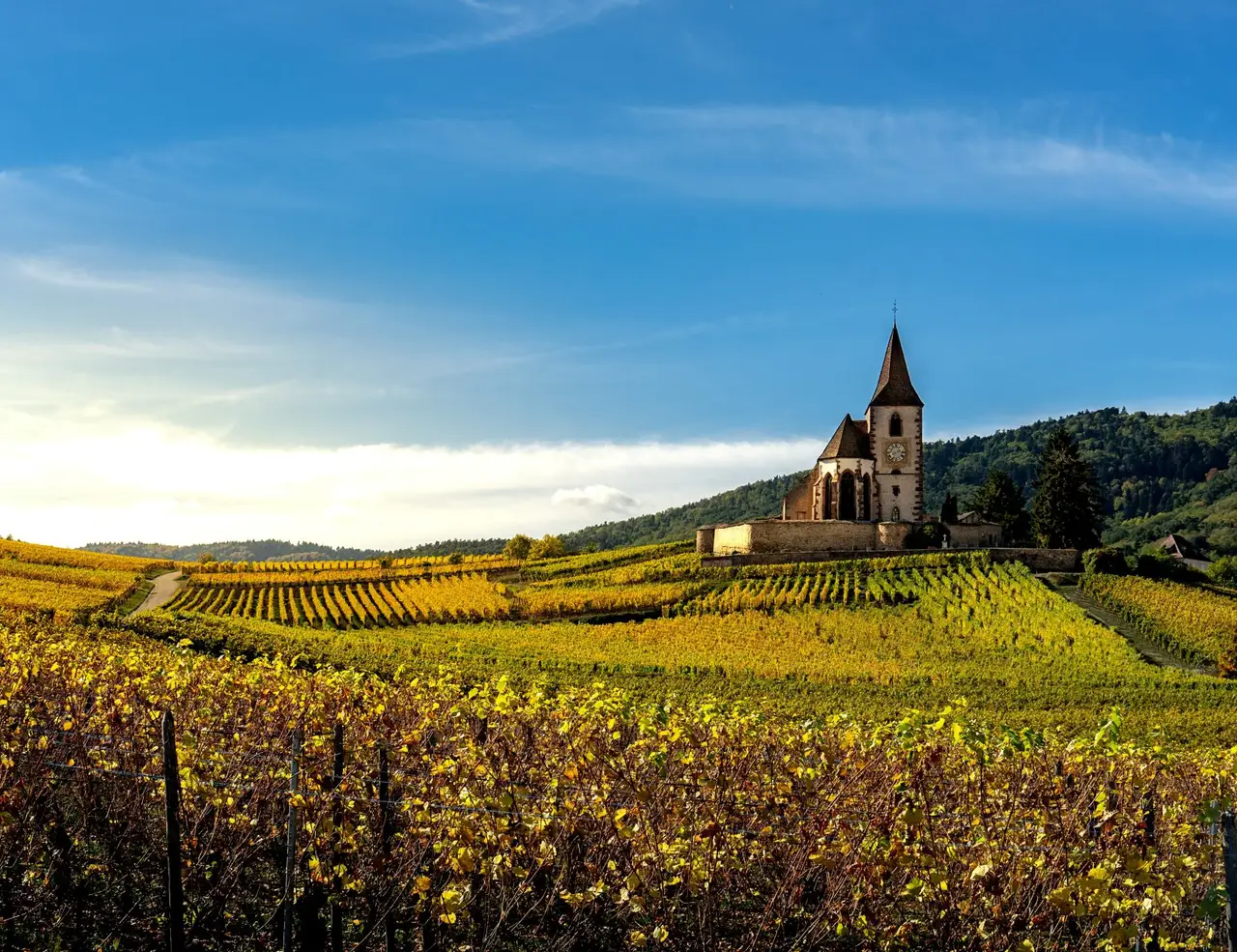
Alsace’s landscape carries a strong sense of cultivation, shaped by centuries of farming, winemaking, and seasonal rhythms. Vineyards dominate the visual palette, their neat rows threading through villages and climbing low slopes. In spring, orchards of cherry, apple, and plum trees soften the scenery with blossoms, while summer brings fields of grain, maize, and hops that hint at the region’s brewing traditions. As autumn arrives, vines turn amber and gold, giving the countryside a warm, textured glow.
Between cultivated land, pockets of woodland and hedgerows introduce a quieter, more natural note. Poplar and oak line waterways and rural lanes, offering shade and a sense of enclosure as you ride. Along canals and rivers, grasses and reeds support a calm, almost meditative atmosphere that contrasts with the order of the vineyards.
Wildlife tends to reveal itself subtly rather than dramatically. Cyclists often spot storks nesting on rooftops or gliding across open fields, a familiar emblem of the region. Hares and roe deer appear at the edges of farmland in the early hours, while birdlife thrives near water, from ducks and swans to smaller river birds. This close coexistence of working landscapes and everyday wildlife adds a quiet richness to cycling in Alsace, where nature feels present without ever overwhelming the human scale of the place.
Economy
Alsace’s economy is shaped by long-standing traditions that sit comfortably alongside modern life. Agriculture remains central, with vineyards forming the most visible expression of this working landscape. Family-owned domaines line village streets, and wine is treated less as a luxury product and more as part of everyday culture, poured at lunch tables and shared at local festivals. The region’s reputation rests on aromatic white wines, yet the rhythm of viticulture here is practical, seasonal, and deeply rooted.
Brewing holds an equally important place. Alsace is one of France’s historic beer regions, influenced by its proximity to Germany and a long tradition of hop cultivation. Small breweries, neighbourhood brasseries, and larger beer halls coexist, making beer as much a part of daily life as wine. Cyclists often pass hop fields, brewery signs, and café terraces where locals pause for a midday drink, underscoring how closely production and consumption are linked.
Tourism weaves through these industries without overpowering them. Visitors are drawn to Alsace for its towns, markets, and culinary culture, supporting guesthouses, restaurants, and local shops rather than large-scale resorts. For those cycling in Alsace, this economy feels accessible and lived-in. The routes move through places where people work, grow, brew, and trade, offering a clear sense of how land, culture, and livelihood remain closely connected.
DREAMING OF CYCLING IN ALSACE?
Explore our amazing bike tours in Alsace now !
Why Go Cycling Alsace?
1. A Borderland Culture You Can Ride Through
Alsace has long existed between worlds, and that layered identity is felt most clearly when moving through it slowly. Half-timbered houses, bilingual place names, village fountains, and fortified towns reflect centuries of shifting borders and blended traditions. Cycling routes link medieval streets, quiet squares, and neighbourhood cafés where French and German influences coexist naturally. Riding here offers an intimate way to experience a region shaped by history that is still visible in daily life.
2. Continuous Routes from City to Countryside
One of the great strengths of cycling in Alsace is how seamlessly routes connect urban centres with rural landscapes. Well-marked cycle paths lead out of cities like Strasbourg and carry riders through canals, riversides, and open countryside without abrupt transitions. Long-distance routes such as the Rhine Cycle Route make it possible to travel steadily from town to town, creating journeys that feel cohesive rather than fragmented. The riding is fluid, accessible, and designed for continuity.
3. Beer and Wine as Everyday Culture
Alsace stands apart in France for its dual drinking traditions. Vineyards produce distinctive white wines poured casually with meals, while beer remains deeply woven into social life. Local brasseries, brewery restaurants, and neighbourhood taverns appear regularly along cycling routes, offering relaxed places to stop and rest. Rather than formal tastings, cyclists encounter beer and wine as part of everyday routine, shared at lunch tables, village gatherings, and evening terraces.
4. Towns and Villages Made for Slow Exploration
From the canals of Strasbourg to the compact streets of Colmar and smaller wine villages beyond, Alsace’s towns reward unhurried wandering. Architecture, markets, and food culture are concentrated within walkable centres, making it easy to combine riding with time off the bike. Smaller villages reveal themselves through a single square, a cellar door, or a bakery window. Cycling in Alsace allows riders to move easily between these places, experiencing history and daily life without rushing from one highlight to the next.
Which Are The Best Places for Cycling in Alsace
Strasbourg to Basel
The stretch between Strasbourg and Basel forms one of the most coherent journeys while cycling Alsace. Following the Rhine and its connected waterways, this route moves through a landscape designed for continuity, with long, flat paths, clear signage, and frequent towns that make daily distances feel manageable and fluid. It is a ride shaped less by landmarks and more by rhythm, where progress is steady and interruptions are few.
Along the way, cyclists pass canal paths, open farmland, riverside forests, and working towns that reflect the region’s cross-border character. The route links Alsace to a wider European cycling network, making it feel both local and international at once. Ending in Basel brings a strong sense of arrival, where rural riding gives way to a compact, bike-friendly city that rewards exploration off the saddle.
Colmar
Colmar feels like the distilled image many people carry of Alsace. Colourful façades, narrow lanes, and waterways create a compact town that rewards slow exploration. It works equally well as a base or a stopping point, with cycling routes fanning out into surrounding vineyards and villages. The rides here are short, scenic, and layered with cultural detail, making Colmar a highlight for those who enjoy combining riding with lingering pauses.
Riquewihr and the Wine Villages
Villages such as Riquewihr, Ribeauvillé, and Eguisheim sit close together, connected by quiet vineyard roads that are ideal for cycling. These towns are known for their preserved medieval cores and strong winemaking traditions. Riding between them feels almost conversational, with frequent opportunities to stop at cellars, bakeries, or shaded village squares. The scale is intimate, and distances are forgiving, allowing cyclists to move easily between places without rushing.
The Alsace Wine Route
The Alsace Wine Route runs like a spine through the region, linking villages, vineyards, and gentle foothills. Cycling along this corridor offers a steady rhythm of low climbs and descents, framed by vines and church spires. The route is well suited to riders who value continuity over challenge, with frequent access to accommodation, food, and wine along the way.
Rhine Plain and Canal Paths
East of the vineyards, the landscape opens out into flatter terrain crisscrossed by canals and rivers. These paths form part of long-distance cycling networks and are especially popular for relaxed, car-free riding. The sense of space here contrasts with the compact villages inland, offering long, uninterrupted stretches that appeal to cyclists covering greater distances. Basel and the Southern Edge of Alsace
At the southern end of the region, Basel marks a natural point of transition. Cycling into the city follows calm riverside routes that feel both international and grounded in local life. Markets, cafés, and riverfront paths make it a rewarding place to arrive, while also serving as a gateway to further journeys beyond Alsace.
PLANNING A CYCLING HOLIDAY IN ALSACE?
Dive into our curated Alsace cycling adventures today!
When Is the Best Time to Cycle Alsace?
Best Season: May to June and September to October
Late spring and early autumn offer the most balanced conditions for cycling Alsace. From May to June, vineyards are lush and villages feel animated without being crowded. Daytime temperatures are generally mild, making long rides comfortable, while cafés and terraces return to daily life after winter. The landscape feels fresh and open, well suited to steady riding along vineyard roads and canal paths.
September and October bring a different energy. Harvest season shapes both the countryside and local calendars, with grape picking and wine-related events adding texture to the experience. Cooler mornings give way to clear days, and vineyards turn warm shades of gold and amber. It is a particularly rewarding time for those interested in food, wine, and the quieter rhythms of rural life.
Shoulder Season: March to April and November
Early spring arrives gently. Blossoms appear in orchards, and the cycling routes are noticeably calmer. Temperatures remain on the cooler side, but conditions are generally favourable for riders who prefer quieter paths and softer light. November, by contrast, feels subdued and reflective. Vineyards are bare, days are shorter, and tourism slows, creating a sense of stillness that appeals to cyclists seeking solitude rather than spectacle.
Off-Season: December to February
Winter in Alsace is cool and often grey, with shorter days and fewer services geared towards visitors. While some cycle paths remain usable, cold temperatures and damp conditions make this the least popular period for cycling. That said, festive markets, especially in towns and cities, add a seasonal character that some riders may find appealing, provided they are prepared for slower days and heavier layers.
Enjoying Food in Alsace
Tarte Flambée (Flammekueche)
A cornerstone of Alsatian food culture, tarte flambée is a thin, crisp flatbread traditionally topped with crème fraîche, onions, and bacon, then baked in a very hot oven. It originated as a way for bakers to test oven heat, but has since become a social dish meant for sharing. Served sliced and brought to the table in quick succession, it encourages lingering and conversation. Cyclists most often encounter it in wine taverns and brasseries, where it pairs equally well with a dry Riesling or a local lager. Light yet satisfying, it makes for an ideal evening meal after a day in the saddle.
Alsace Sausages and Charcuterie
Charcuterie plays a central role in everyday meals across Alsace, reflecting preservation traditions shaped by climate and history. Sausages are typically served simply, with mustard, potatoes, or bread, allowing their flavour to speak for itself. Smoked pork, cured hams, and pâtés appear regularly on brasserie menus, often shared at long tables. These dishes are closely associated with beer culture, particularly wheat beers and lagers, but are just as common alongside wine. For cyclists, they offer a hearty and unfussy way to refuel without ceremony.
Choucroute Garnie
Choucroute garnie is one of Alsace’s most iconic dishes, built around fermented cabbage slowly cooked and served with a variety of sausages and pork cuts. The dish speaks to the region’s Germanic roots and its long tradition of preservation. While rich, it is balanced by acidity and often accompanied by potatoes or bread. Many traditional restaurants serve it as a shared platter, reinforcing its communal nature. Cyclists tend to enjoy it in the evening, when a warm, sustaining meal feels earned after a long ride.
Alsace White Wines
Alsace is best known for its aromatic white wines, including Riesling, Gewürztraminer, Pinot Gris, and Muscat. These wines are closely tied to specific villages and vineyard sites, and labels often reflect a strong sense of place. Tastings are typically informal, with many family-run cellars opening directly onto the street. For cyclists, wine stops feel approachable rather than performative, often combined with conversation and local insight. Wine here is part of daily life, poured casually with meals rather than reserved for special occasions.
Local Beers and Brasseries
Beer has a deep-rooted place in Alsatian culture, shaped by hop cultivation and centuries of cross-border influence. The region is home to both historic breweries and small local producers, serving lagers and wheat beers designed for everyday drinking. Brasseries function as social hubs, where food and beer are inseparable. Cyclists encounter these spaces naturally at the end of the day, where a cold beer accompanies simple, satisfying dishes. Beer in Alsace is not a novelty, but a familiar and steady presence at the table.
Kougelhopf
Kougelhopf is a lightly sweet, yeasted cake that appears at breakfasts, cafés, and bakeries throughout the region. Baked in a distinctive ring mould and often studded with raisins or almonds, it reflects Alsace’s Central European influences. It is less sugary than many French pastries, making it well suited to mornings or mid-ride stops. Cyclists often pick it up from local bakeries to enjoy with coffee. Its simplicity and comfort make it a small but memorable part of the food landscape.
Enjoy the Everyday Pleasures of Cycling Alsace
Discover cycling in Alsace as a journey shaped by continuity rather than spectacle. Vineyard roads, canal paths, and riverside routes link wine villages, working towns, and cities where daily life unfolds at a human scale. Each day on the bike reveals small details, open cellars, local brasseries, market squares, and landscapes that feel lived in rather than curated.
With years of experience designing thoughtful cycling journeys, Art of Bicycle Trips offers guided and self-guided tours that reflect the true character of the region. Expect carefully chosen stays, meaningful food and drink experiences, and seamless on-ground support, allowing you to focus on the pleasure of riding and the quiet depth of cycling Alsace.
READY TO CYCLE ALSACE?
Get started with your cycling adventure now!
Plan Your Active Adventure
Create a private trip or join a small-group departure.
