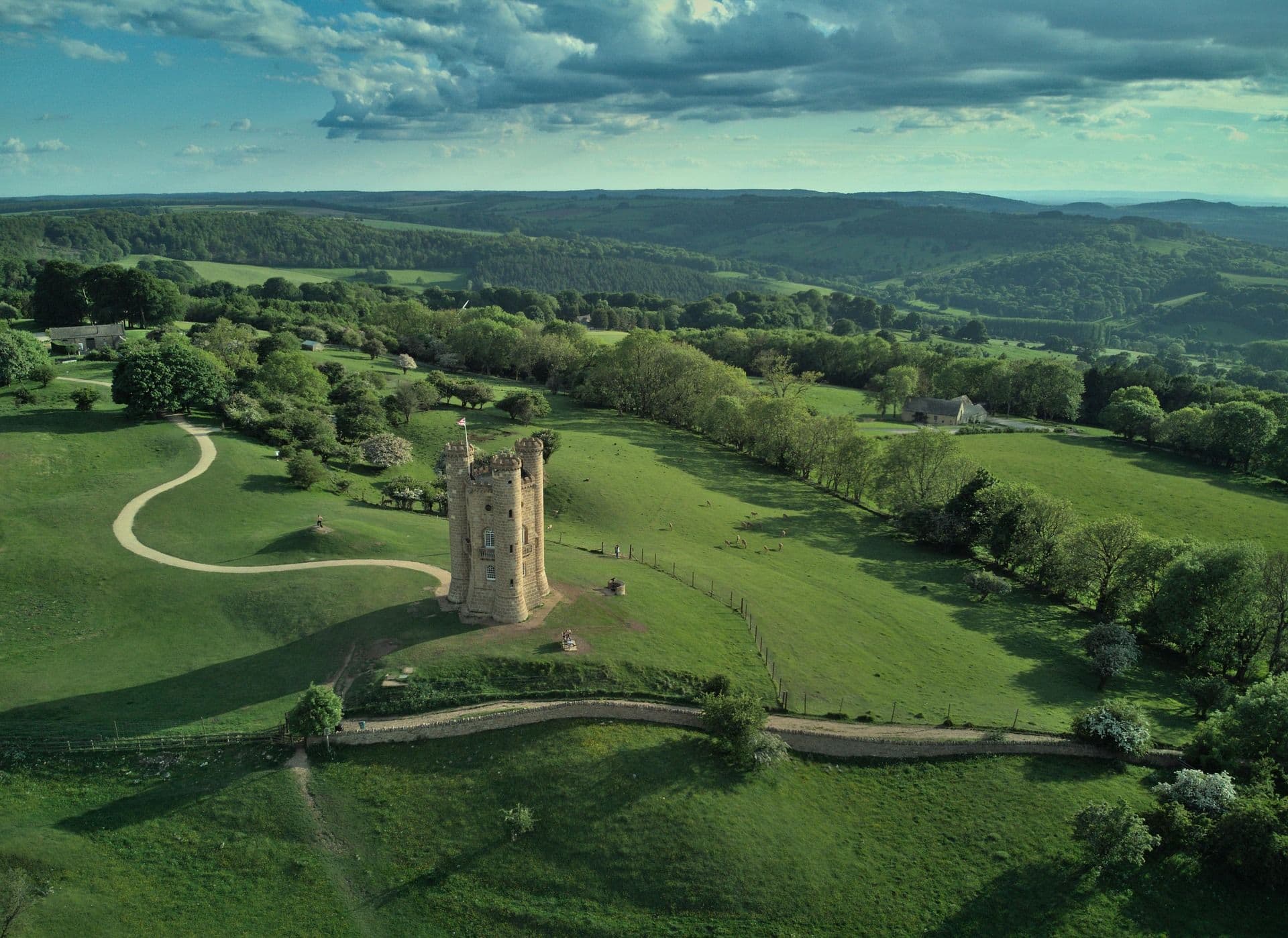
The Cotswolds sits roughly between Oxford to the east, Bath to the south, Stratford-upon-Avon to the north, and Stroud and Gloucester to the west. That positioning, within 90 minutes of London by train and accessible from Bristol in under an hour, means Cotswolds cycling is genuinely accessible for visitors flying into the UK's major airports. The region is compact enough to cross by bike in a long day's ride yet varied enough to sustain a week or more of riding without retracing the same road twice.
What gives Cotswolds cycling its distinctive character is the combination of scale and intimacy. The landscape is rarely vast or dramatic in the way of the Scottish Highlands or the Alps; its appeal is subtler and more accumulated. Every two or three kilometers brings a new village of honey-gold limestone cottages and a church tower visible across the fields. Farms account for around 80% of the land area, and the agricultural patterns, rapeseed flowering yellow in May, harvested grain fields in late summer, autumn plowing, shift the visual character of the landscape with the seasons. Sheep are everywhere, their fleece historically the source of the region's wealth, and their presence along field margins and on common land remains as characteristic as the dry-stone walls that divide the wolds into their patchwork geometry.
Cycling in the Cotswolds requires honest acknowledgment that the terrain is not for the casual leisure rider seeking entirely flat conditions. The name 'wold' means rolling hills in Old English, and the Cotswolds delivers on that etymology consistently. The gradients, however, are rarely extreme outside the western escarpment: most Cotswold lanes climb and descend within a 100 to 200 m (330 to 655 ft) range, with sustained grades of 5 to 8% common and steeper pitches of 10 to 15% concentrated on the escarpment descents and a handful of classic climbs. Riders who can handle that kind of terrain on a hybrid or touring bike will find the routes deeply rewarding; those wanting flat, canal-towpath cycling for long sections will need to plan routes accordingly, selecting from the Water Park and Stroud valley options described below.
Explore our amazing cycling tours now!
The western edge of the Cotswolds is the most topographically dramatic zone in the region and the one that defines the Cotswolds skyline. Here, the Jurassic limestone tilts sharply upward from the Severn floodplain, creating a distinct escarpment face with gradient pitches that challenge even experienced riders. The road from Cheltenham up to Cleeve Hill Common, the highest point in the Cotswolds at 330 m (1,083 ft), gains approximately 260 m (853 ft) over a few kilometers. The reward is a wide plateau of limestone grassland where the views extend west to the Welsh hills and north along the edge toward Broadway and Chipping Campden. The Broadway Hill climb to the south, leading to Broadway Tower at 312 m (1,024 ft), is similarly demanding and similarly rewarding. Wold-top riding between these high points follows open, rolling roads largely clear of trees, with the characteristic golden stone walls running along field boundaries and larks rising from the grass in summer.
East and south of the escarpment, the Cotswolds dip-slope drains into a series of river valleys whose broad meadows and riparian woodland provide the most relaxed cycling in the region. The Windrush Valley, running east from Bourton-on-the-Water through Great Barrington and on to Burford and Witney, follows a shallow gradient through some of the most-photographed scenery in the Cotswolds. The Coln Valley, quieter and less-visited, runs parallel to the south through villages like Bibury, whose Arlington Row of medieval weavers' cottages is one of the most recognizable images in England, and Coln St Aldwyns. The Evenlode Valley, further north, carries traffic from Moreton-in-Marsh toward Chipping Norton through forest tracks and pastoral farmland. All three valleys provide cycling terrain best described as gently undulating: occasional short climbs between valley floor and plateau edge, with mostly smooth tarmac and light traffic on the classified roads and bridleways that connect the villages.
South of Cirencester, the landscape changes character. The hills flatten and the Jurassic limestone gives way to lower ground where the headwaters of the Thames drain through gravel terraces. The Cotswold Water Park, covering 40 square miles (104 sq km) of lakes created by historic gravel extraction near South Cerney and Lechlade, provides genuinely flat cycling through a landscape of open water, wetland bird habitat, and quiet byways. Roads connecting the lakes and the surrounding villages like Fairford, Kempsford, and Kemble are among the easiest cycling terrain in the entire Cotswolds, suitable for families and riders of all abilities. The Thames and Severn Canal towpath runs nearby, offering traffic-free riding in sections. The ancient market town of Cirencester, often called the capital of the Cotswolds, makes a natural hub for this southern zone.
The northern Cotswolds, centered on Chipping Campden and the Vale of Evesham, offer a distinct flavor. The escarpment here is gentler and the countryside more open, with long ridge roads giving northward views over the orchard country and market gardens of the Vale. The lavender fields near Broadway bloom purple from late June through July, making the roads in this corner of the Cotswolds particularly popular during that period. Stratford-upon-Avon, Shakespeare's birthplace, sits just 15 km (9 mi) north of Chipping Campden, reachable via the Stratford Greenway traffic-free path, making the northern Cotswolds accessible as a stage in longer point-to-point routes connecting the region to the Midlands.
The Cotswold Way is a 163 km (102 mi) National Trail running the length of the Cotswold escarpment from Chipping Campden in the north to Bath in the south. While primarily designated as a walking trail, the route passes through terrain and road networks that form the backbone of multi-day Cotswolds cycling itineraries, and sections of the bridleway network run parallel to or directly coincide with the trail. Cycling the equivalent length, using the road network and bridleways that shadow the escarpment, covers approximately 200 km (125 mi) depending on deviations into towns, with a cumulative elevation gain in the region of 3,000 to 3,500 m (9,843 to 11,483 ft) over five to six days. The Cotswold Way cycling corridor links the most iconic villages on the western edge: Chipping Campden, Broadway, Winchcombe, Cheltenham, Painswick, Stroud, Wotton-under-Edge, and on south to Bath.
Distance: 18 km (11 mi) | Terrain: Rolling, one serious climb | Duration: 1 to 2 hours | Difficulty: Moderate.
The route leaves Chipping Campden, whose High Street with its medieval wool market hall and Perpendicular Gothic church tower is one of the finest in England, heading south-west along the escarpment edge. The climb to Dover's Hill, site of the Cotswold Olimpick Games dating from the early 17th century, gains roughly 120 m (394 ft) and rewards with a northward panorama over the Vale of Evesham. The descent and re-ascent to Broadway Tower, a folly on Broadway Hill at 312 m (1,024 ft) built for the Countess of Coventry in the late 18th century, provides the day's most demanding pitch. Broadway village below, with its wide green and honey-stone facades, is one of the most visited villages in the Cotswolds.
Distance: 22 km (14 mi) | Terrain: Escarpment roads with two significant climbs | Duration: 2 to 3 hours | Difficulty: Moderate to Strenuous.
From Broadway, the route heads south through Snowshill, a hamlet whose name reflected the probability of early snowfall on the exposed wolds and whose Tudor manor house holds the National Trust's collection of some 22,000 objects assembled by Charles Paget Wade, before descending to Winchcombe. The ancient Saxon capital of Winchcombe, with Sudeley Castle on its outskirts (the only private castle in England with a queen, Katherine Parr, buried in its grounds), makes an excellent overnight stop. The Cotswold lavender farm between Broadway and Snowshill blooms from late June, scenting the roads with purple fields visible across the valley.
Distance: 20 km (12 mi) | Terrain: Exposed wold top followed by descent | Duration: 1.5 to 2 hours | Difficulty: Moderate.
The section from Winchcombe to Cheltenham passes Cleeve Hill, the highest point in the Cotswolds at 330 m (1,083 ft), on roads that cross open limestone grassland before descending into the Regency spa town of Cheltenham. The Cleeve Hill climb from Winchcombe gains approximately 250 m (820 ft) and the gradient increases to around 8% on the upper section. Cheltenham, famous for its annual National Hunt horse racing festival in March and its Regency architecture, provides the most urban staging point on the full corridor route and the widest range of accommodation.
Distance: 30 km (19 mi) | Terrain: Escarpment edge with valley drops | Duration: 2.5 to 3.5 hours | Difficulty: Moderate to Strenuous.
South of Cheltenham the escarpment character sharpens. Painswick, often called the Queen of the Cotswolds, sits on a spur above the deep Painswick valley, its churchyard of 99 yew trees and medieval wool-trade prosperity still visible in its stone facades. The valley descents here are among the most demanding on the route, with roads dropping 150 to 200 m (492 to 656 ft) on gradients that require confident braking. Stroud, below the escarpment on the River Frome, was once the center of the Cotswolds textile industry; its Golden Valley, once lined with 150 mills, now provides a cycle-friendly route through converted industrial heritage toward the southern sections.
Distance: 55 km (34 mi) | Terrain: Varied, with limestone plateau and final urban descent | Duration: 4 to 5 hours | Difficulty: Moderate.
The southern section of the Cotswold Way cycling corridor passes through Wotton-under-Edge, Hawkesbury Upton, and Marshfield before the final descent into Bath. The landscape here transitions toward the Bath and Bristol fringe: the golden limestone intensifies, the villages become more heavily visited, and Castle Combe, frequently cited as the prettiest village in England, appears in a steep wooded valley. The final kilometers into Bath are downhill, and the city's Georgian architecture and Roman thermal heritage provide a dramatic conclusion to a traverse of the full Cotswolds.
Distance: 84 km (52 mi) | Terrain: Rolling hills with valley sections | Duration: 5 to 6 hours | Difficulty: Moderate to Strenuous.
One of the most celebrated touring circuits in the Cotswolds, this loop from Moreton-in-Marsh traces the Windrush Valley through Bourton-on-the-Water, Great Rissington, Great Barrington, and Burford before returning north through Northleach and the Windrush villages. The riding is characteristically undulating, with gradients rarely exceeding 8% but the terrain consistently rolling enough to demand sustained effort. Bourton-on-the-Water, nicknamed the Venice of the Cotswolds for its low stone bridges across the River Windrush, makes the most logical midpoint break. Burford's High Street, descending steeply to the river with medieval buildings on both sides, is one of the finest approaches to any town in the region on two wheels.
Distance: 70 km (44 mi) | Terrain: Mostly rolling, some flat southern sections | Duration: 4 to 5 hours | Difficulty: Moderate.
Starting from Cirencester, the 'Capital of the Cotswolds' and once one of the largest cities in Roman Britain, this route heads northeast through the Coln Valley, passing Bibury with its iconic Arlington Row cottages before returning via Northleach and the Ampney villages. The Corinium Museum's collection of Roman mosaics, altars, and carved stonework is worth an hour before setting off. The Coln Valley section is among the quietest cycling in the central Cotswolds, with minimal traffic on the minor roads between Coln St Aldwyns, Coln Rogers, and Coln St Dennis.
Distance: 45 km (28 mi) | Terrain: Mostly flat (Greenway section), rolling return | Duration: 3 to 4 hours | Difficulty: Easy to Moderate.
The Stratford Greenway is a 3 km (2 mi) traffic-free trail running south from Stratford-upon-Avon along a disused railway line, connecting to the northern Cotswolds via Mickleton and Long Marston. Extended into a loop through Chipping Campden, the route provides an accessible introduction to Cotswolds cycling for those arriving from Stratford or the Midlands. The Greenway itself is entirely flat and suitable for families; the Cotswolds section adds rolling terrain and the characteristic village scenery of the northern wolds.
Distance: 35 km (22 mi) | Terrain: Flat to gently rolling | Duration: 2 to 3 hours | Difficulty: Easy.
Starting from Kemble station, with a direct rail connection from London Paddington, this loop explores the source of the River Thames and the Cotswold Water Park. The Thames officially rises near Kemble at Thames Head, and the route passes through the villages of Ewen, South Cerney, and Somerford Keynes to reach the Water Park's 140 lakes before returning north. It is the flattest significant cycling circuit in the Cotswolds, making it the natural choice for those seeking a gentle introduction to the region or traveling with young riders. The lake landscapes and wetland bird life add a different visual register from the hill-and-village scenery further north.
Distance: 60 km (37 mi) one-way | Terrain: Rolling, moderate | Duration: Full day | Difficulty: Moderate.
The Cotswold Line rail route from Oxford to Worcester passes through the heart of the northern and eastern Cotswolds, and a parallel cycling route has been mapped using the road network between stations. Ridden one-way from Oxford to Moreton-in-Marsh, the route passes through Chipping Norton and Chipping Campden, covering the eastern Cotswolds before arriving at the Fosse Way market town that serves as the main base for Cotswolds cycling. With train stations approximately every 16 km (10 mi), the route can be tackled in sections and combined with the rail network for a flexible multi-day approach.
Explore our amazing bike tours in Cotswolds now !
Moreton-in-Marsh is the primary cycling hub for the Cotswolds: it sits on the Fosse Way (the Roman road running northeast to southwest across the region), has direct rail connections to London Paddington in approximately 90 minutes, and provides access to the densest concentration of cycling routes in the northern wolds. The town itself has a wide main street and a weekly market that has operated since 1227. From Moreton, cyclists can reach Chipping Campden (14 km/9 mi northwest), Stow-on-the-Wold (9 km/6 mi south), and Bourton-on-the-Water (12 km/7 mi southwest) on roads that pass through Broadwell, Evenlode, and the Evenlode Valley. Suitable for: all levels. Riders seeking village-to-village touring, cafes, and a broad network of routes will find Moreton-in-Marsh the most versatile base in the region.
Broadway serves as the natural base for escarpment-edge cycling in the northern Cotswolds. The village sits at the foot of the Broadway Hill climb, with access to the escarpment top via the ascent to Broadway Tower and south along the ridge to Winchcombe and Cheltenham. The roads off the escarpment northwest into the Vale of Evesham carry minimal traffic and provide a contrasting experience to the wold-top riding: orchard country, timber-framed buildings, and the approach to Stratford-upon-Avon. Broadway itself is one of the most visited villages in England, with a broad green flanked by honey-colored stone and a number of inns and cafes that serve the cycling and walking visitors who arrive throughout the year. Suitable for: intermediate to experienced cyclists comfortable with significant elevation gain and the physical demands of escarpment riding.
Bourton-on-the-Water, with its famous low bridges across the Windrush and its well-developed visitor infrastructure, is the busiest village in the central Cotswolds and a natural stop on any cycling itinerary between Moreton-in-Marsh and Cirencester. As a base, it places riders at the junction of the Windrush Valley and the wolds to the north, with easy access to the Slaughter villages (Upper and Lower Slaughter, each within 3 km/2 mi), Stow-on-the-Wold, and Northleach. The Bourton-to-Bibury loop, following the Coln Valley south before returning north via Northleach, is one of the classic half-day circuits in the Cotswolds and manageable for most riders with some cycling experience. Suitable for: intermediate cyclists and those wanting access to both the valley scenery and the central wolds.
Burford, sitting at the top of a steep High Street that descends to the Windrush at the eastern edge of the Cotswolds, is a market town with significant medieval character and excellent accommodation options. Its position makes it an effective base for the eastern Cotswolds, with routes east toward Oxford and the Wychwood Forest, south toward the Water Park, and west along the Windrush Valley back into the heart of the region. The Wychwood Forest cycle route from Burford via Shipton-under-Wychwood to Chipping Norton covers quieter, tree-lined roads largely unknown to casual visitors. Suitable for: all levels. Burford's own topography (the steep High Street) is a minor challenge; the routes radiating from it range from easy valley riding to demanding wold circuits.
Cirencester, with its Roman amphitheater, medieval wool church, and working-market atmosphere, is the southern hub of the Cotswolds and the most urban base in the region short of Cheltenham. It provides access to the flattest cycling terrain in the Cotswolds, including the Water Park and the Thames source country to the south, as well as the Coln Valley northward and the Stroud valleys westward. The Cirencester to Tetbury route (35 km/22 mi round trip via Highgrove Gardens and Westonbirt Arboretum, the UK's national arboretum) is a popular circuit with straightforward terrain and significant stopping points. Suitable for: all levels. Particularly well-suited to those seeking flatter cycling options or using Cirencester as a gateway to both the wolds and the southern water country.
Cheltenham is the largest urban center within or adjacent to the Cotswolds and offers the widest range of accommodation and services for visiting cyclists. Its position at the foot of the Cleeve Hill escarpment means the most dramatic Cotswolds cycling is immediately available: the climb to 330 m (1,083 ft) begins effectively within the town boundary. The Cheltenham-based routes, whether north along the escarpment toward Broadway or south through Painswick and the deep valleys of the Stroud district, represent the most physically demanding cycling in the Cotswolds and are best suited to riders comfortable with significant climbs. Cheltenham's annual Gold Cup race week in March, the National Hunt Festival, transforms the town and fills accommodation months in advance, so cycling visits should avoid this period unless deliberately planned around the racing. Suitable for: intermediate to advanced riders. The escarpment terrain demands fitness; the valley alternatives out of Cheltenham are more accessible.
Stroud sits at the junction of five valleys on the escarpment's western face and was historically the center of the Cotswolds cloth trade. Its award-winning Saturday farmers' market is one of the best in England, and the compact town center retains a creative, independent-business character distinct from the more tourist-oriented villages further east. The Stroud valleys, including the Golden Valley of the Frome River and the Painswick Valley, provide cycling terrain that combines industrial heritage (converted mills, canal infrastructure) with deep-wooded river scenery. The Stroud to Nailsworth route (8 km/5 mi) follows the valley floor and is one of the gentler rides in the region; expanding the circuit to include the escarpment roads above adds significant challenge. Suitable for: mixed levels. The valley floors are accessible; the escarpment roads above demand serious effort.
May and June represent the optimal months for Cotswolds cycling, combining mild temperatures, the longest pre-peak-season daylight, and the landscape at its most visually varied. Average daytime highs in May run 16 to 18 degrees C (61 to 64 degrees F), rising to 19 to 21 degrees C (66 to 70 degrees F) in June. Rain is possible, as the Cotswolds receives approximately 790 mm (31 in) of annual precipitation spread through the year, but the incidence of wet days is lower in May than at any other time. The rapeseed fields that cover Cotswolds farmland bloom intensely yellow throughout April and May, while bluebell woodlands reach their peak in late April and May. June brings the lavender fields near Broadway into bloom from the third week of the month, with peak color in July. School term remains in session through most of May and into June, keeping village traffic and accommodation demand lower than in the summer holidays. Book accommodation at least two to three months ahead for May weekends, which are popular with London-based visitors.
July and August are the warmest months, with average highs of 21 to 22 degrees C (70 to 72 degrees F) and up to 6.6 hours of daily sunshine in July. For multi-day routes, the long daylight makes July and August the most practical months for completing full-day riding stages. The trade-off is significant: the Cotswolds is one of England's most visited rural destinations, and the school holiday period from late July through August brings heavy visitor traffic to the honeypot villages: Bourton-on-the-Water, Bibury, Broadway, and Burford in particular. Accommodation prices rise sharply and must be booked well in advance, often four to six months ahead for the most popular villages. The heat, while modest by European standards, can make exposed wold-top riding uncomfortable during the warmest afternoons. Cyclists planning July and August visits should start early, before 8 a.m., to cover the more popular village sections before the day-visitor traffic builds.
September is arguably the most rewarding month for experienced Cotswolds cyclists. Schools return in early September, and the crowds thin noticeably while temperatures remain warm: average highs of 18 to 19 degrees C (64 to 66 degrees F) and daylight stretching past 7 p.m. through mid-September. The harvest season changes the landscape from green to gold and amber, and the blackberries that line the country lanes from late August through September offer their own incidental reward. The Moreton-in-Marsh Show, the largest agricultural show in the UK, typically takes place in September and draws large crowds to the town but is a genuine reflection of Cotswolds farming culture. October brings autumn color to the beech woodlands on the escarpment and in the river valleys, at its peak in the second and third weeks, but daylight shortens rapidly and rainfall increases. Plan October rides to finish by 4 p.m. as evenings draw in quickly from mid-month.
March and April offer the quietest Cotswolds roads of the year, with accommodation prices lower than any other season and village visitor numbers manageable even at weekends. Temperatures in March average 8 to 10 degrees C (46 to 50 degrees F) and can be significantly colder on the exposed escarpment. April warms to 10 to 13 degrees C (50 to 55 degrees F) with occasional cold wet days. The countryside is actively and visibly coming into season: wild garlic carpets the woodland floors from March, daffodils line the verges, and the distinctive green of the new season's growth fills the wolds. Note that March also brings the Cheltenham Gold Cup race week, which puts heavy demand on accommodation and fills local roads. The race week window, typically four days in mid-March, is best avoided by those cycling the Cheltenham-adjacent areas unless the horse racing is itself a planned stop.
Winter cycling in the Cotswolds is viable but demands specific preparation. Average highs in December through February run 6 to 8 degrees C (43 to 46 degrees F), and ground frost can persist on exposed lanes through the morning. Ice on the wold-top roads is a genuine hazard from December through February, particularly on the descents off the escarpment, and road surfaces deteriorate more in wet winter conditions. The compensations are considerable: the villages are at their quietest, accommodation prices are at their annual low, and the Cotswolds stone takes on a different quality in low winter light. Christmas in the Cotswolds, with decorated market towns and log fires in centuries-old pubs, has a specific appeal for those willing to layer up and manage the conditions. Shorter days (fewer than 2 hours of useful cycling light in December) require planning routes accordingly.
The Cotswolds AONB was designated primarily for its limestone grassland habitats rather than its village architecture, and cyclists who pay attention to the verges and commons on the wold tops encounter a flora that is largely absent from the farmed lowlands below. Cleeve Hill Common supports one of the largest areas of unimproved limestone grassland in the Cotswolds, with cowslips, pyramidal orchids, and early purple orchids flowering from May through July. The Duke of Burgundy butterfly, a rare and declining species, finds one of its more stable populations on Cleeve Hill's limestone turf. Chalk-blue and marbled white butterflies are visible along the escarpment roads in June and July. Skylarks are heard almost continuously on the wold tops in spring and early summer, the males delivering their continuous song from directly above the road as they hover in the thermals.
Ancient beech woodland characterizes many of the escarpment slopes and some of the deeper valleys, and cycling through these sections in late October provides one of the most visually striking experiences in the Cotswolds. The beech canopy turns from gold to copper to rust over the course of October, and on calm days the fallen leaves form a continuous layer across the roads. The Wychwood Forest area east of Burford is one of the more extensive remnant woodlands in the region, with roads running through stands of oak, ash, and beech that support a resident population of roe deer. The Westonbirt Arboretum near Tetbury, the UK's national arboretum with over 2,500 tree species, hosts its Enchanted Christmas event in November and December but its main autumn color display, genuinely spectacular with Japanese maples alongside native species, runs through October.
The Cotswold Water Park south of Cirencester supports one of the UK's largest inland populations of great crested grebes, along with bitterns, kingfishers, ospreys on migration, and a significant wintering wildfowl population that builds through October and November. Cycling the Water Park in autumn and winter, when the trees are down and the birdlife at its most concentrated, provides a genuinely different kind of encounter from the summer landscape. The River Coln and its tributaries in the central Cotswolds support populations of brown trout in the clear limestone water, with the occasional heron visible in the shallows at dawn and dusk. Otters have returned to several Cotswolds rivers in recent decades following the recovery of the otter population nationally, though sightings from the road are rare and largely a matter of timing and luck.
The seasonal wildflower sequence through the Cotswolds provides markers that experienced riders use to orient their trip planning as precisely as weather forecasts. Wild garlic fills the woodland floor with white flowers and a sharp, herby scent from late March through May. Bluebells peak in late April in the beech woodlands along the escarpment. Common spotted orchids and pyramidal orchids appear on the limestone verges from June. The Cotswold Lavender Farm near Broadway, planted with multiple lavender varieties, provides its most intense display through July. Autumn gentians flower on the limestone grasslands of Cleeve Hill in September. Sloe berries blacken on the blackthorn hedges from September, eventually used in the sloe gin that appears in local bars and farm shops from November.
To ride through the Cotswolds is to move through the visible remains of one of the most prosperous regional economies in medieval England. From roughly the 12th to the 17th century, the Cotswold Lion, a large, long-fleeced sheep specific to the region, produced wool that was exported across Europe, financing the construction of churches, market halls, manor houses, and the distinctive stone cottages that give the Cotswolds its visual identity. The term 'wool churches' is not hyperbole: the Church of St John the Baptist in Cirencester, the Church of St James in Chipping Campden, and a dozen others throughout the region are structures of extraordinary scale and ambition built entirely from the surplus wealth of the medieval fleece trade. Every cycling route in the Cotswolds passes within sight of at least one, and several routes are best understood as connecting these monuments of commercial prosperity.
The Romans came to the Cotswolds long before the wool trade: the Fosse Way, the arrow-straight Roman road running from Exeter to Lincoln, passes directly through Cirencester (Roman Corinium, the second-largest city in Roman Britain) and through Moreton-in-Marsh, and sections of it remain as rideable road today. The Chedworth Roman Villa, reached by road from Bourton-on-the-Water, is one of the best-preserved villa complexes in Britain, with floor mosaics intact and a small museum in place. The Rollright Stones on the Oxfordshire-Warwickshire border, reachable from Chipping Norton, are a Bronze Age stone circle predating the Roman period by two millennia, accessible from a short detour off the Cotswold Line route.
Chipping Campden holds a particular place in the cultural history of the Cotswolds as the town where the Arts and Crafts movement, led by C. R. Ashbee, established its Guild of Handicraft in 1902. The movement's rejection of industrial production in favor of hand craftsmanship, in silver, textiles, furniture, and architecture, found expression in the town's existing medieval character and left behind a legacy of quality local craftsmanship that persists in the small workshops and independent businesses operating there today. William Morris, whose philosophy underpinned much of the Arts and Crafts movement, stayed at Broadway Tower and drew directly from the Cotswolds landscape in his design work. Cycling between Broadway and
Chipping Campden places you in territory that directly shaped a significant strand of 20th-century design culture. Cotswolds cycling also brushes against more recent cultural geography. The area around Chipping Norton, known colloquially as the Chipping Norton Set for the cluster of media, political, and creative figures who have lived in its environs, has given the eastern Cotswolds a different modern character from the farming south. Daylesford Organic, the farm shop and cafe complex near Kingham founded by Carole Bamford and frequented by this social set, has become a genuine destination stop on cycling routes through the eastern wolds, and its influence on the quality of local food retail is visible throughout the region.
Get started with your Cycling adventure now!
A cream tea, meaning scones with clotted cream, jam, and a pot of English or Earl Grey tea, is the defining mid-ride stop in the Cotswolds, available in virtually every village tearoom and cafe throughout the region. The Cotswolds version uses scones fresh from the oven, thick clotted cream, and local preserves made from the seasonal fruit of the hedgerows and orchards. The ritual of the cream tea fits the cycling pace naturally: a 30-minute stop, a stone table outside a 16th-century building, and then back onto the lane for the afternoon section. The difference between a mediocre and an excellent cream tea in the Cotswolds often comes down to the cream, which should be thick enough to require spreading rather than pouring, and the scone, which should break apart at the horizontal without pressure. Village tearooms in Burford, Winchcombe, Bourton-on-the-Water, and Chipping Campden are the most reliably strong options.
Double Gloucester cheese has been produced in Gloucestershire since at least the 16th century, made from the full-cream milk of Old Gloucester cattle, and the region retains a strong artisan cheese culture alongside the commercial producers. Double Gloucester is aged longer than its lighter sibling Single Gloucester, developing a firmer texture and a deeper, more buttery flavor. Stinking Bishop, made by Charles Martell and Son near Dymock in the western Cotswolds, is the most internationally recognized cheese from the region: a strong, washed-rind cheese with a pungent exterior and a creamy, mild interior. It is named after a variety of pear used in the perry wash applied to its rind during production. The Cerney Ash goat's cheese from Cerney House near Cirencester is a consistently award-winning soft cheese. Ploughmans lunches served at Cotswolds pubs almost always include a selection of local cheeses alongside pickled onions, apple, chutney, and crusty bread: an efficient and historically appropriate cyclist's meal that provides carbohydrate, protein, and fat in proportion to the afternoon's effort.
The Cotswold Lion sheep remains a presence in the landscape, and Cotswold lamb, raised on the limestone grasslands and wold pastures where the breed has grazed for centuries, appears on menus throughout the region from spring through late autumn. The grass-fed diet produces meat with a slightly more mineral quality than lowland lamb, and the cooking traditions reflect the seasons: braised shoulder with root vegetables in the colder months, grilled rack or leg in summer. The Sunday roast in a Cotswold pub remains one of the great British eating experiences, and Cotswold lamb shoulder, slow-roasted with rosemary and garlic, is frequently the best item on the plate.
Gloucestershire Cheese and Ale is the county's variation on Welsh rarebit: a sauce of melted Double or Single Gloucester cheese combined with local ale and Tewkesbury mustard, poured over toast and grilled. Tewkesbury mustard, made from mixed mustard seeds and horseradish since medieval times, appears in Shakespeare's Henry IV as a marker of density ('his wit's as thick as Tewkesbury mustard') and is still produced today with its characteristic heat and complexity. The combination of strong cheese, bitter ale, and sharp mustard on toast is a warming post-ride meal well-suited to the colder months. Local ales from the Donnington Brewery at Stow-on-the-Wold, one of England's smallest and most traditional brewers operating from a water mill since 1827, or from Hook Norton Brewery near Chipping Norton, are the appropriate accompaniment.
The ploughmans lunch, a cold plate of bread, cheese, pickle, and accompaniments, originated as a practical pub meal and has survived with its essential character intact in the Cotswolds, where the pub remains a genuine social institution rather than a tourist stop-off. A proper Cotswolds ploughmans is built from local sourcing: Hobbs House bread from Chipping Sodbury, local farmhouse cheeses, chutney from a nearby producer, apple from the orchards of the Vale of Evesham, and pickled walnuts or onions from a regional maker. It is efficiently portable, energy-dense, and requires no kitchen: the ideal cyclist's fuel when packed for a long ride or eaten on a pub bench in the afternoon sun.
The Cotswolds' clear limestone rivers have supported trout farming since at least the Victorian period, and Bibury Trout Farm, in operation at Arlington Row since 1902, is one of the oldest commercial trout hatcheries in England. Rainbow trout from the Coln and its tributaries appear on menus throughout the central Cotswolds, served smoked with horseradish, pan-fried with butter and herbs, or in simple preparations that allow the quality of the fish to remain dominant. The nearby River Severn and River Wye contribute salmon, available at specialist smokehouses in the western Cotswolds and at the better farm shops and fishmongers in Cirencester and Nailsworth.
The Cotswolds Distillery, established at Stourton near Shipston-on-Stour in 2014, is the first full-scale distillery to operate in the region and now produces both a Cotswolds Dry Gin and a single malt whisky that have gained significant national recognition. The gin, made with local grain and a botanical mix that includes lavender from the nearby Cotswolds Lavender Farm, has a distinct regional character. The single malt, aged in American and European oak casks, reflects the general quality of small British distilleries that emerged after 2010. The distillery runs visitor tours throughout the year, and bottles of both products appear in farm shops and pubs across the Cotswolds.
Dive into our curated Cotswolds cycling adventures today!
Cycling in the Cotswolds rewards preparation proportional to the ambitions of the route planned. A gentle valley circuit of 30 to 40 km (19 to 25 mi) with minimal climbing is achievable for any reasonably active adult with a few weeks of preparation riding. A multi-day Cotswold Way corridor traverse covering 200 km (125 mi) with 3,000 to 3,500 m (9,843 to 11,483 ft) of cumulative elevation gain requires a sustained base of longer weekend rides over several months, with the ability to maintain pace on 6 to 8% grades for sustained periods. The specific physical challenge of the Cotswolds is not the individual climb (most are under 3 km/2 mi) but the repetitive rolling terrain, where gradients continue to draw effort even on days that appear moderate on paper. Building a specific program of shorter, repeated hill climbs is more useful preparation than single long flat rides.
The Cotswolds cycling network rewards versatile bikes over pure-road racers. Most classified roads are well-surfaced tarmac with occasional patchy sections, while the bridleway and canal towpath options that extend route possibilities require at minimum hybrid tires capable of handling gravel and compacted dirt. A hybrid or gravel bike with 28 to 40 mm tires provides the best balance for the Cotswolds: efficient on tarmac, capable on bridleways, and with the gearing to manage the 10 to 15% escarpment pitches without stalling. Road bikes with standard gearing work well on the classified roads but are poorly suited to detours off-tarmac. Electric bikes have become increasingly popular in the Cotswolds, as the e-bike makes the escarpment climbs genuinely accessible to riders who want the experience without the physical demand, and the infrastructure in towns like Moreton-in-Marsh and Chipping Campden has developed to accommodate them. Mountain bikes are unnecessary for the road-and-bridleway network and add weight without benefit.
British weather requires layered preparation regardless of the season. In summer, a waterproof gilet or light rain jacket should accompany every long ride, as Cotswolds showers can arrive without much warning and the exposed wold tops provide no shelter. In spring and autumn, full waterproof jacket, thermal base layer, and leg warmers are essential for morning starts when temperatures can be 5 to 8 degrees C (41 to 46 degrees F) even on days that warm through the afternoon. Navigation is important in the Cotswolds, where the dense network of lanes, bridleways, and classified roads requires regular decision-making. Offline GPS maps loaded before departure, via apps that do not require mobile connectivity, are significantly more reliable than mobile map services in the valleys and woodland sections where signal can be weak. Ordnance Survey 1:25,000 Explorer sheets cover the region, with approximately six sheets needed for a full Cotswold Way traverse.
The Cotswolds is exceptionally well-connected by rail from London. Moreton-in-Marsh and Kingham are on the Cotswold Line from London Paddington, with journey times of approximately 90 minutes and 75 minutes respectively. Oxford, the eastern gateway to the Cotswolds, is 55 minutes from Paddington. Cheltenham Spa has direct services from London Paddington (approximately 2 hours 15 minutes) and from Birmingham (45 minutes), Edinburgh, and Bristol. Bath, the southern terminus of the Cotswold Way cycling corridor, is approximately 90 minutes from London Paddington. Bikes can be taken on Great Western Railway services on the Cotswold Line with advance booking; the bike spaces are limited (typically two to four per train) and should be reserved well in advance, particularly for summer and weekend travel. Heathrow Airport connects to both Paddington and Reading stations, providing a direct entry point for international visitors.
Within the Cotswolds, the rail network is limited but useful for point-to-point itineraries. The Cotswold Line stations at Kingham, Moreton-in-Marsh, Honeybourne, and Evesham enable routes to be structured with train returns from the endpoint. Cheltenham Spa connects to Gloucester, Bristol, and Birmingham. Bus services between Cotswold villages exist but are infrequent outside market-day schedules; the Pulhams and Marchants bus operators cover some of the key routes, but services reduce significantly on Sundays and in winter. Planning around the train rather than bus services produces more reliable logistics.
Cotswolds roads are generally well-maintained and carry relatively light traffic compared to major A-roads, but several practical safety considerations apply. Country lanes are narrow, often too narrow for two cars to pass simultaneously, and the blind bends and high hedgerows of many routes require defensive positioning, riding near the center of the lane on bends to remain visible. High-speed tractor and agricultural machinery traffic during harvest (July to September) requires particular caution on rural lanes. Weekend mornings between May and September bring higher volumes of leisure car traffic to the honeypot villages.
The A44 Chipping Campden to Oxford road, the A429 Fosse Way, and the A40 Burford to Oxford road carry faster-moving traffic and should be avoided where alternatives exist. Most cycling routes use classified B-roads and unclassified lanes where through-traffic is minimal.
The United Kingdom requires visas for visitors from many countries, though citizens of the EU, USA, Canada, Australia, New Zealand, and a number of other countries do not require advance visas for short visits (under 6 months for most). EU citizens and some others are required to use the UK Electronic Travel Authorization (ETA) system for stays under 6 months, which must be applied for in advance online. Requirements change periodically: check the official UK Visas and Immigration website (gov.uk) before travel. There are no specific cycling-related entry requirements.
The currency is the British pound sterling (GBP). Credit and debit cards are accepted at almost all accommodation and restaurants in the Cotswolds, including most rural pubs. Cash remains useful for smaller cafes, farm shops, and car parks. The Cotswolds is not a budget destination: accommodation ranges from approximately 80 to 150 GBP per room per night at B&Bs and inns in the mid-range, with manor house hotels and premium country house accommodation running considerably higher. Pub meals average 15 to 25 GBP per person; cream teas and cafe meals run 8 to 15 GBP. There is no tipping obligation in England, but leaving 10% in restaurants for good service is standard.
English is the only language required throughout the Cotswolds. No additional language preparation is needed. Mobile phone coverage is generally good in the towns and main villages but can drop to one bar or no signal in the deeper valleys and some of the more remote wold-top sections. Downloading offline maps before departure is strongly recommended. The Three network provides the best rural coverage in the Cotswolds based on user reports, though all networks have coverage gaps. Free WiFi is available in most pubs, cafes, and B&Bs.
The UK operates on Greenwich Mean Time (UTC+0) in winter and British Summer Time (UTC+1) from late March through late October. In midsummer, daylight extends past 9 p.m. in the Cotswolds, providing more than enough light for long cycling days. In December, usable cycling daylight shrinks to approximately 7.5 hours (roughly 8 a.m. to 3:30 p.m.), which limits winter day rides significantly.
England does not have Scotland's universal right to roam. Cyclists in the Cotswolds are restricted to public roads, designated bridleways (where cycling is permitted), and permissive paths where landowner permission has been given. The Cotswolds AONB publishes maps of the bridleway network. Cycling on footpaths is illegal in England, regardless of how remote the path or how light the foot traffic. The Countryside Code applies throughout the Cotswolds: leave no trace, close gates, and yield to other path users.
The Cotswolds has one of the densest concentrations of characterful small accommodation in England, ranging from working-farm B&Bs in converted barns to 15th-century coaching inns and luxury country house hotels. For cyclists, the practical considerations are secure bike storage, early breakfast availability (for long-day starts), and proximity to the route. Most Cotswold B&Bs and inns are used to cycling guests and will store bikes in a locked outbuilding or garage on request; confirm this when booking.
B&Bs and small inns in the range of 80 to 130 GBP per room per night represent the majority of accommodation in the central Cotswolds. These typically include a cooked English breakfast and provide the most direct engagement with local hospitality culture. The Porch House at Stow-on-the-Wold, claiming the distinction of England's oldest inn (origin debated but with records to the 10th century), the Lamb Inn at Burford, and the Crown Inn at Blockley are examples of the kind of stone-built, fireplace-warmed Cotswolds inn that defines the overnight experience in the region. Larger towns, including Cheltenham, Cirencester, and Moreton-in-Marsh, provide more hotel-format accommodation with greater availability and easier last-minute booking.
Camping and glamping options exist throughout the Cotswolds, though the concentration of campsite infrastructure is lighter here than in the Lake District or Dartmoor. Several farms open for cyclists and walkers specifically, and basic camping barns provide minimal-cost overnight options on the multi-day escarpment routes. Cyclists completing a Cotswold Way traverse should plan accommodation at least two to three months in advance for summer travel; the combination of walking and cycling traffic on this corridor creates significant demand in July and August.
Cycling in the Cotswolds by Chiz Dakin (Cicerone Press) is the most practical dedicated cycling guidebook for the region, covering 21 half and full-day routes plus a four-day 200 km (125 mi) tour. Its focus on the bridleway and canal network alongside the road routes makes it genuinely useful for extending itineraries beyond the classified road network.
J. B. Priestley's English Journey (1934) contains a celebrated passage on Cotswold stone and the character of the region's architecture, written at a moment before mass tourism changed the villages materially. It remains one of the clearest-eyed literary engagements with what makes the Cotswolds distinctive rather than merely picturesque.
The Wool Churches of the Cotswolds by Tim Sherwood provides a focused account of the connection between the medieval fleece trade and the construction of the region's extraordinary church architecture. Understanding the economic context of what you pass while riding transforms the visual experience significantly.
Downton Abbey used Bampton, a village on the eastern edge of the Cotswolds in Oxfordshire, as its exterior filming location for the fictional Yorkshire village of Downton. The gap between the show's fictional setting and the actual Cotswolds landscape that substitutes for it is worth thinking about: it suggests something about how the region functions as a projection screen for ideas about English rural life.
Restoration Man (Channel 4) has covered several Cotswolds properties over its run, and its episodes dealing with the conversion and restoration of Cotswold stone buildings provide context for the architectural vocabulary cyclists encounter on the routes.
The Cotswold Olimpick Games at Dover's Hill above Chipping Campden take place annually in late May or early June, on the Friday following the Spring Bank Holiday. The Games date from 1612, when Robert Dover established a program of physical contests on the escarpment. The current program includes tug-of-war, shin-kicking (the iconic Cotswold sport), and a torchlit procession to Chipping Campden following the evening events. The route from the town to Dover's Hill is a 2.5 km (1.5 mi) climb that most cycling visitors will already know from the Cotswold Way.
The Stroud Farmers' Market, held every Saturday morning in the center of Stroud, is one of the best food markets in England. Operating year-round and covering an unusually wide range of producers from across the Cotswolds and the Severn Valley, it provides an opportunity to engage with the actual food culture of the region rather than the visitor-oriented version available in the tourist villages. Planning a Saturday night in Stroud or the adjacent villages to catch the early market before setting off works well as a route integration.
The Westonbirt Arboretum near Tetbury, the UK's national arboretum, reaches peak visual interest in mid-October when its collection of maples, liquidambar, and other specimen trees creates a color display that justifies planning a route specifically around it. The arboretum is open year-round, with an admission charge; combining it with the Cirencester to Tetbury route makes a natural half-day or full-day itinerary.
Get started with your cycling adventure now!
Cycling the Cotswolds delivers an experience specific to England and difficult to replicate: the combination of genuine topographical challenge, medieval cultural density, and a food-and-pub culture deeply embedded in the rhythm of moving through the countryside on two wheels. Whether you are drawn by the escarpment climbs above Broadway and Winchcombe, the quieter valley riding through the Coln and Windrush, or the flat water-and-sky landscapes of the Cotswold Water Park, the region rewards sustained exploration rather than single-day visits.
Art of Bicycle Trips designs custom cycling itineraries built around the experience of place rather than generic route templates. If the Cotswolds is on your itinerary, whether as a standalone destination or as part of a wider England cycling journey incorporating the Lake District, Scotland, or Wales, we are ready to help you design a trip that reflects what you actually want from the riding and the stops along the way. We know how to build itineraries that avoid the peak-traffic village hours, find accommodation that keeps bikes secure and breakfasts early, and sequence routes to balance effort and reward across multiple days.
Reach out to the Art of Bicycle Trips team at artofbicycletrips.com to start planning your Cotswolds cycling itinerary. We build private tours for individuals, couples, and small groups, with support, logistics, and local knowledge included.
Get started with your Cycling adventure now!
Create a private trip or join a small-group departure.