Chat with us on WhatsApp. We're just a message away.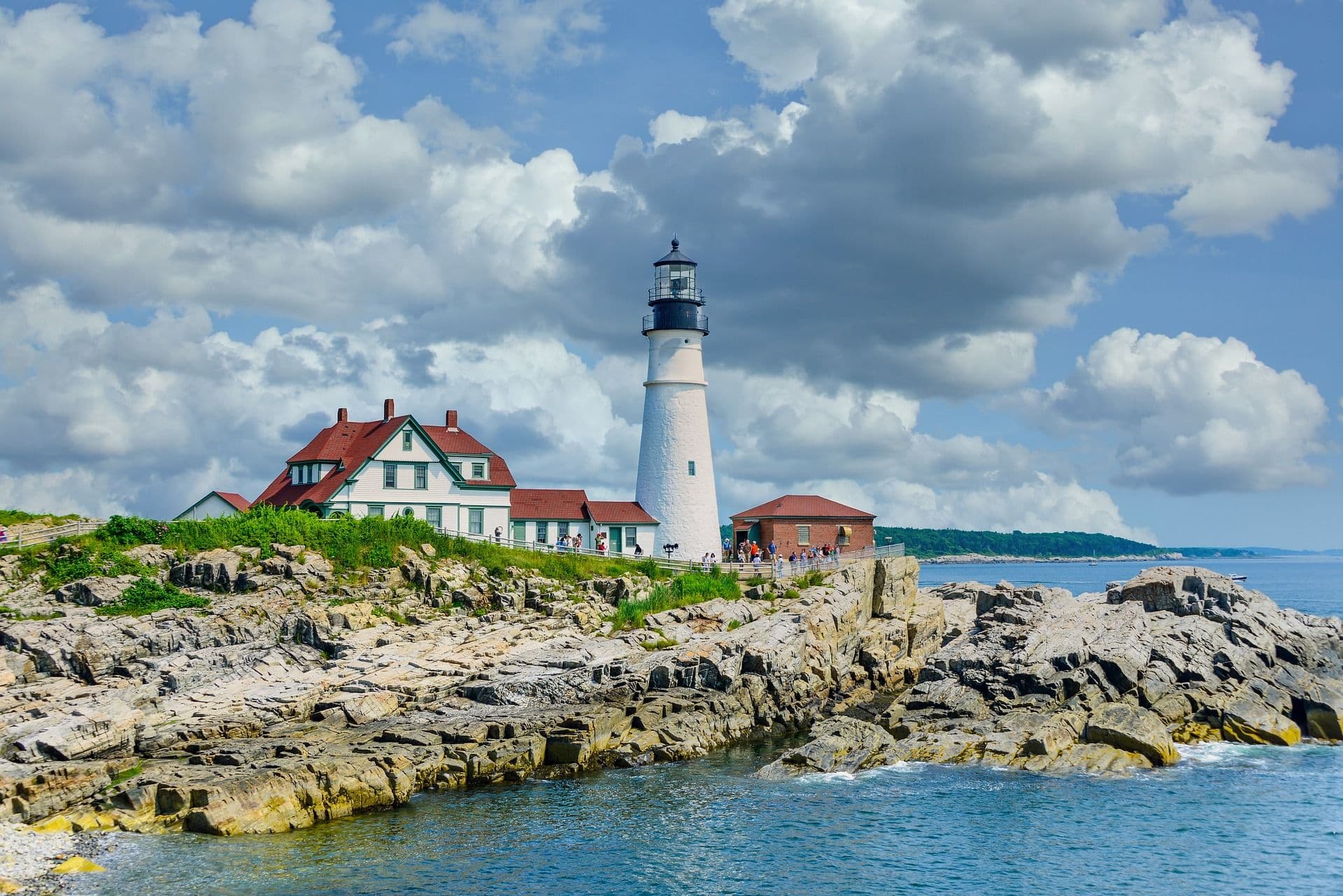
Maine is the largest state in New England, covering approximately 35,380 square miles, and it is the second-most-rural state in the entire country, with a population density of just 43 people per square mile. It shares its southern border with New Hampshire, and its northeastern border runs against the Canadian provinces of Quebec and New Brunswick. The St. Croix River marks part of that international boundary, and the town of Calais, in the far northeast, is where one of the great American cycling routes, US Bicycle Route 1, has its northern terminus.
The state divides naturally into several distinct travel regions. The Maine Beaches in the south, from Kittery to Old Orchard Beach, draw summer crowds to wide sandy shorelines. Greater Portland and Casco Bay anchor the cultural center of the state, with Portland's food scene now ranking among the best in New England. The Mid-Coast runs north through Damariscotta, Rockland, and Camden, and is widely considered the heart of the classic Maine experience. Working fishing harbors, historic lighthouses, and peninsulas that jut into glittering bays. The Downeast and Acadia region includes Mount Desert Island, Bar Harbor, and Acadia National Park, as well as the vast, underpopulated stretch of coast toward the Canadian border. Further inland, Maine's Lakes and Mountains region and the Maine Highlands contain the serious mountain biking terrain of Carrabassett Valley and the remote interior.
Cycling Maine draws a distinctive community. There is no dominant racing culture here, no Flandrien identity built on suffering for suffering's sake. What Maine cycling offers instead is something closer to exploration: the gradual revelation of a landscape that does not reveal itself quickly from a car window. The state road network has a generous supply of lightly trafficked secondary routes, and the culture of quiet hospitality in small towns means cyclists are generally welcomed rather than simply tolerated. Many roads along the mid-coast and Downeast carry almost no traffic outside of summer weekends, and even in peak season the famous infrastructure bottleneck happens on US Route 1, not on the backroads where cyclists actually ride.
Explore our amazing bike tours in Maine now !
The southernmost section of Maine's coast, from Kittery through the Kennebunks to Portland, is the flattest and most accessible terrain in the state. Sandy beaches alternate with working harbors, and the roads run through classic New England seaside communities with relatively gentle gradients. The Eastern Trail, a multi-use path being developed from Kittery to South Portland, passes through Scarborough Marsh, the largest salt marsh in Maine. This terrain suits beginners, families, and those doing multi-day touring who prefer to ease into the state before the terrain stiffens further north.
From Brunswick north through Rockland and Camden to Castine, the mid-coast introduces the characteristic Maine topography: a series of peninsulas running roughly south into the sea, connected by a main artery corridor along US Route 1. The riding on these peninsulas is genuinely beautiful, with quiet roads looping through fishing villages, past working harbors, and out to rocky headlands where the view extends to island-dotted bays. The terrain is rolling rather than mountainous, with climbs typically reaching 60 to 150 m (200 to 500 ft) before dropping back to water level. This is the Maine that most touring cyclists come for.
Acadia National Park sits on Mount Desert Island, roughly 260 kms (160 mi) northeast of Portland. The park's highest point is Cadillac Mountain at 466 m (1,530 ft), the tallest mountain on the eastern seaboard north of Rio de Janeiro. The terrain here is dramatic by any New England standard: pink granite domes, fjord-like Somes Sound (the only natural fjord on the US East Coast), and a 27-mile Park Loop Road that traces the island's eastern shore past Sand Beach, Thunder Hole, and Otter Cliff. The 45 miles of carriage roads built by John D. Rockefeller Jr. between 1913 and 1940 are the cycling centerpiece of the park. Crushed stone, motor-vehicle free, and traversing 17 stone-faced bridges across mountain streams and pond outlets, the carriage roads reward riders of every ability level, from family-friendly lake loops to full-day around-the-mountain traverses.
East of Ellsworth and the Acadia gateway, the landscape changes register. The coast becomes wilder, the towns smaller, the blueberry barrens wider. Downeast Maine, named for the old sailing term for traveling downwind to the northeast, is where the crowds thin and the road shoulders often disappear. The riding here is remote in a way that is genuinely unusual for the Eastern United States. Elevations are modest, rarely exceeding 100 m (330 ft), but the terrain rolls continuously and the wind off the Bay of Fundy can be a factor. The Down East Sunrise Trail, an 85-mile (137 km) rail trail from Ellsworth to Ayers Junction, provides the primary off-road alternative to the road network.
Inland Maine is mountain biking country. Carrabassett Valley, centered on Sugarloaf Mountain at 1,291 m (4,237 ft), has developed into one of the premier mountain biking destinations in the Northeast, with miles of sanctioned singletrack trails at the Sugarloaf Outdoor Center. Sunday River in Bethel offers additional lift-accessed mountain biking. Further north, the Katahdin region around Baxter State Park provides raw backcountry access for gravel cyclists willing to navigate forest service roads through one of the most remote corners of the eastern US.
The definitive cycling Maine experience is the coastal touring route connecting Portland to Bar Harbor, with the final days spent in Acadia National Park. This route, typically covered over 7 to 10 days depending on pace and side trips, covers approximately 400 to 450 kms (250 to 280 mi) of coastal roads, minor peninsulas, and ferry crossings, with Acadia's carriage roads providing a spectacular finale. It is the route that defines what cycling Maine means for most visitors: a series of daily rides through working harbors, past historic lighthouses, with a cold lobster roll at the end and a charming inn waiting around the next headland.
Distance: 135 kms (84 mi) | Terrain: Coastal rolling | Duration: 2 to 3 days | Difficulty: Moderate
The route begins in Portland, Maine's largest city and a food destination that warrants at least a day's exploration before the pedals turn. From Portland, the riding moves north along quiet coastal roads through Freeport, home of L.L. Bean and a city that perfected the all-hours outdoor outfitter, before crossing into the mid-coast proper at Brunswick. The Pemaquid Peninsula, reached via a series of classic Maine backroads, leads to Pemaquid Point Lighthouse, where the rock formations beneath the tower are among the most dramatic anywhere on the coast. The stage ends at Boothbay Harbor, a working fishing town whose harbor is almost always busy with lobster boats and windjammers.
Distance: 100 kms (62 mi) | Terrain: Rolling, peninsula roads | Duration: 2 days | Difficulty: Moderate
This section moves through some of the quietest and most rewarding cycling Maine has to offer. Backroads through the Pemaquid and St. George peninsulas carry almost no traffic and deliver a continuous stream of harbor views, lobster trap stacks on working docks, and the kind of small-town rhythm that feels entirely specific to Maine. Port Clyde, the departure point for the Monhegan Island ferry, has a lighthouse that appeared in the final scenes of Forrest Gump. Nearby Cushing is where Andrew Wyeth painted Christina's World, one of the most recognized American paintings. Rockland, the final destination, is the self-proclaimed lobster capital of the world and hosts the Maine Lobster Festival each July.
Distance: 85 kms (53 mi) | Terrain: Rolling coastal, occasional hills | Duration: 2 days | Difficulty: Moderate to Challenging
The section from Rockland north through Camden introduces the first serious climbing of the route. Camden Hills State Park rises directly behind the harbor town, and the road up to the 455-m (1,490-ft) summit of Mount Battie rewards the effort with panoramic views across Penobscot Bay and its constellation of islands. From Camden, the route crosses to the Castine peninsula by ferry, avoiding the busier US Route 1 corridor. Castine itself is a beautifully preserved Colonial-era town with a maritime history and architecture to match.
Distance: 100 kms (62 mi) | Terrain: Coastal rolling, ferry crossings | Duration: 2 days | Difficulty: Moderate
The final road stage crosses to the Blue Hill Peninsula, with ferry options across Eggemoggin Reach to Deer Isle, one of the most rewarding islands for cycling in the mid-coast. From the Trenton area, the bridge onto Mount Desert Island marks the transition from touring to the park itself. Bar Harbor, the gateway town to Acadia, is where most riders spend a night before moving into the park the following morning.
Distance: 70 to 95 kms (43 to 59 mi) | Terrain: Carriage roads, park road, optional mountain climb | Duration: 2 to 3 days | Difficulty: Easy to Strenuous
The carriage roads of Acadia National Park are the climax of cycling Maine's coast. Built by John D. Rockefeller Jr. from 1913 to 1940, the 45-mile (72-km) network of broken-stone roads is entirely closed to motor vehicles. Riders can pedal over 17 architecturally distinct stone-faced bridges, around Eagle Lake and Bubble Pond, and up to sweeping mountain vistas without once sharing the surface with a car. The Jordan Pond Loop at 8.6 miles (14 km) is the classic short option, combining flat lakeside riding with views of the Bubbles mountains. The Around the Mountain Loop at 11.3 miles (18 km) is the full immersion, crossing seven bridges and offering the park's most varied terrain. The 27-mile (43-km) Park Loop Road adds a paved coastal dimension, passing Sand Beach, Thunder Hole, and Otter Cliff. For those with the legs, the paved Summit Road climbs to Cadillac Mountain at 466 m (1,530 ft): the first place in the continental United States to see sunrise during certain times of year.
Distance: 640 kms (396 mi) | Terrain: Mixed road, rail trail | Duration: 10 to 14 days | Difficulty: Moderate to Challenging
US Bicycle Route 1 is one of the original corridors of the US Bicycle Route System, opened in 1982, and its northernmost segment through Maine is among the most genuinely wild stretches of cycling anywhere on the East Coast. Starting at Calais on the Canadian border, the route runs south through the forested backwoods of Downeast Maine, through Bangor and Augusta, and down the southern coast to Portsmouth, New Hampshire. Maine's portion climbs over 16,300 ft (4,970 m) of accumulated elevation. The Amtrak Downeaster, running from Brunswick south to Boston, provides an exit option for riders who want to ride only part of the route. USBR 1A, added in 2011, is an alternate coastal path from Bucksport that traces the Mid-Coast for 215 kms (135 mi), passing through the harbor towns that the main inland route bypasses.
Distance: 137 kms (85 mi) | Terrain: Crushed stone rail trail | Duration: 2 to 3 days | Difficulty: Easy to Moderate
The longest rail trail in New England and the longest continuous off-road section of the East Coast Greenway, the Down East Sunrise Trail follows the former Calais Branch of the Maine Central Railroad from Ellsworth to Ayers Junction near the Canadian border. The surface is crushed stone with some sandy sections requiring gravel or fat-tire bikes. What the trail lacks in smoothness it more than makes up for in atmosphere: it passes through boreal forest, salt marshes, and blueberry barrens, crosses rivers where Atlantic salmon run, and traverses areas where moose, beaver, and bald eagle sightings are genuinely common. Note that portions of the trail allow motorized use from June through October; plan accordingly.
Distance: 104 kms (65 mi) | Terrain: Mixed paved and gravel trail, road sections | Duration: 2 to 3 days | Difficulty: Easy to Moderate
The Eastern Trail is both an existing trail network and a long-term vision for a fully off-road corridor connecting Kittery at the New Hampshire border to Bug Light Park in South Portland. Currently about 29 miles (47 km) of the route are open in safe off-road sections, including a beautiful passage through Scarborough Marsh, the largest salt marsh in Maine and one of the best birding areas in New England. The trail links into the broader East Coast Greenway system, which runs from Calais all the way to Key West, Florida, with Maine representing its most northerly and wild section.
Distance: 24 kms (15 mi) | Terrain: Paved road | Duration: Half day | Difficulty: Easy to Moderate The Schoodic Peninsula is part of Acadia National Park but sits on the mainland east of Mount Desert Island, reached by ferry from Bar Harbor or by road from Ellsworth. It offers a quieter, less crowded alternative to the main park experience. The 12-mile (19-km) one-way road loop takes riders past more than 27 acres of distinctive pink granite shoreline with open views of Mount Desert Island, Cadillac Mountain, and three historic lighthouses. Schoodic Point itself, at the tip of the peninsula, takes the full force of the Atlantic on its exposed granite ledges. Combine with the neighboring fishing village of Corea for a full day of riding.
Distance: 10.5 kms (6.5 mi) | Terrain: Paved rail trail | Duration: Half day | Difficulty: Easy The Kennebec River Rail Trail runs between Augusta and Gardiner along the river corridor, passing through Hallowell and Farmingdale on fully paved, motor-vehicle-free tarmac. At 6.5 miles (10.5 km) it is a short ride by touring standards, but its flat terrain, riverside setting, and connections to Augusta's historic district make it a useful and pleasant addition to any itinerary that passes through inland Maine. The Kennebec Valley region more broadly offers quiet country roads that link Augusta, Waterville, and Skowhegan through farmland and river towns with minimal traffic.
Portland is the obvious base for anyone beginning a coastal cycling trip or wanting urban amenities alongside the riding. The city's Eastern Promenade Trail is a 2.1-mile (3.4-km) paved path with open views of Casco Bay and the island ferries that depart for Peaks Island, which can itself be circled by bike in a relaxed hour. The Casco Bay Trail system connects Portland to suburban Falmouth, Yarmouth, Freeport, and Brunswick along 35 miles (56 km) of coastal riding. Portland's Old Port district and its concentration of outstanding restaurants, craft breweries, and knickknack shops make it the most visitor-friendly city in Maine and a natural beginning or end point for any cycling tour. Suitable for: beginners, touring cyclists, food-focused travelers, families.
The mid-coast is the heart of cycling Maine for most visitors. The combination of quiet peninsula roads, working harbor towns, Penobscot Bay islands accessible by ferry, and an accommodation infrastructure ranging from working fishermen's inns to boutique coastal lodges makes this region the most complete cycling destination in the state. Rockland, Camden, and Castine are the primary bases. Camden Hills State Park provides an accessible climb for those who want elevation with their coastal riding. The Pemaquid Peninsula, reached as a day ride or a touring stage, is the region's most beautiful single ride. Suitable for: intermediate touring cyclists, inn-to-inn travelers, those seeking the quintessential Maine experience.
Acadia National Park is the cycling Maine destination that stands on its own regardless of what the surrounding region offers. The carriage road network alone is worth building a trip around, and the combination of the Park Loop Road, Mount Desert Island's quieter western side roads, and the ferry-accessible Schoodic Peninsula creates a multi-day cycling experience within a remarkably compact geographic area. Bar Harbor is the main gateway town, with the widest range of accommodation and services on the island. The park is extremely popular from mid-July through late August; visiting in June or September provides substantially better carriage road solitude. Suitable for: all levels, families, gravel and mountain bikers, those wanting national park experience without hiking.
East of Ellsworth and the Acadia gateway, cycling Maine becomes a genuinely remote proposition. The Downeast coast from Milbridge through Machias to Calais is sparsely populated, the roads carry minimal traffic, and the landscapes, including blueberry barrens, salmon rivers, and cliff-top views across the Bay of Fundy, are unlike anything in the rest of New England. This is where the Down East Sunrise Trail runs its 85-mile (137-km) course, and where serious bikepacking travelers can spend days without encountering crowds. West Quoddy Head in Lubec is the easternmost point in the continental United States and a remarkable cycling destination in its own right. Suitable for: experienced long-distance riders, bikepacking enthusiasts, nature-focused travelers.
The Maine Highlands are the least visited of the state's cycling regions but arguably the most dramatic by pure landscape standards. Baxter State Park, closed to motor vehicles beyond the gatehouse, surrounds Katahdin at 1,606 m (5,268 ft), Maine's highest point and the northern terminus of the Appalachian Trail. Moosehead Lake, the largest body of freshwater in the eastern United States, anchors the region's visitor infrastructure at the town of Greenville. The riding here involves unpaved forest roads, significant distances between services, and the genuine possibility of moose encounters. Best approached as a gravel or bikepacking adventure rather than a road tour. Suitable for: experienced gravel riders, bikepacking travelers, wildlife enthusiasts.
Western Maine's lakes and mountains region is the primary mountain biking territory of the state. Carrabassett Valley's Sugarloaf Outdoor Center and Sunday River in Bethel both offer purpose-built singletrack networks with varied terrain from beginner-friendly flow trails to technical expert lines. The broader region also offers road cycling through a landscape of farmland, lakeshores, and forested hills on lightly trafficked secondary routes. The Narrow Gauge Pathway at 5.4 miles (8.7 km) follows the Carrabassett River through Kingfield with mountain views in both directions. Suitable for: mountain bikers, families seeking trail networks, those combining skiing-region infrastructure with summer cycling.
Southern Maine's beach towns from Kittery through the Kennebunks to Old Orchard Beach offer the flattest, most family-accessible cycling terrain in the state. The Eastern Trail connects much of this corridor on dedicated off-road paths. Kennebunkport and its surrounding roads provide the classic southern Maine cycling experience. Wide sandy beaches, historic mansions, working harbors, and the particular atmosphere of a place that has been attracting summer visitors for well over a century. The Old Orchard Beach pier and its ocean-facing amusement park are a vintage New England detour worth adding to any route through the area. Suitable for families, beginner cyclists, those wanting easy flat riding along the coast.
Maine's cycling season runs from late May through October, with the warmest and most reliably pleasant riding concentrated in June, July, and September. Each period has distinct trade-offs that are worth understanding before booking.
June is widely considered the optimal month for cycling Maine's coast. Temperatures along the coast typically run 15 to 22 degrees C (59 to 72 degrees F), daylight extends well past 8 pm, the accommodation is available without weeks of advance booking, and the infamous summer traffic on US Route 1 has not yet arrived. The landscape is at its most lush, lupines bloom purple and pink along the roadsides in mid-June, and the carriage roads of Acadia are quiet enough to feel private. The one drawback is water temperature: the Gulf of Maine stays cold well into summer, with ocean temperatures rarely above 15 degrees C (59 degrees F) even in late July.
July and August bring Maine's warmest riding weather, with coastal temperatures averaging 22 to 27 degrees C (72 to 80 degrees F) and inland temperatures occasionally 5 degrees C (9 degrees F) higher. Daylight is abundant. The blueberry barrens of Downeast reach peak fruiting in late July and early August, creating a landscape that cyclists describe as genuinely unique. The trade-off is significant: accommodation in popular areas fills months in advance, Acadia's Park Loop Road can feel congested, and US Route 1 through coastal towns carries heavy motor traffic. Cyclists who plan well and ride before 9 am and after 4 pm find the crowds manageable. The Maine Lobster Festival in Rockland (first weekend in August) and the Trek Across Maine event (mid-June, starting in Brunswick) are the two major cycling-adjacent events of the season.
September is arguably the single best month for cycling Maine. Temperatures remain warm at 15 to 22 degrees C (59 to 72 degrees F), summer crowds have thinned dramatically, accommodation prices drop, and the early autumn color in the inland hills begins reaching the coast by mid-month. The blueberry barrens of Downeast turn crimson. Acadia's carriage roads recover their quiet. The fishing harbors return to their working rhythms. Experienced Maine cycling travelers who have tried both July and September consistently report September as the preferred choice. Reservation lead times of two to four weeks are typically sufficient, compared to several months for July.
October brings spectacular foliage across Maine's inland regions, with peak color typically falling between the first and third weeks of the month. Coastal temperatures drop to 8 to 16 degrees C (46 to 61 degrees F), requiring layered riding kit, and the days shorten noticeably. Many coastal inns and small businesses close by mid-October. The riding is beautiful where it is possible, and the Highlands and Lakes and Mountains regions offer their finest landscapes. Serious road cyclists with appropriate cold-weather gear and flexible itinerary plans can find October in inland Maine genuinely rewarding. Cyclists focused on the coast should plan to finish by early October.
Maine winters are serious. Snow can fall as early as October and as late as May, and coastal temperatures between November and March regularly drop below freezing. The spring mud season in April makes many unpaved trails impassable and some paved roads difficult due to frost heave damage. This is not cycling territory for most visitors. The Carriage Roads of Acadia close to cyclists during the mud season, typically March and April. Cyclists arriving in late May should confirm trail conditions with the park service before assuming access.
Maine has one of the densest moose populations in the lower 48 states, with an estimated 60,000 to 75,000 animals, second only to Alaska among US states. Moose are most frequently encountered in the western highlands, around Moosehead Lake, and in the Katahdin region, typically wading in ponds and wetlands during summer to feed on aquatic vegetation and escape insects. Cyclists on the Down East Sunrise Trail and on rural roads through Aroostook County and the Maine Highlands have regular moose sightings, most often at dawn and dusk. Moose can exceed 500 kg (1,100 lb) and should be observed from a respectful distance without approach.
Maine's offshore islands host some of the most significant seabird colonies on the Atlantic coast. Puffins, whose bright-billed profile is a symbol of Maine coastal tourism, nest on several islands including Seal Island and Matinicus Rock, both managed by the Audubon Society. Cyclists based in Rockland or Camden can book summer boat tours to puffin nesting colonies. Along the cycling routes themselves, bald eagles are a consistent presence, particularly around rivers and tidal areas. Ospreys nest on platforms erected specifically for them above many coastal harbors. Great blue herons stand motionless in salt marshes that cyclists pass through on the Eastern Trail and Scarborough Marsh corridors.
The Gulf of Maine supports substantial whale populations through the summer months. Humpback whales, finback whales, minke whales, and the critically endangered North Atlantic right whale all feed in these waters from June through September. Harbor seals are a constant presence on offshore ledges visible from coastal roads, and gray seal populations have expanded significantly in recent decades. Cyclists staying in Bar Harbor or along the mid-coast can combine cycling days with morning whale-watching departures from Frenchman Bay or Penobscot Bay.
Maine's autumn foliage is among the most celebrated in North America, and the cycling routes through the western hills and Highlands deliver it from the most intimate possible perspective. Sugar maple, red maple, and yellow birch create the primary palette. Peak color in the Maine Highlands and western mountains typically occurs in the first two weeks of October, arriving at the coast one to two weeks later. Cyclists on the roads around Bethel, Carrabassett Valley, and the Rangeley Lakes region in early October experience foliage conditions that are exceptional by any standard.
The wild blueberry barrens of Downeast Maine, particularly in Washington County, are a cycling landscape unlike anything else in the region. Low-growing shrubs cover broad open hillsides and turn the entire terrain a soft blue-purple in late July and early August, then crimson and orange through September. Maine produces 99% of the US commercial wild blueberry crop. Cyclists riding the Down East Sunrise Trail or the coastal roads of Washington County between Milbridge and Calais pass through this landscape at its most expansive. Roadside lupines in coastal river valleys bloom from mid to late June in dramatic pink and purple drifts.
Dive into our curated Maine cycling adventures today!
Maine has been a destination for people seeking outdoor experience and deliberate disconnection since at least the mid-nineteenth century, when writers and painters first began arriving to document what they found at the northeastern edge of the country. Winslow Homer spent the final 27 years of his life painting at Prouts Neck on the Maine coast, producing some of the most powerful marine paintings in American art from direct observation of the sea and the people who worked it. Andrew Wyeth painted at Cushing for decades, and his Christina's World, now in the Museum of Modern Art in New York, captures the dry grass and gray sky of a mid-coast farm with an uncanny fidelity to place. Cyclists riding through Cushing pass the actual farm where the painting was made.
The lobstering culture of Maine is not background scenery. It is a working industry that dates to the colonial period and now lands approximately 40 million pounds of lobster annually, representing roughly 90% of the US domestic supply. The stacks of traps on harbor wharves, the painted buoys hanging outside fish shacks, and the lobster boat schedules that determine when coastal traffic peaks: these are not decorative. Cycling routes through working harbors at 6 am deliver an entirely different experience from the tourist economy of midday.
The Rockefeller carriage road system in Acadia is a specific chapter of American cultural history worth understanding before riding it. John D. Rockefeller Jr. spent years actively involved in designing the roads, knowing every worker by name, overseeing the placement of individual coping stones, and insisting that each of the 16 to 17 bridges be architecturally unique and built entirely from native granite. His stated purpose was to create spaces where park visitors could enjoy the interior landscape free from the noise and pollution of automobiles, at a time when the automobile was rapidly claiming all available American road space. The result is one of the most considered cycling environments ever deliberately created.
Maine cycling culture is also shaped by the Trek Across Maine, an event that has run for more than 35 years and brings approximately 2,000 cyclists together for a three-day ride across the state, with proceeds benefiting the American Lung Association. It starts and finishes at Brunswick Landing and represents the largest cycling fundraiser of its kind in the country. The Maine Lighthouse Ride, benefiting the Eastern Trail Alliance, gives riders the specific goal of linking nine historic lighthouses along the southern coast. These events reflect a cycling culture that is community-focused and environmentally connected rather than performance-oriented.
Get started with your Cycling adventure now!
The lobster roll is Maine's most essential food, and the debate over how to prepare it correctly is one the state takes seriously. There are two camps. The Maine style, which dresses cold, freshly cooked lobster claw and knuckle meat with just enough mayonnaise to bind it, piled into a split-top, butter-toasted hot dog bun; and the Connecticut style, which serves the same lobster warm with drawn butter. Both are available throughout the state, and finding a roadside stand on a coastal route that does either version well is genuinely one of the pleasures of cycling Maine. The key signals of quality are chilled meat that is not diluted with filler, a bun that has been properly buttered and toasted, and a price that reflects real lobster. Anything significantly below current market rates is a clue to proceed with caution.
Maine clam chowder is a white cream soup built on quahog or steamer clams with potatoes and salt pork, thickened with cream rather than flour, and served with oyster crackers on the side. It is the warming mid-ride fuel of choice throughout the coastal season, and a properly made bowl found at a dockside counter after a morning of peninsula roads delivers a particular satisfaction that is hard to replicate. Beyond chowder, Maine's coastal restaurants serve mussels, scallops, and haddock prepared with a directness that reflects the fishing culture. Fried whole-belly clams, available at seafood shacks throughout southern Maine, are a regional institution distinct from the clam strips served elsewhere on the Eastern Seaboard.
Maine produces more wild blueberries than any other state, accounting for 99% of the US supply. Smaller and more intensely flavored than cultivated varieties, wild Maine blueberries ripen between late July and early August and are sold fresh, as jam, in baked goods, and infused into beers, wines, and syrups at farms and roadside stands throughout Downeast Washington County. Blueberry pie is the official state dessert. Cyclists on the Down East Sunrise Trail in late July and early August will ride through active harvesting barrens where mechanical harvesters and hand-rakers work simultaneously. Stopping to buy a pint of fresh-picked blueberries from a roadside farm stand in Washington County is cycling Maine in miniature: simple, specific, and impossible to replicate elsewhere.
Maine's official state treat is the whoopie pie, a soft sandwich of two round chocolate cake rounds joined by a thick filling of vanilla buttercream. The origin of the whoopie pie is disputed between Maine and Pennsylvania, but Maine has staked its claim legally and commercially. They appear in bakeries, general stores, and farmers' markets throughout the state in everything from the classic chocolate-vanilla to blueberry, pumpkin, and red velvet variations. For cyclists, they function as one of the better portable energy snacks available. Dense, sweet, and durable enough to survive a jersey pocket, unlike a slice of pie.
Portland has developed into one of the most notable craft beer cities in the Northeast, with a concentration of acclaimed breweries in and around the Old Port district. Allagash Brewing Company, founded in Portland in 1995, is known nationally for Belgian-inspired ales, particularly Allagash White, a cloudy wheat ale with coriander and orange peel that is ubiquitous on coastal Maine menus and genuinely refreshing after a long day in the saddle. Shipyard Brewing Company produces a range of ales at its Portland facility. Along the mid-coast, smaller operations produce local brews that pair particularly well with the food and landscape. Cyclists finishing a day's riding in a harbor town are rarely far from a cold local IPA and a view worth lingering over.
The Jordan Pond House in Acadia National Park is a specific culinary destination that cyclists on the carriage roads should build their route around. Located at the southern end of Jordan Pond within the park, the Jordan Pond House has been serving afternoon tea with popovers since the late nineteenth century. The popovers, light hollow pastries made from an egg-heavy batter cooked at high heat, emerge from the oven large, crisp, and airy, and are served with butter and strawberry jam while the view across the pond to the Bubbles mountains takes care of everything else. It is one of those simple pleasures that arrives at exactly the right moment in the middle of a day on the carriage roads.
Maine's inland regions produce maple syrup of genuine quality from the sugar maple forests that cover the western hills. Roadside farm stands throughout the Lakes and Mountains region sell local syrup in grades ranging from the light golden to the dark, robust amber that most Mainers prefer for cooking. The same stands sell corn, tomatoes, squash, and apples through the summer season, providing the freshest possible on-the-road nutrition for cyclists heading through the interior. Wild mushroom foraging is a local tradition in the forests of inland Maine, and some farm stands sell dried porcini and chanterelles for cooking at accommodation.
The fitness requirement for cycling Maine depends entirely on the route and pace chosen. The carriage roads of Acadia, the flat coastal roads of southern Maine, and short peninsula loops are accessible to recreational cyclists with a basic level of fitness and no specialized training. A week of inn-to-inn coastal touring covering 50 to 80 kms (31 to 50 mi) per day on rolling terrain requires comfortable familiarity with multi-hour riding and the ability to manage short climbs in the 60 to 120 m (200 to 400 ft) range without distress. The more serious undertakings, including the full USBR 1 through Maine or a multi-day bikepacking traverse of the Downeast interior, call for genuine endurance preparation: consistent weekly mileage of at least 150 to 200 kms (93 to 124 mi) in the months before arrival, and experience with loaded riding if carrying panniers.
Maine's cycling diversity makes bike choice genuinely consequential. For pure road cycling on the coastal touring routes, a road bike or lightweight touring bike handles most of the terrain with ease. The carriage roads of Acadia require wider tires: a minimum of 35 to 40 mm is recommended, and hybrid or gravel bikes are the preferred choice for any ride that mixes the carriage roads with road sections. For the Down East Sunrise Trail, gravel or fat-tire bikes are necessary, as the crushed stone and occasional sandy sections make narrow road tires impractical. Mountain biking at Sugarloaf, Sunday River, or on Katahdin-area trails calls for full suspension or hardtail mountain bikes suited to the technical singletrack on offer. E-bikes are growing in availability at rental outlets across Maine, though they are specifically prohibited on Acadia's carriage roads.
Maine's weather is genuinely variable, and packing accordingly is not optional. Even in July, coastal riding can turn cool and wet within an hour, particularly when the sea fog rolls in off the Atlantic. A packable waterproof jacket, cycling gloves, and a thermal base layer should accompany any multi-day Maine cycling trip regardless of the forecast. Hydration planning requires attention: services on Downeast roads and the Down East Sunrise Trail can be separated by 20 to 30 kms (12 to 18 mi), and carrying two large water bottles plus a reservoir is sensible on remote sections. Bug protection, specifically against the blackflies that swarm around marshes and wetlands from late May through June, is recommended for any riding that includes trail sections near standing water. DEET-based repellent or head nets are effective; arm warmers provide some physical protection.
Maine's cycling infrastructure has expanded significantly in recent years. Portland, Bar Harbor, and major mid-coast towns all have bike shops capable of providing rental bikes, basic repairs, and advice on local routes. The Bicycle Express shuttle service in Acadia, running at half-hour intervals from June through September, ferries cyclists from Bar Harbor's Village Green to Eagle Lake at the carriage road trailhead, a genuinely useful service for those not wanting to navigate the road approach to the park. Detailed route maps for the Acadia carriage roads are available at the Hulls Cove Visitor Center and online through the National Park Service. The Bicycle Coalition of Maine maintains a comprehensive map of self-guided bicycle routes statewide, available through the Explore Maine website.
The primary air gateway for cycling Maine is Portland International Jetport (PWM), served by major US carriers with connections through Boston, New York, and other eastern hub airports. Boston Logan International (BOS) is the nearest major hub, approximately 100 miles (160 km) from Portland, and Amtrak's Downeaster service connects Boston's North Station to Portland (2 hours), Brunswick (2.5 hours), and intermediate stops along the coastal corridor. The Downeaster allows bicycles with advance reservation, making it a practical option for cyclists beginning a tour in Brunswick or Portland. Driving from Boston to Portland takes approximately 90 minutes under normal traffic conditions; the return trip on summer weekends can be significantly longer.
Within Maine, cycling is the primary means of self-propelled transport for visitors, but the distances between major regions are significant. The state's public transit infrastructure is limited outside Portland. Greyhound serves Portland and Bangor. Concord Coach Lines runs services along US Route 1 between Portland and Rockland. For cyclists doing point-to-point touring, the Amtrak Downeaster serves as the most reliable public transport option, connecting coastal points from Portland south to New Hampshire and north to Brunswick. Calais, the northern terminus of USBR 1, has no direct public transit connection, and reaching it typically requires a private vehicle transfer or coordination with the East Coast Greenway's published transit itinerary.
Maine law requires cyclists to follow the same traffic rules as motor vehicles. Helmets are required for cyclists under 16 and strongly recommended for all riders given the occasional absence of paved shoulders on coastal secondary roads. US Route 1, the main coastal artery, carries heavy summer traffic and is not recommended for cycling except on the dedicated trail segments that parallel it. Secondary roads on the Pemaquid, St. George, and Blue Hill peninsulas, and on Deer Isle, carry minimal traffic and are where the best coastal cycling actually happens. Night riding on rural Maine roads without lights is genuinely dangerous, and lights are both legally required and a practical necessity on woodland stretches.
US citizens require no visa to travel in Maine. Citizens of Visa Waiver Program countries, including the UK, most EU nations, Australia, New Zealand, and Japan, require an ESTA authorization for entry to the United States but no additional visa. Cyclists crossing into Canada from Calais require a valid passport, and re-entry to the US requires the same. The crossing at Calais is active and generally straightforward for travelers on bicycles, though wait times can extend during summer peak periods.
Maine uses the US dollar. Credit cards are accepted throughout the state, including at most small coastal restaurants and inns, though some rural farm stands and roadside lobster shacks operate cash-only. A mid-range inn along the coastal route costs between $150 and $350 per night in peak season, with significant price reductions in June and September. A lobster roll at a working harbor stand typically runs $18 to $28 depending on lobster prices for that season. Groceries at coastal supermarkets and farm stands provide substantially cheaper fueling options for self-catering cyclists.
English is the only language necessary for cycling Maine. The state has a significant French-Canadian cultural influence in its northern regions, particularly around Madawaska and the St. John Valley near the Canadian border, where Acadian French remains a living community language. In practical cycling terms, this is background context rather than a navigation requirement. Cell coverage is good throughout southern Maine, the mid-coast, and Acadia but deteriorates significantly in the Downeast and Highland interiors. The Ride with GPS app is widely used for navigation in areas with limited connectivity, as routes can be downloaded for offline use. The carriage roads of Acadia have consistent numbered signpost intersections referenced on the park's official map, making navigation straightforward without cell service.
Maine operates on Eastern Time (UTC-5 in winter, UTC-4 during Daylight Saving Time, which applies from early March through early November). In peak summer, sunrise comes before 5 am and sunset arrives after 8 pm, giving cyclists approximately 15 hours of usable daylight for riding and exploration. This extended daylight is one of the genuine pleasures of summer cycling in Maine. Early morning rides before the road traffic increases are possible without any compromise to sleep, and long evening rides in the golden hour after 6 pm are a Maine cycling experience worth planning around.
Acadia National Park charges an entry fee: $35 per vehicle for a 7-day pass, $15 for an individual on foot or bicycle. The America the Beautiful Annual Pass at $80 covers entry to all US national parks for one year and pays for itself quickly for anyone planning more than two national park visits. The Bicycle Express shuttle to Eagle Lake is free with paid park entry. From June 15 through Columbus Day, timed entry reservations are required for the Park Loop Road at certain peak hours; check the park's current reservation requirements before arrival as the system has evolved in recent years.
Maine's accommodation culture for cyclists is built around the classic New England inn. A converted historic building, typically a sea captain's house or a Victorian summer cottage, run by proprietors who understand the needs of guests arriving tired, hungry, and occasionally wet. Most coastal inns are enthusiastically bicycle-friendly, with covered storage, a hose for cleaning bikes, and evening meal arrangements that align with the post-riding hour rather than formal restaurant times.
The inn-to-inn touring model is the dominant format for multi-day cycling in Maine, and it works exceptionally well. Luggage transfer services, offered by specialized Maine cycling operators, move bags between accommodations while cyclists ride with day packs only. The mid-coast from Boothbay Harbor to Bar Harbor has the densest concentration of cycling-appropriate inns, spaced conveniently for 55 to 80 km (34 to 50 mi) daily stages. Booking three to six months ahead is necessary for popular mid-coast inns in July and August, while June and September reservations can often be secured within four to six weeks.
Camping is a well-developed option for cyclists willing to carry gear. Maine has an extensive network of state park campgrounds, private campgrounds, and, in the Acadia context, the large Blackwoods and Seawall campgrounds that provide the most affordable base in the park. Several sections of the Down East Sunrise Trail pass near primitive camping areas suitable for bikepacking travelers. Maine's wild camping rules differ from those in some other states. Camping on private land without permission is not permitted, and the Leave No Trace ethic is expected in all public lands.
Bar Harbor and the Acadia area offer the full range from budget hostels to high-end hotels, all concentrated in a small area that is walkable from the carriage road access points. The shoulder-season advantage is pronounced here. The same rooms that cost $400 per night in August often drop to $150 in September with near-identical weather. The mid-coast inns at Pemaquid, Tenants Harbor, and Castine represent the finest examples of the Maine cycling accommodation experience, small, personal, locally owned, and positioned at the edges of the landscape rather than behind parking lots.
Elizabeth Strout's Olive Kitteridge and its sequel Olive, Again are set in the fictional mid-coast town of Crosby, Maine, and render the specific texture of small-town Maine life with a precision and quiet devastation that is impossible to fully appreciate without having ridden through the actual landscape. Strout grew up in Maine and writes about it from the inside. Henry David Thoreau's The Maine Woods documents three 19th-century expeditions into the interior of Maine, including ascents of Katahdin, and reads as an encounter with a wilderness that has changed less than almost anywhere else in New England. For practical cycling context, the Adventure Cycling Association's maps for USBR 1 through Maine provide the most detailed and locally current route information available.
Forrest Gump (1994) includes scenes filmed at the Marshall Point Lighthouse in Port Clyde, making it the most recognizable film location on any Maine cycling route. More substantially, the documentary Wild Maine (various editions, available on Maine Public Broadcasting) covers the state's wildlife and ecological landscape across seasons and is genuinely informative preparation for understanding what cyclists are passing through on the Downeast and Highlands sections. The Public Broadcasting documentary series on Acadia National Park covers the history of the park's creation and the carriage road program in detail that contextualizes the cycling experience significantly.
The Maine Lobster Festival in Rockland runs for five days in the first week of August and is the largest celebration of the state's defining food product, with cooking competitions, boat races, and a volume of lobster consumption that is staggering even by Maine standards. Cyclists passing through Rockland during this period experience the mid-coast at its most festive, though accommodation requires very early booking. The Trek Across Maine, held in June from Brunswick Landing, is the state's most significant cycling event and one of the largest cycling fundraisers in the country, drawing 2,000 riders for a three-day crossing. Wild Blueberry Weekend, held on the first weekend of August in Washington County, gives cyclists riding through Downeast access to farm tours, picking sessions, and blueberry-everything across the Machias area.
Maine cycling rewards the traveler who arrives with the right combination of preparation and openness, ready for the riding, open to the detours that make every trip here particular and unrepeatable. The carriage roads of Acadia in morning fog, a lobster roll at a harbor dock in the late afternoon sun, the silence of the Down East Sunrise Trail through blueberry barrens at the edge of the continent. These are the experiences that bring people back to Maine, year after year, by bicycle.
Art of Bicycle Trips specializes in crafting cycling journeys that connect travelers to destinations at the pace and depth that only two wheels can deliver. If you are considering a Maine cycling trip and want guidance on routes, timing, logistics, or itinerary design, we would be glad to help shape your journey from the first inquiry to the final mile. Reach out through artofbicycletrips.com to start the conversation, and let us help you experience Maine the way it deserves to be seen, slowly, intentionally, and from the seat of a bike.
Get started with your cycling adventure now!
Create a private trip or join a small-group departure.