Chat with us on WhatsApp. We're just a message away.
Cycling Guides | Last updated:
By Shivangi Vaswani •
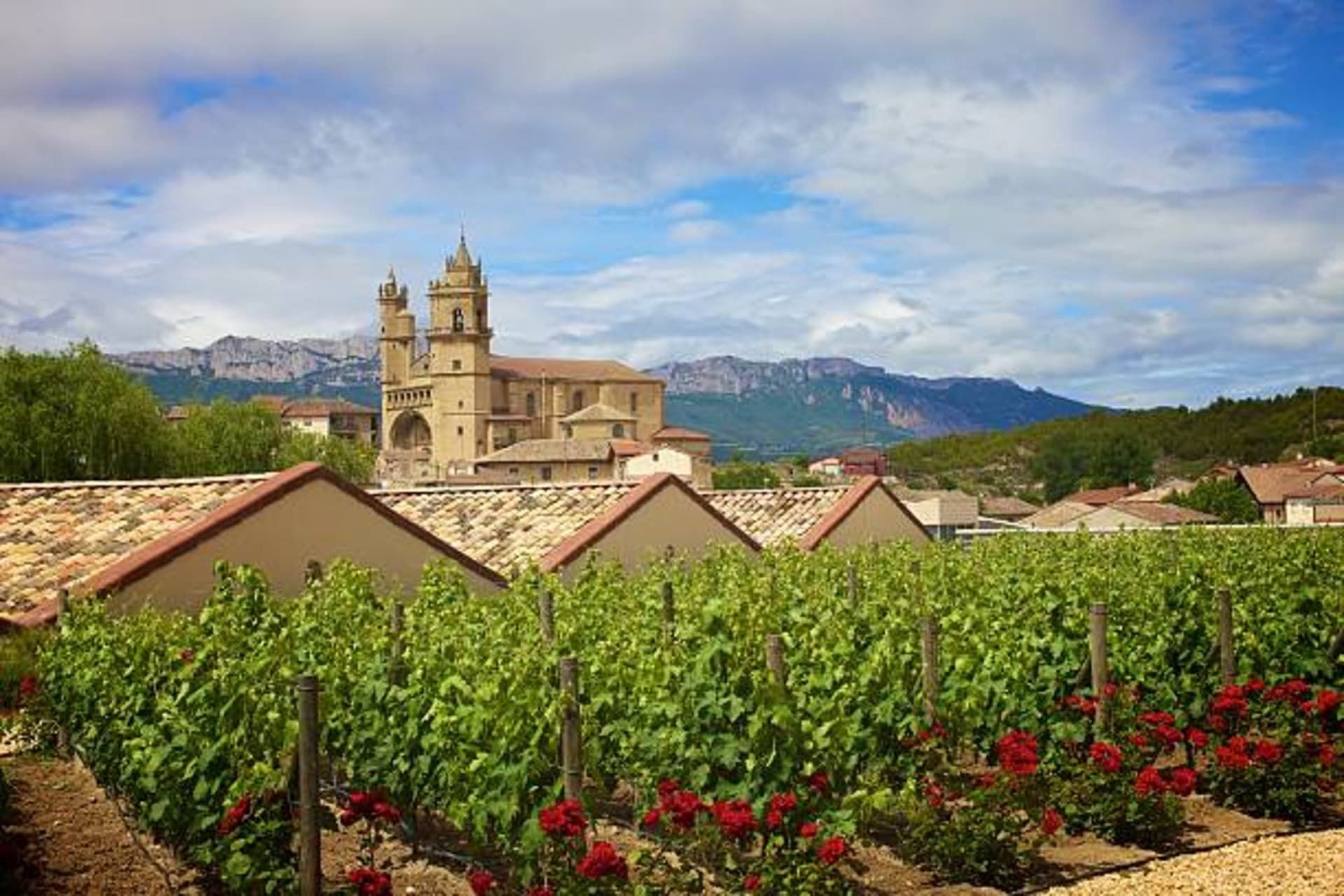
Cycling La Rioja Wine Region means riding through the single most concentrated wine-producing landscape in Spain, a 120-kilometer (75-mile) corridor along the Ebro River where more than 600 wineries sit inside a patchwork of vineyards, stone villages, and river terraces. The region produces the country's most internationally recognized red wine, built almost entirely around the Tempranillo grape, and its road network was never designed with tourism in mind: it grew up connecting one wine village to the next, which is exactly why it works so well by bike. Quiet two-lane roads link hamlets a few kilometers apart, elevation changes are gentle enough for a broad range of riders, and nearly every junction offers a choice between visiting a bodega, a Romanesque church, or a hilltop walled town.
The wine region itself is not identical to the political province of La Rioja. It stretches roughly 16 kilometers (10 miles) on either side of the Ebro River from Haro in the northwest to beyond Logroño, the regional capital, and spills across three administrative territories: La Rioja proper, the Basque province of Álava (the zone known as Rioja Alavesa), and a sliver of Navarre. For a cyclist, none of that administrative complexity matters much on the road. What matters is that the terrain shifts continuously. Flat river paths along the Ebro, gently rolling vineyard lanes through Rioja Alta, and short sharp climbs up to hilltop towns like Laguardia, all framed by two mountain ranges, the Sierra de Cantabria to the north and the Sierra de la Demanda to the south, that shelter the valley from Atlantic weather and give the wine region its unusually mild, dry microclimate.
This guide covers the full range of what cycling in La Rioja Wine Region has to offer: the flagship wine road between Haro and Laguardia, the region's other significant rides through greenways and mountain foothills, the best bases for a multi-day trip, and the food, wine, history, and wildlife that make the miles between wineries worth savoring. Whether the goal is a gentle few days pedaling between tastings or a longer route that climbs into the Sierra de la Demanda, La Rioja rewards cyclists with a rare combination of serious wine culture, manageable distances, and a landscape still quiet enough to ride for hours without much traffic. Few destinations in Europe compress this much history, gastronomy, and viticulture into a region small enough to cross by bike in a single week, which is precisely why La Rioja Wine Region cycling has grown steadily in popularity among riders who want depth over distance.
Explore our amazing bike tours in La Rioja Wine Region now !
La Rioja is the smallest of Spain's mainland regions by population, yet it produces an outsized share of the country's wine reputation. The wine region sits in the upper Ebro valley, roughly 100 kilometers (62 miles) south of the Bay of Biscay, in a natural corridor between the Basque mountains and the arid plateau of central Spain. Geographically, the Denominación de Origen Calificada (DOCa) Rioja splits into three subzones: Rioja Alta, the cooler, higher country west of Logroño known for structured, long-aging reds; Rioja Alavesa, the Basque-administered strip on the north bank of the Ebro known for steep limestone slopes and boutique wineries; and Rioja Oriental, the warmer, lower-lying eastern zone (formerly called Rioja Baja) that produces riper, fuller-bodied wines. A cyclist moving through the region in a few days can feel these distinctions directly. The temperature, the steepness of the roads, and even the color of the soil change from one subzone to the next.
What makes the wine region distinctive as a cycling destination is the density of interest packed into a compact area. Villages appear every few kilometers, each with a Romanesque church, a medieval gate, or a family-run bodega, so a day's ride rarely feels like open, empty countryside. At the same time, the region has avoided the crowding that affects better-known wine destinations in France and Italy. Roads are quiet, English is spoken less often than in Spain's coastal resorts, and the wineries, from centuries-old cellars to titanium-clad architectural landmarks, are still primarily working businesses rather than tourist attractions built for volume. For riders drawn to a destination where the cycling, the wine, and the history are inseparable from one another, cycling in La Rioja Wine Region delivers all three without requiring long transfers between them.
The population of the wine region reflects its agricultural character. Logroño, the capital, holds around 150,000 residents, but most of the towns a cyclist will pass through, Haro, Laguardia, Nájera, Santo Domingo de la Calzada, number in the low thousands, and many wine villages have only a few hundred inhabitants. This small scale is part of the appeal: a rider can cross an entire wine-producing municipality in the time it takes to drink a coffee, and the sense of place, one recognizable village center after another, rarely fades over the course of a multi-day trip. Economically, wine dominates and an estimated majority of agricultural land within the DOCa boundary is planted with vines, and the rhythm of planting, tending, and harvesting shapes nearly everything else, from restaurant menus to festival calendars to the pattern of traffic on rural roads each September.
The Ebro River runs the length of the wine region on a broadly east-west axis, and the land closest to its banks is the flattest riding available. Riverside paths and quiet farm roads connect Haro, Briones, Cenicero, Fuenmayor, and Logroño along mostly level ground, with elevation changes rarely exceeding a few dozen meters. This is the easiest terrain in the region, well suited to relaxed touring, and it doubles as the region's agricultural spine. Vineyards, orchards, and vegetable plots line the river on both sides, feeding directly into the produce that appears on restaurant tables that same week.
Move even a kilometer or two away from the river and the land begins to roll. Rioja Alta, west and southwest of Logroño, sits at slightly higher elevation, generally between 400 and 600 m (1,300 and 2,000 ft), and its vineyards climb over a series of low ridges separated by streams draining down toward the Ebro. Rioja Alavesa, on the north bank around Laguardia and Elciego, is more dramatic: vineyards rise on limestone terraces directly beneath the wall of the Sierra de Cantabria, and short, punchy climbs of 5 to 8 percent gradient are common on the roads connecting hilltop villages. Neither subzone requires technical mountain-bike skills, but a hybrid or gravel-capable bike handles the transitions between paved lanes and hard-packed vineyard tracks more comfortably than a pure road bike.
Two mountain ranges frame the wine region and offer a serious step up in difficulty for riders who want it. To the north, the Sierra de Cantabria rises abruptly to peaks over 1,300 m (4,265 ft), acting as a climatic barrier that shields the vineyards from Atlantic storms and creates the sheltered microclimate the DOCa depends on. To the south, the Sierra de la Demanda climbs higher still, to the Pico de San Lorenzo at 2,271 m (7,451 ft), the highest point in the whole of La Rioja. Roads into this range, particularly around the town of Ezcaray, include serious climbs such as the Alto de la Cruz de la Demanda, which tops 1,800 m (5,905 ft) and has featured as a stage finish in the Vuelta a España, and the ascent to the Valdezcaray ski station. These are optional detours rather than required riding, but they turn a gentle wine-country trip into a legitimate mountain challenge for anyone who wants one.
To the south and east, where the Rioja Oriental subzone gives way to the Cameros valleys, the Iregua, Leza, and Jubera rivers have carved narrow canyons through the limestone, some with walls rising up to 200 m (656 ft). These canyon roads, along with the greenways built on former railway lines, add a dramatically different character to riding in La Rioja Wine Region: sheer rock faces, circling raptors, and cooler microclimates that offer welcome relief from summer heat in the valley below.
The overwhelming majority of roads used for cycling in La Rioja Wine Region are fully paved and well maintained, from the main wine road linking Haro and Laguardia to the smaller lanes threading between vineyard plots. Where surfaces do turn to gravel, typically on tracks running directly between vine rows or on sections of the region's Vías Verdes, the packed earth and fine gravel are kept in good condition and require no technical off-road skill, only a bike with slightly wider tires than a pure racing setup. This combination of quiet, well-surfaced roads and short, clearly signed gravel connectors is a major reason the region works so well for touring cyclists of varied experience levels riding at their own pace.
If a single ride defines cycling in La Rioja Wine Region, it is the corridor connecting Haro, the historic capital of Rioja Alta's wine trade, to Laguardia, the walled hilltop town at the heart of Rioja Alavesa. The direct distance is a modest 25 to 30 kms (16 to 19 mi), but the route can be extended, looped, and detoured through dozens of villages and wineries, making it equally suited to a relaxed half-day ride or the anchor stage of a multi-day trip. It is also the finishing stretch of Art of Bicycle Trips' own Ebro River to Rioja Wine Country tour, which arrives into this corridor after several days of riding down from the Cantabrian Mountains.
The ride begins in Haro, a town of around 11,000 people that punches enormously above its weight in wine terms. Haro's Barrio de la Estación, the Station Quarter, was built up around the arrival of the railway in the 1880s and today houses some of Rioja's most historic producers, including López de Heredia, CVNE, Muga, and La Rioja Alta S.A., within a few hundred meters of one another. Cyclists can roll between six major bodegas without leaving the neighborhood, then climb briefly into Haro's old town, a Historic-Artistic Site since 1975, for tapas on Calle Arrabal before setting out.
Leaving Haro, the route crosses the Ebro and follows quiet lanes through vineyard country toward San Vicente de la Sonsierra, a fortified hilltop village on the north bank with a castle-church complex visible for kilometers before arrival. From here the route can either continue along the north bank into Rioja Alavesa or cross back south to Briones, widely regarded as one of the best-preserved medieval towns in the region and home to the Vivanco Museum of Wine Culture, one of the most substantial wine museums in Europe.
The final stretch climbs gradually into Rioja Alavesa, where the terraced vineyards beneath the Sierra de Cantabria produce some of the region's most sought-after wines. This is also where the region's contemporary wine architecture appears: Santiago Calatrava's Bodegas Ysios, its undulating roofline echoing the mountain silhouette behind it, and, a short ride further at Elciego, Frank Gehry's titanium-ribboned Hotel Marqués de Riscal, often nicknamed the Guggenheim of wine. The road rises to Laguardia itself, a walled medieval town perched on a hill with 360-degree views back across the vineyards, where narrow cobbled streets sit above a warren of ancient underground wine cellars carved into the rock beneath the town.
Distance: 25 to 30 kms (16 to 19 mi) point to point, extendable to 60 kms (37 mi) with village detours | Terrain: Rolling, with short climbs into Alavesa | Duration: Half day to full day | Difficulty: Easy to Moderate
For cyclists with more time, the corridor extends naturally in both directions: west from Haro toward Briñas and the Ebro Reservoir country, or south from Laguardia toward Elciego and Cenicero, effectively allowing a rider to string together three or four days entirely within the vineyard zone without repeating roads.
Distance: 27 kms (17 mi) | Terrain: Rolling, mostly paved | Duration: Half day | Difficulty: Moderate
This loop out of Haro threads through the vineyard country immediately surrounding the town before returning along the Ebro. It is a good introductory ride for cyclists based in Haro who want a half-day sense of the terrain before committing to a longer point-to-point route.
Distance: 20.5 kms (13 mi) | Terrain: Gently rolling, fully paved | Duration: Half day | Difficulty: Easy to Moderate
Starting from the regional capital, this loop circles the La Grajera reservoir, a century-old irrigation lake now surrounded by parkland and a network of traffic-free paths. It is the easiest ride in this guide, well suited to a rest-day spin or a family outing, and gives visitors a low-effort introduction to cycling in La Rioja Wine Region before tackling more demanding terrain.
Distance: 15 kms (9 mi) one-way | Terrain: Flat, traffic-free, hard-packed surface | Duration: 1 to 2 hours | Difficulty: Easy
Built along a disused railway line, the Oja Greenway follows the Oja River from the mountain town of Ezcaray down toward Haro, with the rideable section currently reaching Casalarreina. Traffic-free and flat by definition, it is one of the most family-friendly rides in the region and offers a direct route from the Sierra de la Demanda foothills down into wine country.
Distance: 35.6 kms (22 mi) | Terrain: Flat greenway with connecting road sections | Duration: Half day | Difficulty: Moderate
This greenway follows the Cidacos River through Rioja Oriental, past Arnedillo's thermal springs and griffon vulture nesting cliffs, and into the heart of the region's dinosaur tracksite country around Arnedo, Préjano, and Enciso. It combines flat, easy riding with access to one of the most scientifically significant paleontological landscapes in Europe.
Distance: 65.9 kms (41 mi) | Terrain: Sustained mountain climbing | Duration: Full day | Difficulty: Hard
For cyclists seeking the harder edge of the region, this loop climbs out of Ezcaray toward the Valdezcaray ski station, gaining roughly 1,700 m (5,577 ft) over the course of the ride. It is the closest thing the wine region has to a genuine mountain stage, and it rewards the effort with sweeping views back over the vineyards from well above 1,500 m (4,921 ft).
Distance: Approximately 65 kms (40 mi) across the region | Terrain: Flat to gently rolling | Duration: 1 to 2 days | Difficulty: Easy to Moderate
The French Way of the Camino de Santiago crosses La Rioja from Logroño through Navarrete, Nájera, and Santo Domingo de la Calzada before continuing into Castile. Cyclists increasingly ride sections of this route on gravel or hybrid bikes, following the same waymarked path used by walking pilgrims for over a thousand years, passing monasteries, pilgrim hospitals, and the cathedral town of Santo Domingo along the way.
Distance: Up to 400 kms (249 mi) over 3 to 5 days | Terrain: Rolling, mixed paved and gravel | Duration: Multi-day | Difficulty: Moderate
For riders with a full week and a preference for road cycling, a longer circuit stringing together Rioja Alta, Rioja Alavesa, and the fringes of Rioja Oriental can extend to roughly 400 kms (249 mi), winding along well-kept, quiet roads that dip and climb through vineyard after vineyard while stopping at wineries along the way. This format works particularly well as a self-guided, point-to-point itinerary with luggage transferred ahead each day, letting riders focus purely on the road, the wine, and the villages rather than logistics.
Centered on Haro, Rioja Alta is the historic heart of the appellation, home to the oldest bodegas and the most traditional winemaking styles, often aged for years in American oak. The terrain here is gently rolling, with vineyards climbing low ridges between the Ebro and the foothills of the Sierra de la Demanda. Suitable for riders who want classic wine-country cycling without serious climbing, and an excellent base for anyone prioritizing winery visits over mileage.
On the north bank of the Ebro, Rioja Alavesa combines dramatic scenery with some of the region's most architecturally ambitious wineries. Vineyards rise on limestone terraces directly beneath the Sierra de Cantabria, and the riding here has more texture: short, sharp climbs between villages like Laguardia, Elciego, and Samaniego. Suitable for riders who want a bit more elevation and some of the best photographic vistas in the wine region.
The regional capital sits at the geographic center of the wine region and offers the flattest, most convenient riding, plus the best transport connections and the liveliest tapas scene, concentrated on Calle Laurel and Calle San Juan. Suitable for cyclists who want a lively home base with easy access to routes in every direction, and for anyone building a trip around an arrival or departure in the city.
Technically part of the autonomous community of the Basque Country but historically and culturally tied to Rioja wine production, the Sonsierra around San Vicente de la Sonsierra offers quieter roads and a strong sense of frontier history, with a fortified hilltop church-castle complex that dominates the skyline for kilometers. Suitable for riders looking to escape the busier Haro-Laguardia corridor while staying within the wine zone.
East of Logroño, Rioja Oriental (long known as Rioja Baja) is lower, warmer, and more sparsely populated, with a landscape that shifts from vineyards to almond groves, dry riverbeds, and the canyon country around Arnedo and Calahorra. Suitable for riders interested in the region's dinosaur trackway sites, thermal spring towns, and a quieter, less touristed side of cycling in La Rioja Wine Region.
South of the vineyard belt, the Sierra de la Demanda rises into genuine mountain terrain around the elegant town of Ezcaray, with beech and pine forests, ski infrastructure repurposed for warm-weather activity, and some of the hardest climbing available anywhere in the region. Suitable for stronger riders wanting a serious physical challenge and a cooler climate during the height of summer.
Further south still, the Cameros valleys and the Sierra de Cebollera Natural Park offer a wilder, less-visited highland landscape of beech and Scots pine forest, transhumance history, and some of the best wildlife viewing in the region. Suitable for riders combining cycling with hiking or wildlife-focused travel, and for anyone seeking a genuine change of scenery from the vineyard floor.
La Rioja enjoys good cycling weather across most of the year, and unlike destinations with a hard rainy season, precipitation here is generally light, localized, and spread thinly across the calendar rather than concentrated in a single period. The main variables are heat in summer and cold in the depths of winter, both manageable with the right timing.
Spring is one of the two best windows for cycling in La Rioja Wine Region. April brings mild days around 15 to 20 degrees C (59 to 68 degrees F) with the vines just beginning to leaf out, while May and June warm steadily toward 22 to 28 degrees C (72 to 82 degrees F). By late June the vineyards are fully green and bushy, though this period also brings La Rioja's most chaotic festival: the Batalla del Vino in Haro on June 29, when thousands of participants climb to the cliffs of Bilibio to douse one another in red wine in a centuries-old ritual. Riders who want to combine cycling with the festival should book accommodation in Haro many months ahead, as rooms sell out well in advance.
Midsummer in La Rioja can be genuinely hot, with afternoon temperatures regularly exceeding 35 degrees C (95 degrees F) in the valley, though mornings remain considerably cooler and higher-elevation routes around Ezcaray and the Sierra de la Demanda offer relief. Riders visiting in July or August should plan to start early, aiming to finish the day's distance before the early afternoon heat peaks, and should treat routes up into the mountains as a natural escape valve when the valley floor becomes uncomfortable.
Autumn is the second prime season and, for many, the best time of all to go cycling La Rioja Wine Region, because it coincides with the grape harvest, or vendimia. September brings warm days without midsummer's intensity, typically 22 to 27 degrees C (72 to 81 degrees F), along with the sight and sound of harvest activity throughout the vineyards: pickers in the rows, tractors hauling grapes to the bodegas, and the faint scent of fermenting must in the air around Haro and Logroño. Logroño's Fiestas de San Mateo, the Rioja Wine Harvest Festival, runs for a week in late September and includes the traditional treading of the first grapes and the ceremonial offering of must to the city's patron. October cools gradually but remains comfortable for riding well into the month, with the added bonus of turning vine leaves in shades of gold and deep red across the hillsides.
Winter is the off-season for cycling in La Rioja Wine Region, though it is far from unrideable. Daytime temperatures generally stay above 10 degrees C (50 degrees F) even in the coldest months, and the valley floor sees relatively little snow. The bare vines and quieter towns have their own appeal for riders who prioritize solitude and don't mind cooler mornings, though the Sierra de la Demanda's higher elevations can see genuine winter conditions, including snow at the Valdezcaray ski station. For most cyclists, this is the season to skip in favor of the spring or autumn windows.
The wine region itself is intensively farmed, but it sits within a few kilometers of genuinely wild country in every direction, and cyclists who venture even slightly off the vineyard floor encounter a surprising range of species.
The limestone canyons carved by the Iregua, Leza, Cidacos, and Jubera rivers in Rioja Oriental host some of the region's most dramatic wildlife viewing. Griffon vultures nest on the cliff faces around Arnedillo, where a dedicated interpretation center allows visitors to observe nesting sites through telescopes, and Egyptian vultures, booted eagles, and short-toed eagles are regularly seen circling on thermals above the canyon walls. Cyclists riding the Vía Verde del Cidacos in spring and early summer have a strong chance of spotting several raptor species without leaving the saddle.
South of the vineyard belt, the Sierra de la Demanda and the Sierra de Cebollera Natural Park hold some of La Rioja's richest forest habitat, with Scots pine, beech, and Pyrenean oak stands sheltering red deer, wild boar, foxes, and European wildcat, along with a small population of Iberian wolf in the more remote valleys. The rivers here support otters and the endangered Pyrenean desman, a semi-aquatic mole-like mammal found almost nowhere else in Europe outside the Pyrenees and northern Iberian ranges. Birdlife includes goshawk, honey buzzard, and, at the highest elevations, black and bearded vultures, species significant enough that the entire Demanda-Cebollera-Cameros massif is protected as a Special Protection Area for birds.
Along the Ebro itself, protected gallery forests, known locally as sotos, harbor a different ecosystem: poplar, ash, and willow stands that support smaller birds and provide a green, shaded contrast to the open vineyard rows just meters away. These riverside strips are some of the most biodiverse habitat remaining in the otherwise heavily cultivated valley floor, and several sections near Logroño are protected as nature reserves.
Long before the vines, the Rioja Oriental landscape was a network of Early Cretaceous lakes, deltas, and tidal flats, and the fossilized footprints left in that ancient mud have made La Rioja one of the most significant dinosaur tracksite regions in Europe. More than 170 tracksites and upward of 10,000 individual footprints have been documented around the towns of Enciso, Igea, Munilla, and Cornago, including trackways showing carnivorous theropods running at speed, swimming dinosaurs, and one of the largest concentrations of ichnites recorded anywhere in the world at the Era del Peladillo site near Igea. Several sites are accessible by short signed paths and connect naturally to a ride along the Vía Verde del Cidacos, giving cyclists a rare chance to combine a bike route with a walk back roughly 125 million years.
Dive into our curated La Rioja cycling adventures today!
Rioja became Spain's first Denominación de Origen in 1925 and was elevated to the higher Denominación de Origen Calificada status in 1991, the first Spanish wine region to receive it. That legal framework, and the classification system built around aging (Joven, Crianza, Reserva, and Gran Reserva, each requiring progressively longer time in oak barrel and bottle before release) shapes daily life throughout the wine region far beyond the wineries themselves. Barrel-making, cork supply, bottle labeling, and harvest labor form an economic backbone that touches nearly every town a cyclist passes through, and the rhythm of the agricultural calendar, budbreak in April, flowering in June, veraison in August, harvest in September, is something locals discuss the way other regions discuss weather.
Few wine regions anywhere pair centuries-old stone cellars with contemporary architecture as boldly as Rioja. Alongside traditional bodegas where wine still ages in dim, cave-like cellars carved into hillsides, a wave of architect-designed wineries appeared from the late 1990s onward: Santiago Calatrava's wave-roofed Bodegas Ysios in Laguardia, its sinuous concrete walls tracing the silhouette of the Sierra de Cantabria behind it, and Frank Gehry's titanium-ribboned Hotel Marqués de Riscal in Elciego, often compared to his Guggenheim Museum in Bilbao. Cycling between these buildings and the centuries-old cellars of Haro's Barrio de la Estación gives a visitor a compressed tour of Spanish wine architecture across nearly a thousand years.
The French Way of the Camino de Santiago crosses La Rioja for roughly three days of walking, passing through Logroño, Nájera, and Santo Domingo de la Calzada, and pilgrim infrastructure, hostels, waymarks, and centuries-old bridges, is woven into the region's back roads. A short detour south of the main route leads to San Millán de la Cogolla, home to the twin monasteries of Suso and Yuso. The sixth-century Monastery of Suso is where a monk annotated a Latin manuscript with marginal notes in early Romance vernacular, the Glosas Emilianenses, generally considered the earliest written examples of the Castilian language, a distinction that earned the site UNESCO World Heritage status and gives La Rioja a claim as the literal birthplace of modern Spanish.
Wine here is not confined to tasting rooms. On June 29 each year, the town of Haro empties out before dawn as thousands of participants dressed in white climb 7 kms (4 mi) to the cliffs of Bilibio for the Batalla del Vino, an event with origins tracing back centuries as a boundary dispute pilgrimage that evolved into a full-scale wine fight, declared a Fiesta of International Tourist Interest in 2011. In September, Logroño's Fiestas de San Mateo mark the start of the harvest with grape-treading ceremonies and a city-wide celebration that fills Calle Laurel's tapas bars for a full week. Both festivals reflect a place where wine culture is communal and physical, not just something poured into a glass.
Dive into our curated La Rioja Wine Region cycling adventures today!
This potato stew, simmered with chorizo, onion, garlic, and dried nyora pepper, is the region's definitive comfort dish and appears on nearly every menú del día across La Rioja. The recipe varies subtly from kitchen to kitchen, but the base of paprika-tinted broth and tender potato remains constant, and it is a reliable, filling choice after a long day of riding.
Small lamb chops grilled directly over burning vine cuttings, or sarmientos, this dish ties the region's cuisine literally to its vineyards: the pruned wood from the previous season's vines fuels the fire that cooks the meat. The smoky, slightly sweet char imparted by the vine wood is distinctive and found almost nowhere outside wine-growing regions that also raise sheep, making it a genuinely local specialty rather than a generic Spanish grill dish.
Long, sweet red peppers, grown throughout the Ebro valley and traditionally roasted over open flame before peeling, appear both as a side dish and stuffed with meat or seafood as pimientos del piquillo rellenos. The Ebro's fertile floodplain produces vegetables of a quality that shows up directly on restaurant tables within the same week of harvest, and roasted pepper season in late summer overlaps directly with the start of grape harvest.
Salt cod, stewed in a sauce built on the same nyora peppers and tomato used in the potato stew, reflects Spain's long tradition of preserving fish for transport inland before refrigeration. The dish remains a fixture on traditional menus throughout the region, particularly in the cooler months.
Logroño's Calle Laurel and adjoining Calle San Juan form one of Spain's most concentrated tapas districts, where the tradition is to move from bar to bar sampling a single specialty dish and a small glass of wine at each stop. Individual bars often build a reputation around one dish alone, whether grilled mushrooms, a specific preparation of egg and chorizo, or a particular cut of grilled meat, and a rest evening spent working down the street is one of the most enjoyable ways to experience the region's food culture after a day on the bike.
Mazapán and almendrados, marzipan and almond biscuits, reflect the almond groves common in the warmer Rioja Oriental subzone, while peras al vino, pears poached slowly in red wine and cinnamon, offer one of the most direct culinary links between the region's fruit orchards and its wine. Both make an easy, packable snack for a mid-ride stop in any of the wine region's village bakeries.
Tempranillo is the backbone grape of red Rioja, typically blended with smaller portions of Garnacha, Graciano, or Mazuelo, and the region's classification system by aging, Joven for young unoaked wine, Crianza for a minimum of one year in oak plus bottle aging, Reserva for at least three years combined aging, and Gran Reserva for a minimum of five, gives visitors a clear framework for tasting their way through a winery's range. Many bodegas along the cycling routes described in this guide, particularly around Haro's Barrio de la Estación and the wineries of Rioja Alavesa, offer tastings that walk through this ladder from youngest to oldest in a single visit.
Cycling in La Rioja Wine Region is accessible to a broad range of fitness levels. The core vineyard routes around Haro, Logroño, and Laguardia involve gentle rolling terrain with only occasional short climbs, well within reach of anyone who cycles casually and has a few weeks to prepare with regular rides of an hour or more. Riders planning to tackle the Sierra de la Demanda climbs or a multi-day itinerary covering 50 to 65 kms (31 to 40 mi) a day should build a base of longer rides beforehand, and everyone should prepare for warm-weather riding during the summer months, when starting early and pacing for the heat matters more than raw fitness.
A hybrid or trekking bike is the most versatile choice for the wine region, since it handles paved lanes at a reasonable pace while also coping with the hard-packed gravel tracks that run directly through many vineyards. Road bikes work well for riders sticking to the paved wine road between Haro and Laguardia and the flatter river routes, but will struggle on some of the rougher vineyard tracks and greenway surfaces. Gravel bikes offer the best all-around compromise for riders who want to explore off the main paved roads, particularly around the Vías Verdes and into the Cameros valleys, and e-bikes are an increasingly popular choice for riders who want to take on the Sierra de la Demanda climbs or cover longer daily distances without exhausting themselves before the evening's wine tasting.
Bike rental infrastructure in La Rioja has expanded steadily as cycle tourism has grown, particularly around Logroño, Haro, and the towns along the Camino de Santiago, though it remains less extensive than in more heavily touristed parts of Spain. Riders planning an independent trip should confirm rental availability and bike specifications well in advance of arrival rather than assuming options will be available on short notice, and those joining a supported or self-guided tour typically have bikes, sizing, and basic maintenance handled as part of the package. Whatever the source of the bike, a basic repair kit and a familiarity with fixing a flat are worth having, since La Rioja Wine Region cycling often means long stretches between towns with a bike shop of their own.
The nearest major international airport is Bilbao (BIO), roughly one hour by road from Haro and about ninety minutes from Logroño, making it the most practical arrival point for most international visitors. Logroño's own regional airport has extremely limited scheduled service and should not be relied upon for international connections. Santander and Bayonne-Biarritz are the next-closest airports but have weaker onward transport links. Madrid is a viable alternative for long-haul travelers, with direct trains to Logroño taking three to four hours.
Regular train service connects Logroño to Madrid, Barcelona, and Zaragoza, and regional bus lines link the smaller wine towns, though schedules can be sparse outside the main Logroño-Haro corridor. Most cyclists touring the region rely primarily on the bike itself for point-to-point travel between towns, since distances between wine villages are short enough to ride directly.
Bicycles are explicitly prohibited on Spain's motorway network, including the A-12, AP-68, and A-13 that pass through or near the wine region, but are permitted on virtually all other roads. Certain national ('N') roads, including the N-120, along with the LR-111 and LR-136, carry heavier traffic and are best avoided in favor of the region's extensive network of quieter local roads. Entering Logroño by bike is most comfortable from the north via the Puente de Hierro or from the west via Fuenmayor, both of which connect directly to a riverside cycling path through the city. Traffic on smaller roads can increase noticeably during the September harvest, when tractors and delivery trucks move grapes between vineyards and wineries.
Spain is part of the Schengen Area, and entry requirements depend on nationality. Visitors from the UK, US, Canada, Australia, and New Zealand can generally enter for short tourist stays without a visa under the relevant Schengen rules, though requirements can change, and travelers should confirm current entry rules with their home country's official travel advisory before departure.
Spain uses the euro. Credit cards are widely accepted in hotels, restaurants, and larger wineries, though smaller family-run bodegas and rural cafes may prefer cash. ATMs are available in all the region's towns of any size, including Haro, Logroño, and Laguardia.
Spanish is the primary language throughout the wine region, with Basque spoken in parts of Rioja Alavesa. English proficiency is improving but remains inconsistent outside hotels and larger wineries; smaller restaurants and family bodegas often operate in Spanish only, which is part of what keeps the region feeling authentic rather than built for mass tourism.
Mobile data coverage is reliable throughout the vineyard zone and the main towns, though it can weaken in the more remote valleys of the Sierra de la Demanda and Sierra de Cebollera. Offline map apps are recommended as a backup for anyone riding into the mountain sections of the region.
La Rioja observes Central European Time (CET), one hour ahead of the UK and six hours ahead of the US East Coast, with daylight saving observed in summer. Summer days are long, with useable riding light from before 7 a.m. to after 9 p.m. in June and July, giving cyclists ample time to combine long rides with winery visits.
Anyone cycling La Rioja Wine Region during the September grape harvest should build a small amount of flexibility into route planning. Farm machinery and delivery trucks use the same narrow lanes that cyclists favor, particularly early in the morning and again in the evening as the day's grapes come in, so riding through the middle of the day, when harvest traffic typically eases, tends to be more relaxed. The upside is considerable: harvest season offers the best chance to see the wine region's entire production cycle in motion, from vine to press, in the course of a single ride.
Accommodation throughout the wine region ranges from simple rural guesthouses to some of the most architecturally striking hotels in Spain, and cyclists have a genuinely wide range of choices at every budget level.
Family-run casas rurales, rural guesthouses converted from traditional stone houses, are common throughout the smaller wine villages and offer an intimate, low-cost base for touring cyclists. Many are located directly on or near the main cycling corridors between Haro and Laguardia, and hosts are frequently well versed in local route knowledge.
A distinctive feature of accommodation in La Rioja is the winery hotel, where a stay is bundled directly with the producer's own wine, cellar tours, and tastings. These range from small family operations to architecturally significant properties, and staying at one gives cyclists an immersive base without needing to travel far from the vines themselves.
Haro, Logroño, and Laguardia all offer well-appointed hotels within walking distance of their historic centers, giving cyclists easy access to tapas streets, wine bars, and transport connections after a day's ride. Laguardia in particular offers rooms built into or adjacent to the town's medieval walls, some with underground cellars of their own.
Accommodation around Haro fills quickly in the days surrounding the Batalla del Vino in late June, and rooms across the region can be tight during the September harvest festivals, so cyclists planning a trip around either event should book well in advance. Outside these peak dates, availability is generally comfortable even for last-minute planning.
Wine Atlas of Spain by Benito Molina and Sarah Jane Evans offers a thorough regional grounding in Rioja's classification system and subzones before a trip. For a narrative angle, Jay McInerney's wine writing collections touch on Rioja's place in the broader story of Spanish wine's modernization, while Gonzalo de Berceo, the poet who lived at the Monastery of Suso, remains a foundational figure worth reading about for anyone interested in the linguistic history bound up in the region's landscape.
Documentaries on Spanish wine culture, several produced for regional Spanish television and available with subtitles, cover the harvest cycle and the architectural transformation of Rioja's wineries in the 2000s, including the construction of the Gehry-designed Hotel Marqués de Riscal. Footage of the Batalla del Vino, widely available online, gives a vivid preview of the festival's scale and chaos for anyone considering timing a trip around it.
Beyond the dishes covered earlier in this guide, the Vivanco Museum of Wine Culture in Briones is worth a dedicated visit for its scale and depth, covering wine's history from antiquity through to modern Rioja production, with a tasting room attached. In Logroño, an evening spent working down Calle Laurel, one pintxo and one small glass of wine at a time, remains one of the most direct ways to understand the region's food culture.
The Batalla del Vino in Haro on June 29 and the Fiestas de San Mateo in Logroño in late September are the two signature events for visitors willing to build a trip around a specific date. For a quieter experience, timing a visit to coincide with the September grape harvest, without necessarily attending the festival itself, allows cyclists to watch pickers working the vineyards firsthand and to catch the last of the season's warm, dry riding weather before autumn sets in.
Art of Bicycle Trips offers a Self-Guided Ebro River to Rioja Wine Country Bike Tour, a multi-day journey that begins in the Cantabrian Mountains near Campoo, follows the Ebro River through canyon country and medieval Castilian towns, and finishes with two full days of riding through the heart of the wine region itself. From the historic cellars of Haro, through the vineyard-covered hills of Rioja Alavesa, to the walled medieval town of Laguardia. The final stretch traces much of the flagship route described in this guide, passing wineries, hilltop villages, and the contemporary wine architecture that has made the region as notable for design as for wine.
For cyclists who want the mountain, canyon, and river scenery of northern Spain as a prelude to the wine country experience, this self-guided format, complete with luggage transfers, app-based navigation, and a support line for the length of the trip, offers a well-tested way to experience cycling in La Rioja Wine Region without needing to plan each day's logistics independently. The trip runs at an easy to moderate level across 283 kms (176 mi) of total cycling distance over six riding days, making it accessible to a broad range of fitness levels while still delivering the full arc from mountain reservoir to vineyard valley.
Whether the appeal is the wine, the architecture, the history stretching from dinosaur trackways to the birthplace of the Castilian language, or simply the pleasure of riding quiet roads between excellent meals, La Rioja Wine Region rewards exactly the kind of unhurried, curious travel that cycling makes possible. Art of Bicycle Trips would be glad to help plan a visit, whether that means joining the Ebro River to Rioja Wine Country tour or discussing a custom itinerary built around the routes and regions covered in this guide.
Get started with your cycling adventure now!
Create a private trip or join a small-group departure.