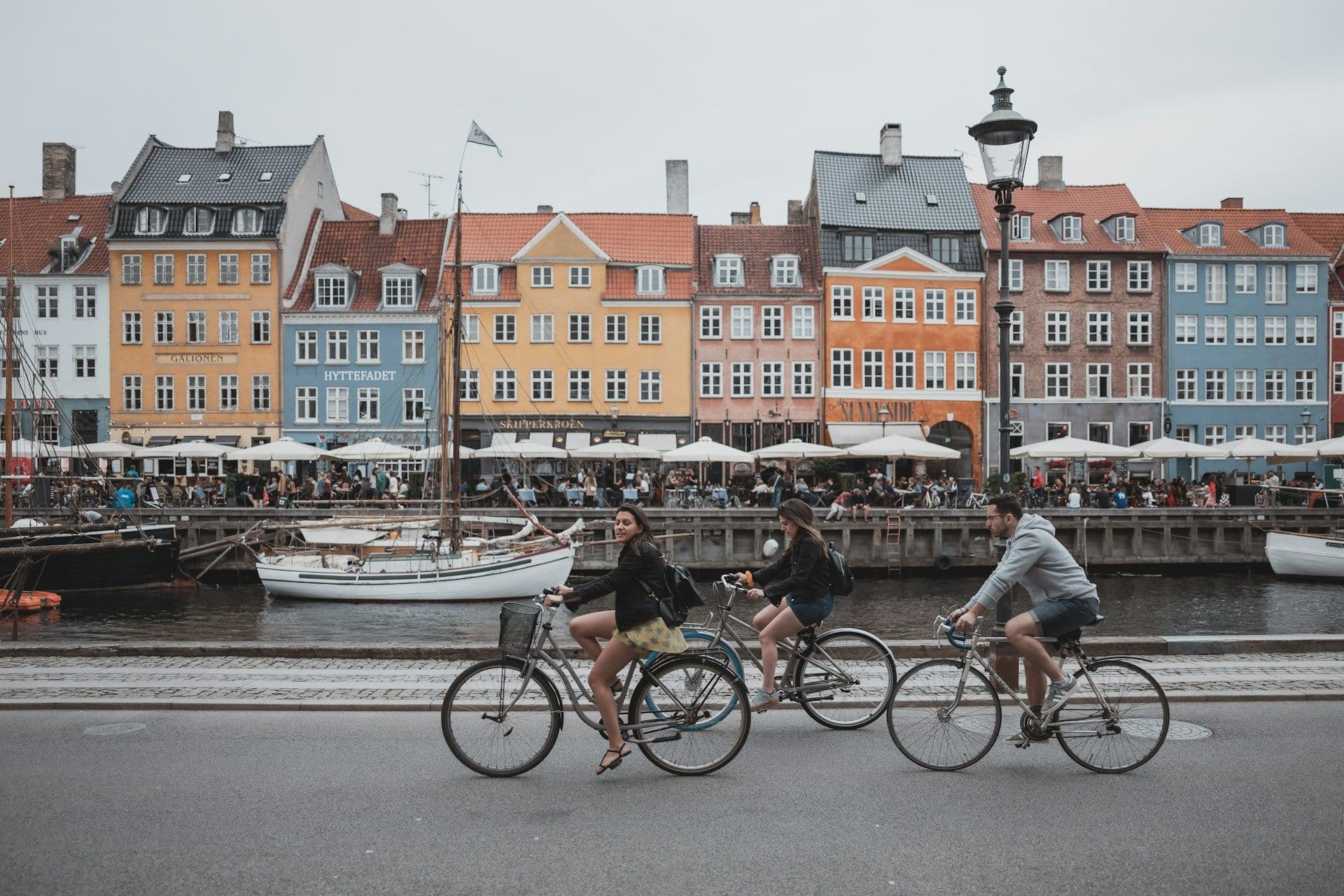
Denmark occupies a modest 43,094 square kilometers (16,639 sq mi), smaller than Switzerland, with a population of roughly 5.9 million people. Geographically it consists of the Jutland peninsula, which shares a land border with Germany to the south, plus the islands of Zealand, Funen, Lolland, Falster, Bornholm, and hundreds of smaller landmasses scattered between the North Sea and the Baltic Sea. Copenhagen, the capital, sits on the eastern edge of Zealand, directly across the Oresund strait from Sweden, a geography that has made the city as much a maritime crossroads as a seat of government.
Three major crossings hold the country’s geography together, the Great Belt Bridge linking Zealand and Funen, the Little Belt Bridge linking Funen and Jutland, and the Oresund Bridge linking Zealand to Malmo in Sweden. For cyclists, this matters practically. Ferries throughout the country routinely carry bikes at no extra cost, and regional trains accept bicycles with a supplementary ticket, so island hopping is less a logistical challenge than a built in feature of any route that touches the coast.
What makes cycling in Denmark distinctive is not any single landmark but the density of infrastructure wrapped around ordinary Danish life. The cycling network here, referred to locally as cykelruter, was not built primarily for visitors. It grew out of decades of transport policy that treats the bicycle as a serious mode of transport rather than a summer pastime, which is why a rider can move from central Copenhagen to a beech forest to a fishing harbor in a single afternoon without once feeling like an afterthought on the road. Add to that the cultural backdrop of hygge, the Danish concept of coziness and unhurried comfort, and cycling Denmark by bicycle starts to feel less like an activity and more like an entry point into how the country actually lives.
Distances between towns tend to run short by touring standards, often 20 to 40 kilometers (12 to 25 mi) apart, which keeps daily stages manageable even for riders who are not chasing personal bests. That compactness is part of why a first time visitor can string together castles, coastlines, and harbor towns in a single week without ever feeling rushed between them.
Explore our amazing bike tours in Denmark now!
Zealand, the largest island and home to Copenhagen, is a landscape of gentle moraine hills left behind by retreating glaciers, rarely climbing above 100 meters (330 ft). North Zealand in particular carries a legacy of royal hunting grounds, oak forests, and freshwater lakes such as Esrum So, Denmark’s second largest lake, all connected by quiet paved lanes and the occasional gravel stretch through state forest. The terrain suits a road or hybrid bike more than a mountain bike, though a handful of routes through Gribskov Forest run on packed gravel and are better suited to wider tires.
Jutland stretches nearly 350 kilometers (217 mi) from the German border to the northern tip at Skagen, and it carries Denmark’s only real topography. Möllehoj, at 170.86 meters (560.5 ft), and the nearby Yding Skovhoj mark the country’s high points, both found in the moraine hill country east of the peninsula’s spine. The west coast tells a completely different story, a nearly unbroken line of dunes, marram grass, and wide flat beaches facing the North Sea, backed by the Wadden Sea’s tidal flats in the south. Grass covered dunes hide the concrete remains of World War Two coastal bunkers along several stretches, half buried in sand and still facing out to sea, a quiet reminder that this coastline has been strategically important for longer than it has been a cycling destination. Wind, not elevation, is the defining variable here, and the region generates roughly 30 percent of Denmark’s total energy and 60 percent of its electricity from turbines that line the coast.
Funen sits between Zealand and Jutland and is known within Denmark as the garden of the country, a reference to its orchards, rolling farmland, and manor houses. South of the main island, the South Funen Archipelago breaks into dozens of smaller islands, including Aero and Langeland, connected by short cycle friendly ferry crossings. The terrain is gentle throughout, rarely presenting a climb longer than a few hundred meters, which makes the archipelago one of the easiest regions in the country for a multi day loop built around cycling Denmark at a relaxed pace.
Bornholm, an outlying island in the Baltic roughly 200 kilometers (124 mi) east of the Danish mainland, breaks every rule the rest of the country follows. Its bedrock is granite rather than glacial moraine, producing genuine climbs, sea cliffs, and a coastline that feels more Scandinavian than Danish. The island’s toughest ascent, an 8 kilometer (5 mi) climb from the harbor at Vang to the Hammer Lighthouse near Hammershus, hosts an annual mountain cycling championship and remains one of the few stretches of road in the country that will get a rider out of the saddle.
Of all the multi day routes threaded through Denmark, the ride along the Oresund coast between Copenhagen and Helsingor captures the country’s range in the smallest space. In roughly 56 kilometers (35 mi), it moves from a capital city’s harbor to a royal deer park, past two of Europe’s most visited modern art institutions, and into the shadow of the castle that gave the world Hamlet. It is one of the clearest possible introductions to cycling in Denmark for anyone with only a day or two to spare, and it forms the backbone of longer loops that extend north into the Danish Riviera and inland toward the country’s grandest palaces.
Distance 56 km (35 mi) | Terrain Flat, coastal and forest gravel | Duration 1 day | Difficulty Easy The ride begins at Nyhavn, Copenhagen’s 17th century canal harbor, where colorful gabled townhouses front a line of wooden ships still moored at the quay. From there, the route follows Langelinie Pier past the Little Mermaid statue before turning north, and the character of the city changes almost immediately, sleek apartment blocks give way to leafy suburbs, then to open coastline. At Klampenborg, a short detour leads into Jaegersborg Dyrehave, a UNESCO listed deer park where gravel paths wind beneath centuries old oaks and herds of red and fallow deer graze within a few meters of the trail, a working remnant of the 17th century royal hunting grounds that still define much of North Zealand’s landscape today.
North of the deer park, the coastal route passes through Rungsted, once home to author Karen Blixen and now the site of a museum dedicated to her life and writing, and continues to Humlebaek, home to the Louisiana Museum of Modern Art, whose sculpture garden spills directly toward the water. The ride ends at Helsingor, where Kronborg Castle occupies the narrowest point of the Oresund strait, its ramparts facing Sweden across barely 4 kilometers (2.5 mi) of water. Kronborg is a UNESCO World Heritage Site and the real world setting Shakespeare used for Elsinore in Hamlet, and few castles in Denmark pair so directly with a view of the country they were built to defend.
Distance 75 km (47 mi) | Terrain Rolling, quiet roads with one gravel stretch | Duration 1 day | Difficulty Easy to moderate Riders with an extra day can extend the coastal route into a loop known locally as the Castle Route, forming a rough triangle between Hillerod, Helsingor, and Dronningmolle. This inland variant adds Frederiksborg Castle and Fredensborg Palace to Kronborg, running through the UNESCO listed par force hunting landscape and a short gravel stretch through Gribskov Forest before returning along the shore of Esrum Lake. Together, the coastal and inland options make North Zealand one of the most complete single regions for cycling in Denmark, compact enough to cover on a long weekend and rich enough to justify a full week.
North Zealand is only one thread in a much larger network. Denmark’s eleven national cycling routes stitch together the entire country, and five in particular define what cycling Denmark looks like once a rider moves beyond the capital region.
Distance 820 km (510 mi) | Terrain Coastal, island hopping | Duration 10 to 14 days | Difficulty Moderate Shaped like a figure eight, this route runs through the fjords west of the Little Belt Bridge, the archipelago around South Funen, and the chalk cliffs of Mon before looping back through southern Jutland. Its defining feature is the repetition of a single rhythm, ride, board a cycle friendly ferry, disembark on a new island, ride again. For travelers who want the fullest possible sense of what island hopping means in this corner of the Baltic, it remains the most complete single route in the country.
Distance 560 km (348 mi) | Terrain Flat, coastal, occasional soft sand | Duration 7 to 10 days | Difficulty Moderate
Running the full length of Denmark’s Route 1 from the German border to Skagen at the northern tip of Jutland, this route follows dunes, fishing villages, and the Wadden Sea’s tidal flats, home to seals and some of the country’s finest oysters. Wind off the North Sea is the defining challenge rather than gradient, and riders who have covered it describe long stretches where the sea and the sky seem to fill the entire field of view. The route ends at Grenen, the sandy spit where the Skagerrak and Kattegat seas meet in a visible line of turbulence just offshore.
Distance 450 km (280 mi) | Terrain Rolling moraine, gravel and forest track | Duration 6 to 9 days | Difficulty Moderate Once a route for pilgrims, drovers, and merchants moving cattle and goods the length of the peninsula, Haervejen now runs from Padborg near the German border to Frederikshavn in the north, tracing the moraine hills that form Jutland’s spine. Long sections run on gravel and forest track rather than pavement, making it a favorite among riders looking to pair a touring bike with genuine off road texture, and its waypoints include Viking burial sites and centuries old market towns.
Distance 600 km (373 mi) | Terrain Flat fjord shoreline with wooded ridges | Duration 7 to 9 days | Difficulty Easy to moderate The Limfjord is Denmark’s largest fjord system, some 180 kilometers (112 mi) of islands, bays, and narrow channels connected by small ferries and bridges that the Vikings navigated more than a thousand years ago. This route circles the entire fjord, alternating between gentle farmland on the sheltered east side and rougher, wind exposed stretches where the fjord opens toward the North Sea.
Distance 129 km (80 mi) | Terrain Rolling, forested, fjord crossings | Duration 2 to 3 days | Difficulty Easy to moderate Running from Norsminde, just south of Aarhus, down to Vejle, this signposted route follows Jutland’s east coast past three fjords and through forested, rolling countryside, passing through Horsens along the way. It sits close enough to Aarhus, Denmark’s second largest city, to work as a short extension for any trip that starts or ends there, and it introduces a version of cycling Denmark that leans more wooded and undulating than the flat coastal stretches further west.
Distance 236 km (147 mi) | Terrain Rolling hills, fjords, coastal flats | Duration 4 to 6 days | Difficulty Moderate For riders who want the peninsula itself as the story rather than a single coastline, this signposted route crosses Sonderjylland in southern Jutland from the North Sea to the Baltic Sea, moving through sandy western shores, rolling hill country, and sheltered fjords before finishing on the east coast. Historic towns along the way carry colorful merchant houses, cobbled streets, castles, and centuries old churches, and the ride works as a compact answer to anyone asking what cycling Jutland end to end actually feels like in a single week.
Distance approximately 630 to 700 km (390 to 435 mi) | Terrain Flat to gently rolling, forest and farmland | Duration 10 to 14 days | Difficulty Easy to moderate Part of the EuroVelo 7 network and signposted in Denmark as National Cycle Route 9, this international route links the German and Danish capitals across roughly three stages, moving through Brandenburg and Mecklenburg Vorpommern before crossing into Denmark. The most established version of the ride includes a ferry crossing between Rostock and Gedser, after which the route threads through southern Zealand toward Copenhagen. It is one of the more popular ways to arrive in Denmark already deep into a cycling trip rather than starting fresh, and riders who complete it typically budget at least twelve days end to end.
Distance approximately 550 km (342 mi) plus an 18 km (11 mi) ferry crossing | Terrain Flat, coastal, mixed surface | Duration 6 to 8 days | Difficulty Easy A shorter and increasingly popular alternative to the full Berlin route, this ride follows the Schleswig-Holstein and Danish Baltic coastline from Hamburg through Lubeck, small towns like Bad Oldesloe and Travemunde, and across the water via a ferry from Puttgarden on the island of Fehmarn to Rodby in Denmark. From there it continues north through Falster, past Nykobing, and on toward Copenhagen, mostly on asphalt and quiet rural roads with a handful of forest trail sections mixed in. With good fitness or an e-bike, it is realistic to complete within a single week, which makes it one of the more approachable ways to combine cycling Denmark with a few days in northern Germany.
Distance 105 km (65 mi) | Terrain Granite hills and cliff top road | Duration 2 to 3 days | Difficulty Moderate to difficult Denmark’s only genuinely hilly island offers a full coastal circuit that passes round medieval churches, artisan towns like Svaneke and Gudhjem, and the fine white sand of Dueodde Beach, once prized for hourglasses. The loop also climbs past Hammershus, the largest surviving castle ruin in Northern Europe, perched on a granite headland above the Baltic.
Distance 275 km (171 mi) | Terrain Flat, fjord shoreline, largely car free | Duration 3 to 5 days | Difficulty Easy Starting at Roskilde, a short ride from Copenhagen, this route circles Roskilde Fjord and Isefjord across the northern and western reaches of Zealand. It stays close to the water nearly the entire way, passing Viking heritage sites and a UNESCO listed area of quiet peninsulas, with almost no meaningful elevation to speak of, which makes it one of the gentler options for anyone new to cycling Denmark over several consecutive days.
Beyond the long distance network, Denmark scatters dozens of shorter signposted rides across its regions, and several stand out for travelers with only an afternoon to spare. On the island of Mon, the 18 kilometer (11 mi) Panoramic Route climbs through lush forest and Scandinavia’s first Dark Sky Park toward the white cliffs of Mons Klint. On the island of Fano off the west coast, a 37 kilometer (23 mi) loop nicknamed the Big Five crosses the island’s five highest dunes, each rising between 15 and 21 meters (49 and 69 ft). And near Skagen, an easy, mostly flat ride along the northeast coast tracks the migration path of birds of prey past Rabjerg Mile, Denmark’s largest wandering dune. None of these require more than half a day, but each captures a distinct piece of the country’s character in miniature.
Where a rider chooses to base a cycling Denmark trip does more to shape the experience than any single route, since each region suits a different pace and a different kind of curiosity.
North of Copenhagen, this region combines royal history with an easy coastal rhythm, and its short distances between towns make it ideal for riders who want culture and scenery without long days in the saddle. Suitable for leisure cyclists, families, and anyone building a first trip around cycling in Denmark rather than a demanding one.
Known within Denmark as the country’s garden, Funen offers rolling farmland, orchards, and manor houses, with the South Funen Archipelago adding island hopping by cycle friendly ferry to islands such as Aero and Langeland. Suitable for riders who want variety without difficulty, and families traveling with children tend to gravitate here.
This is Denmark’s wildest edge, a landscape of dunes, wide beaches, and the UNESCO listed Wadden Sea, best suited to long distance riders who enjoy open horizons and don’t mind a headwind. Suitable for committed multi day tourers rather than casual day tripping.
Called the pearl of the Baltic locally, Bornholm delivers dramatic cliffs, round medieval churches, and artisan towns in a compact, self contained loop. Suitable for riders who want a shorter, more physically demanding trip with a strong sense of place, and it works well as a standalone week or an add on to a Zealand based itinerary.
This region combines tranquil countryside with Denmark’s most dramatic natural feature, the 128 meter (420 ft) chalk cliffs of Mons Klint, part of a UNESCO Biosphere Reserve and Scandinavia’s first officially recognized Dark Sky Park. Suitable for riders drawn to natural spectacle and quiet backroads over castle hopping or nightlife.
The capital deserves its own entry, since more bicycles move through its streets each day than cars, and its cycling infrastructure, including the elevated Cykelslangen bike bridge, is a destination in its own right. Suitable for riders who want a few days of urban cycling bookending a countryside trip, moving between design museums, historic canals, and the alternative enclave of Christiania before heading into the countryside proper.
North of the Limfjord itself, the Himmerland region blends rolling hills with fjord views along the 65 kilometer (40 mi) Mariager Fjord Route, which passes the UNESCO listed Fyrkat Ring Fortress and the pastel harbor town of Mariager before climbing briefly through the rugged Bramslev Bakker hills. Further north again, the landscape flattens into heath and moorland before rising to Skagen at the very tip of the peninsula. Suitable for riders who want a quieter alternative to the busier southern regions, with Viking history layered into an otherwise understated stretch of countryside.
Denmark asks travelers to plan around light as much as temperature. June brings up to 18 hours of daylight and average highs of 20 to 22 degrees C (68 to 72 degrees F), making it, alongside July and August, the most popular window for long distance touring and the peak season for accommodation availability. Cycling Denmark in high summer means riding until nine or ten at night if the mood strikes, since dusk barely qualifies as darkness at that latitude.
Spring, from April through June, brings blooming countryside and quieter roads, with temperatures ranging from 10 to 20 degrees C (50 to 68 degrees F). May in particular strikes a balance many experienced riders prefer, mild enough for comfortable long days, cool enough to avoid the crowds that build through July, and green enough that the farmland regions feel genuinely alive.
September is something of a well kept secret for cycling in Denmark, with daytime temperatures around 10 to 15 degrees C (50 to 59 degrees F), noticeably thinner crowds, and the first turn of color across the beech forests of Zealand and Jutland. October brings more rain and shorter days, and by November the west coast wind turns properly uncomfortable for touring, with average highs dropping to 2 to 6 degrees C (36 to 43 degrees F) through the winter months. For riders whose dates are flexible, late June carries an additional draw, Copenhagen Sprint, a World Tour cycling race through the capital and its surrounding region, returns on 20 to 21 June 2026 with public rides and a bicycle festival built around race weekend.
Dive into our curated Denmark cycling adventures today!
Denmark’s wildlife rarely announces itself the way it might in a mountain destination, but riders who keep their eyes on the verges are consistently surprised by how much moves alongside them. Jaegersborg Dyrehave, the royal deer park north of Copenhagen, holds several hundred red and fallow deer that graze within easy view of the gravel paths threading the old oak forest, a living connection to the estate’s origins as a 17th century royal hunting ground.
Along the west coast and in the Wadden Sea National Park, riders regularly spot harbor seals hauled out on sandbanks at low tide, alongside enormous numbers of migratory birds using the tidal flats as a stopover between Arctic breeding grounds and wintering sites in Africa. Further north, the wandering dune of Rabjerg Mile, Denmark’s largest, draws birds of prey that ride the coastal thermals above the sand, while riders touring the dune country in late spring report adders sunning themselves on warm gravel and cuckoos calling from nearby woodland at dawn.
None of this requires special effort to find. It is simply what happens when a country builds its cycling network through farmland, forest, and coastal marsh rather than around them, so the wildlife and the route share the same ground.
Denmark’s relationship with cycling did not emerge from a modern wellness trend. It grew out of a much older pattern of moving efficiently across flat, water bound terrain, one that stretches back to the Viking Age. At Roskilde, a short ride west of Copenhagen, the Viking Ship Museum displays five original vessels recovered from the fjord, offering a direct look at the seafaring culture that first knit these islands together, while Fyrkat, a UNESCO listed ring fortress near Hobro in northern Jutland, preserves the geometric earthworks of a 10th century military encampment.
Layered on top of that maritime history is several centuries of royal building. Kronborg, Frederiksborg, and Fredensborg castles all sit within a short ride of one another in North Zealand, and the forests connecting them were originally laid out as a par force hunting landscape for the Danish crown, a UNESCO recognized design that still shapes the region’s road and trail network today.
What makes modern cycling in Denmark culturally distinctive is how thoroughly it has been democratized. The bicycle here carries no class signal the way it might elsewhere. Business travelers in suits ride alongside schoolchildren and octogenarians, traffic lights include dedicated bike boxes that let cyclists queue ahead of cars, and Copenhagen’s S trains carry bicycles free of charge at all hours. The cargo bike, now a fixture of daily Danish life for ferrying children and groceries alike, was first built in the freetown of Christiania in the 1980s, and variations on that same three wheeled design remain in production and everyday use across the country today. Underneath all of it sits hygge, the Danish idea of unhurried comfort, which shows up on a bike tour less as a philosophy and more as a habit, a mid morning coffee stop that runs twenty minutes longer than planned, and nobody minds.
Get started with your Cycling adventure now!
Denmark’s iconic open faced sandwich starts with a dense slice of dark rye bread, rugbrod, topped with anything from pickled herring and remoulade to roast beef and crispy onions. It is built to be eaten with a knife and fork rather than carried on a bike, which makes it the natural centerpiece of a proper midday stop rather than a snack grabbed on the move.
These pan fried meatballs, usually a blend of pork and veal bound with breadcrumbs and onion, appear on nearly every traditional Danish menu, typically served with boiled potatoes, brown gravy, and pickled cucumber. After a long day covering wind exposed coastline, it is the kind of dense, warming plate a touring cyclist actually wants.
What much of the world calls a Danish pastry is, in Denmark, simply wienerbrod, and bakeries, known locally as bageri, selling it appear in nearly every town along every route in this guide. Flaky layers of laminated dough wrap around custard, marzipan, or fruit preserve, and a wienerbrod alongside a small, strong coffee is the standard mid morning ritual for cyclists and commuters alike.
On Bornholm specifically, this dish translates to sun over Gudhjem and consists of smoked herring served on rye bread with a raw egg yolk, chopped onion, radish, and chives arranged around it like rays. It is a direct product of the island’s smokehouse tradition, and it rarely appears on menus outside the Baltic island itself.
Nearly every Danish meal, cycling trip or otherwise, runs through rugbrod, a dense sourdough rye bread that anchors both smorrebrod and simple packed lunches. Its long shelf life and sustained energy release make it a practical choice for riders carrying their own midday food between towns on the quieter stretches of the west coast or the Limfjord.
Crispy fried pork belly served with parsley cream sauce and boiled potatoes, stegt flaesk, is regularly cited in national polls as Denmark’s favorite traditional dish, and it still anchors Sunday menus at countryside kro along routes through Funen and rural Zealand. It is not a dish built for speed, and a proper plate of it tends to signal the end of a riding day rather than a pause in the middle of one.
Cafes across Denmark run on the same unhurried logic as everything else in the country, small, strong coffee, a pastry, and a table shared without much ceremony between cyclists and locals. On longer days, budgeting real time for this stop rather than treating it as an afterthought tends to make the whole ride feel less like an endurance exercise and more like the trip it was meant to be.
Denmark’s broader culinary reputation, built over the past two decades around the New Nordic movement, shows up on a cycling trip less as fine dining and more as an attitude toward ingredients, foraged berries, root vegetables, and local fish appear even on modest countryside menus, plated with more intention than the setting might suggest. Harbor towns along the west coast and on Bornholm in particular lean on smoked fish and shellfish pulled straight from the surrounding water, a practical extension of geography as much as a culinary trend.
Denmark’s flat terrain means fitness demands here differ from mountainous cycling destinations. Elevation gain is rarely the limiting factor. Wind is. Riders heading up the west coast in particular should prepare for sustained headwinds off the North Sea rather than climbing, and building comfort with several consecutive hours in the saddle matters more than hill training before departure.
A hybrid or touring bike handles the great majority of Denmark’s paved cykelruter comfortably, but riders planning to include stretches of Haervejen, the gravel tracks of Gribskov Forest, or the Wadden Sea National Park’s tidal paths will get more out of a gravel bike with wider tires. An e bike is a genuinely practical choice for riders concerned about wind resistance or covering longer daily distances without the fatigue a persistent headwind can produce, and it has become common enough on Danish routes that no one looks twice.
Denmark’s cycling infrastructure extends to a well developed rental market in Copenhagen and most larger towns, so arriving without a bike is a realistic option for shorter trips. On multi day touring routes, basic repair kits are recommended regardless of rental or personal bike, since bike shops thin out considerably once a rider leaves the cities for rural Jutland or the smaller islands.
Layers matter more than any single heavyweight item, since Danish weather can shift within a single afternoon even in midsummer, a warm morning giving way to a sharp coastal shower by lunchtime. A windproof jacket earns its space in any season, given how central wind is to the west coast experience, and a swimsuit is worth including even outside summer, since lakes, harbor pools, and the Baltic itself all invite a midday dip when the weather allows it. A basic first aid kit, a portable charger for GPS or phone, and a set of lights sufficient for a stretch of unlit rural road round out the essentials.
Copenhagen Airport (CPH) is the country’s principal international gateway, connected to the city center by metro in around 15 minutes. Billund Airport (BLL) serves central and western Jutland, while Aalborg Airport (AAL) covers the north, both useful for riders starting a trip away from Zealand.
Bicycles travel free on Copenhagen’s S trains at all hours, and regional and intercity trains across the country accept bikes with a supplementary ticket, subject to available space. With more than 400 islands, ferries are a core part of the transport network rather than an occasional convenience, and the great majority accept bikes at no additional cost, making island hopping routes like the Baltic Sea Cycle Route logistically simple. The Copenhagen Metro also allows bikes outside peak commuter hours with a separate ticket, which is particularly useful for a quick hop between the airport and the harbor front at the start or end of a trip.
Bicycles are legally classed as vehicles in Denmark, meaning cyclists stop at red lights and yield to pedestrians at marked crossings. Riders keep to the right, use hand signals when turning, and in cities encounter bike boxes, dedicated waiting areas ahead of the car stop line at traffic lights. Cycling on sidewalks is not permitted except for young children, and in shared pedestrian and bicycle zones, pedestrians hold priority. Helmets are not mandatory for adults but are required by law for children under 15, and a white front light plus a red rear light are required after dark. The national emergency number, 112, connects to police, ambulance, and fire services from any phone, including one without a local SIM, and is worth saving before departure regardless of how uneventful the route ahead looks.
Denmark is part of the Schengen Area, so travelers from the UK, the United States, Canada, Australia, and most of the EU can enter visa free for stays of up to 90 days. A passport valid for at least three months beyond the planned departure date is required.
Denmark uses the Danish krone (DKK) and ranks among the most cashless societies in Europe, with cards accepted at nearly every business, including small village cafes. A small amount of cash remains useful for rural shops, markets, or public restrooms that occasionally require coins.
English proficiency is exceptionally high, with roughly 87 percent of Danes speaking it fluently, so language poses little practical barrier for visitors. A handful of local phrases, hej for hello and tak for thank you among them, tend to be appreciated even if unnecessary.
Denmark sits in the Central European Time zone (UTC+1, UTC+2 during summer) and maintains strong 4G coverage nationwide with 5G in larger cities, though riders heading into remote stretches of West Jutland, Bornholm, or Langeland should download offline maps as a precaution against occasional weak signal.
Accommodation for cyclists in Denmark spans a wide range without much difficulty at any point on the scale. City hotels in Copenhagen, Odense, and Aarhus offer secure bike storage as standard, while traditional countryside inns known as kro serve hearty regional meals alongside simple, comfortable rooms, often in buildings that have operated continuously for well over a century.
A national Bed and Bike certification scheme flags accommodation specifically set up for cyclists, guaranteeing secure overnight bike storage and basic repair tools on site, and it is worth checking for that certification when booking outside the main tourist towns. At the more basic end, Denmark maintains a network of more than 600 primitive shelters, most free or available for a nominal fee, intended for cyclists, hikers, and kayakers moving through the countryside, though wild camping outside designated sites remains prohibited nationwide.
For riders who want a touch more comfort without sacrificing character, several manor houses and historic hotels sit directly on or near major routes, particularly around the castle triangle in North Zealand and the artisan towns of Bornholm, where converted 19th century buildings now operate as boutique stays within walking distance of the harbor.
Booking a night or two extra at the start or end of a trip is worth building into the plan rather than treating as an afterthought. Copenhagen alone deserves an extra day of exploring on foot or by bike before the countryside stages begin, and a rest day tucked into an island stop, whether that is Bornholm, Aero, or Mon, tends to be where the trip actually slows down enough to be remembered.
Hans Christian Andersen, born in Odense on Funen, remains Denmark’s best known literary export, and the city preserves his childhood streets and devotes a museum to his life and work, making a stop worthwhile for any rider passing through the region even without prior familiarity with his stories. Karen Blixen’s memoir of her years farming in Kenya, written after her return to the family estate at Rungsted on the Oresund coast, offers a very different register of Danish literary history and pairs naturally with a stop at the museum housed in her former home.
The Bridge, a Scandinavian crime drama built around a body discovered on the Oresund Bridge itself, gave international audiences one of their more memorable introductions to the strait that separates Denmark from Sweden, and riders tracing the coastline between Copenhagen and Helsingor will recognize the geography immediately.
Copenhagen Sprint, a World Tour cycling race through the capital, returns for its second edition on 20 to 21 June 2026, bringing closed circuit public rides and a festival atmosphere to the city for a weekend built entirely around bicycles. Skagen, at the northern tip of Jutland, has drawn painters since the late 19th century for a quality of coastal light that shifts constantly through the day, and standing at Grenen to watch the North Sea and Baltic visibly meet offshore remains one of the more understated spectacles in Danish travel. For riders touring in winter, Denmark’s growing winter swimming culture, cold water immersion followed by a sauna or a hot drink at the water’s edge, has become a genuine local pastime worth trying at least once. On Bornholm, the annual mountain cycling championship up to Hammer Lighthouse draws a modest but devoted crowd each summer, and timing a visit around it turns an already memorable climb into something closer to a local event.
Get started with your cycling adventure now!
Denmark rarely announces its appeal with drama. It offers something steadier: safe roads, a coastline that keeps changing character every few dozen kilometers, and a culture that has spent a century figuring out how to make the bicycle the easiest possible way to get somewhere. Whether that means a royal deer park outside Copenhagen, a smokehouse breakfast on Bornholm, or a wind blown afternoon along the west coast dunes, the appeal builds cumulatively rather than through any single landmark.
Art of Bicycle Trips’ self guided Coast to Coast Oresund Bike Tour covers the heart of the territory this guide has walked through, beginning in the Danish stretch along the Oresund strait, from Copenhagen’s harbor through Nyhavn and the Little Mermaid, into the royal deer park at Jaegersborg Dyrehave, past the Karen Blixen Museum at Rungsted and the Louisiana Museum at Humlebaek, and on to Kronborg Castle at Helsingor, before the route crosses the strait to continue along the Swedish coast and the island of Ven. Across seven cycling days and roughly 261 kilometers (162 mi), the trip is built for riders who want the culture, the coastline, and the castles without a demanding daily distance, with route notes, luggage transfers, and accommodation arranged from Malmo back to Malmo.
For anyone ready to turn this guide into an actual itinerary, reach out to Art of Bicycle Trips to start planning a cycling trip through Denmark’s Oresund coast and beyond. Whatever the season or the pace, there is a version of this route built to fit it.
Dive into our curated Denmark cycling adventures today!
Create a private trip or join a small-group departure.
